
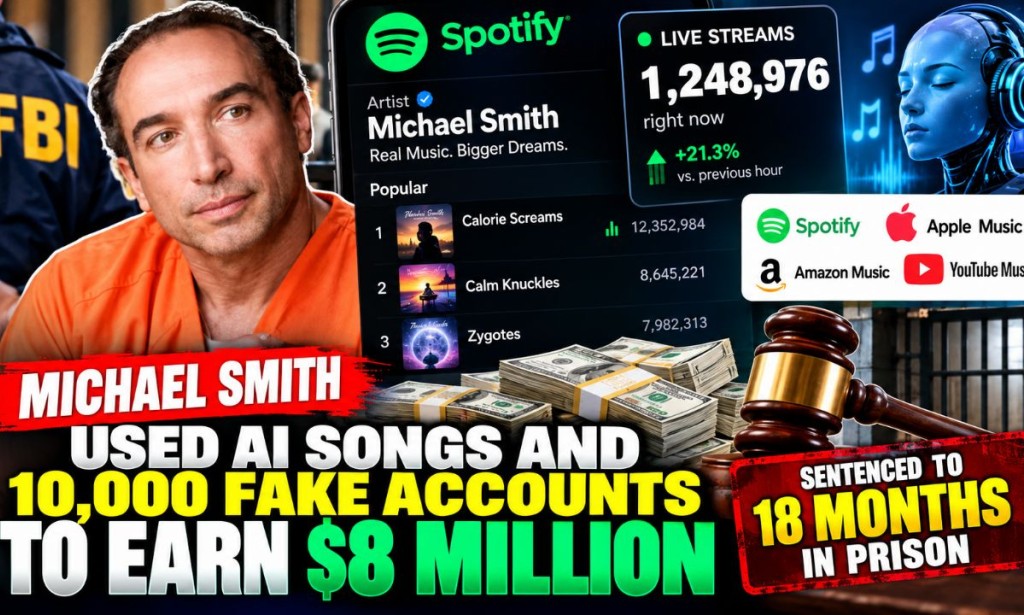
Man Who Used AI Songs and 10,000 Fake Accounts to Make $8 Million Sentenced to 18 Months in Prison
A North Carolina man who used artificial intelligence to create hundreds of thousands of songs and automated accounts to generate billions of fake streams has been sentenced to 18 months in prison. Michael Smith reportedly collected more than $8 million in music royalties through the scheme, which targeted major streaming platforms including Spotify, Apple Music, Amazon Music and YouTube Music.
The case has sparked widespread debate online about artificial intelligence, music royalties, digital fraud and whether technology is making it easier to manipulate online platforms.
How the $8 Million AI Music Scheme Worked
According to the United States Department of Justice, Smith, 54, from Cornelius, North Carolina, operated the scheme between 2017 and 2024.
Rather than relying on genuine listeners to discover his music, he allegedly built an artificial streaming operation using AI-generated songs and thousands of automated accounts. At certain points, prosecutors said, he used as many as 10,000 bot accounts simultaneously.
Smith created hundreds of thousands of songs using AI and uploaded them under numerous artist names. Some of the unusual song titles reportedly included “Calorie Screams,” “Calm Knuckles” and “Zygotes.”
The strategy was to produce a massive catalogue of music and distribute the streams across numerous tracks. By spreading the activity across so many songs, the operation was designed to make the artificial listening activity less obvious to streaming platforms' fraud-detection systems.
Prosecutors also said Smith used fake email accounts and fraudulently obtained debit cards to establish accounts for the operation. Software then caused those accounts to stream the music repeatedly, generating royalty payments tied to the artificial plays.
His AI Songs Outstreamed Taylor Swift in One Category
One of the most striking details in the case concerns the number of streams generated in a single month.
According to the Justice Department, in April 2023, Smith's bot accounts generated approximately 80.9 million fraudulent streams of his AI-generated music through YouTube Music family plans.
During that same month, Taylor Swift's entire music catalogue received approximately 9.3 million streams through those family-plan streams, according to prosecutors.
This means Smith's artificial streaming activity in that particular category was more than eight times the reported number of streams for Swift's entire catalogue during the same period.
The comparison illustrates the scale of the alleged manipulation. It does not mean Smith's music was more popular than Taylor Swift's; the figures involved fraudulent streams rather than genuine audience demand.
How Much Money Did He Make?
Federal prosecutors said the operation generated more than $8 million in fraudulent royalties from music streaming platforms.
The services named in the case included Spotify, Apple Music, Amazon Music and YouTube Music. The scheme exploited the way streaming royalties are calculated and distributed, allowing artificial plays to generate payments that would otherwise be allocated according to legitimate listening activity.
Instead of earning money because real listeners enjoyed and repeatedly played the songs, Smith used automated accounts to manufacture the activity that triggered royalty payments.
Prosecutors argued that this diverted money from the legitimate music ecosystem, including artists, songwriters and other rights holders whose work was genuinely streamed.
Michael Smith Sentenced to 18 Months in Prison
On October 6, 2026, a federal judge sentenced Smith to 18 months in prison for his role in the scheme.
Smith had pleaded guilty in March 2026 to one count of conspiracy to commit wire fraud. In addition to the prison sentence, the court imposed two years of supervised release following his imprisonment.
He was also ordered to forfeit $8,091,843.64 connected to the fraudulent operation.
The Justice Department described the prosecution as its first criminal case involving music-streaming fraud assisted by AI technology. The case is significant because it demonstrates that the use of AI to produce music is not, by itself, the central issue in this type of prosecution. The alleged criminal conduct involved deliberately manipulating streaming systems to obtain money fraudulently.
Is Using AI to Make Music Illegal?
The case has raised an important question: can musicians use AI to create songs and earn money from them?
AI-generated music is not automatically illegal simply because it was created with artificial intelligence. Artists and producers can use AI tools as part of their creative process, subject to applicable copyright laws, platform policies and other legal requirements.
The distinction in Smith's case was the alleged use of automated accounts to fabricate listener activity and collect royalties through deception.
For example, an independent musician who creates songs with AI and promotes them to real listeners is engaging in a fundamentally different activity from someone who creates fake accounts and artificially inflates streaming numbers to obtain payments.
The case sends a clear warning to anyone attempting to manipulate online platforms for financial gain: automated activity does not become legitimate simply because the technology behind it is sophisticated.
Social Media Reactions: Some Call Him Clever, Others Say Artists Were Cheated
Following reports of the sentence, social media users expressed sharply different opinions about the case.
Some commenters questioned why Smith was punished when he created the songs himself and used technology to generate the streams. Others described the operation as a clever way of exploiting a system they believe is already unfair to independent artists.
One commenter wrote that the money should be paid to real artists, while another argued that Smith had simply found a way to make money by getting AI-generated music played.
Other users focused on the scale of the operation, particularly the reported use of as many as 10,000 automated accounts. Several comments also raised concerns about the growing volume of AI-generated music appearing on streaming services.
However, these online reactions represent individual opinions rather than legal findings. The court case centred on the fraudulent manipulation of streams and the resulting royalty payments, not simply on the fact that the songs were produced using AI.
What This Case Means for Independent Artists
The case highlights a major challenge facing the modern music industry: how can streaming services ensure that royalties go to creators whose music is genuinely being listened to?
Streaming platforms rely on enormous quantities of listening data to calculate payments. When automated accounts imitate genuine listeners, they can distort those calculations and undermine confidence in the system.
For independent artists who spend time writing, recording, producing and promoting their music, fraudulent streams can create an uneven playing field. Fake activity can inflate the apparent popularity of certain tracks while potentially reducing the share of royalties available to legitimate rights holders.
The case also demonstrates why artists should focus on genuine audiences, transparent promotion and compliance with streaming-platform rules instead of artificial engagement schemes.
Final Thoughts
Michael Smith's case is a striking example of how artificial intelligence and automation can be used in ways that create serious legal consequences.
He reportedly produced hundreds of thousands of AI-generated songs, used thousands of automated accounts to manufacture billions of streams and obtained more than $8 million in royalties. The operation ultimately resulted in an 18-month prison sentence, two years of supervised release and an order to forfeit more than $8 million.
The central lesson is not that AI music is inherently criminal. Rather, it is that using technology to deceive streaming services and obtain money through fraudulent activity can lead to prosecution.
As AI tools become more accessible, digital platforms will face increasing pressure to distinguish genuine engagement from automated manipulation. For musicians and online entrepreneurs alike, innovation can create opportunities, but those opportunities do not remove the need to follow the law.
What do you think about this case? Was the 18-month prison sentence appropriate for the scale of the fraud, or should streaming platforms do more to prevent these schemes before they happen? Share your thoughts in the comments.
Source: United States Department of Justice, U.S. Attorney's Office for the Southern District of New York.
Read the official Justice Department announcement.
Follow #1Official for more trending news, technology stories and viral updates.


You must be logged in to post a comment.