

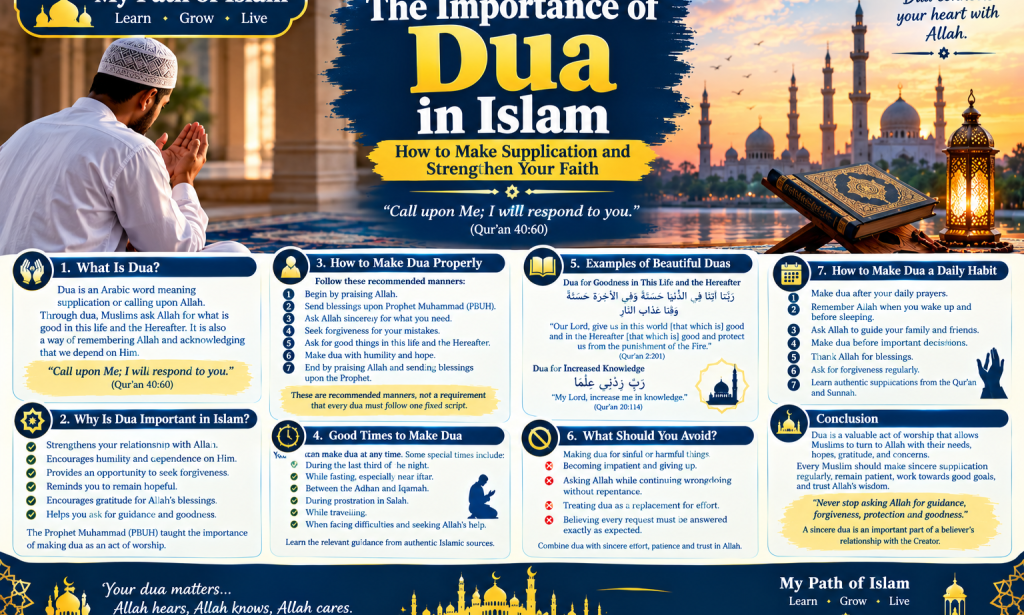
The Importance of Dua in Islam: How to Make Supplication and Strengthen Your Faith
Introduction
Dua is one of the beautiful acts of worship in Islam. It is the act of calling upon Allah, asking for His help, seeking forgiveness, expressing gratitude, and requesting guidance.
A Muslim can make dua at any time and in any language. Whether someone is happy, worried, grateful, or facing difficulties, they can turn to Allah through sincere supplication.
Dua reminds believers that Allah is always aware of their needs and that they should place their trust in Him.
1. What Is Dua?
Dua is an Arabic word meaning supplication or calling upon Allah.
Through dua, Muslims ask Allah for what is good in this life and the Hereafter. It is also a way of remembering Allah and acknowledging that human beings depend on Him.
Allah says:
"Call upon Me; I will respond to you." (Qur'an 40:60)
This verse encourages believers to turn to Allah through prayer and supplication.
2. Why Is Dua Important in Islam?
Dua has an important place in a Muslim's life for several reasons:
- It strengthens a person's relationship with Allah.
- It encourages humility and dependence on the Creator.
- It provides an opportunity to seek forgiveness.
- It reminds Muslims to remain hopeful.
- It encourages gratitude for Allah's blessings.
- It helps believers ask for guidance and goodness.
The Prophet Muhammad (peace be upon him) taught the importance of making dua as an act of worship.
3. How to Make Dua Properly
A Muslim can make dua using simple and sincere words. The following practices can help:
1. Begin by praising Allah.
2. Send blessings upon Prophet Muhammad (PBUH).
3. Ask Allah sincerely for what you need.
4. Seek forgiveness for your mistakes.
5. Ask for good things in this life and the Hereafter.
6. Make dua with humility and hope.
7. End by praising Allah and sending blessings upon the Prophet.
These are recommended manners of supplication, not a requirement that every dua must follow one fixed script.
4. Good Times to Make Dua
Muslims may make dua at any time. Some times and situations are especially highlighted in Islamic teachings, including:
- During the last third of the night.
- While fasting, particularly near the time of breaking the fast.
- Between the Adhan and Iqamah.
- During prostration in Salah.
- While travelling.
- When experiencing difficulties and seeking Allah's help.
Muslims should learn the relevant guidance from authentic Islamic sources.
5. Examples of Beautiful Duas
Here are two supplications from the Qur'an:
Dua for Goodness in This Life and the Hereafter
"Our Lord, give us in this world [that which is] good and in the Hereafter [that which is] good and protect us from the punishment of the Fire."
(Qur'an 2:201)
Dua for Increased Knowledge
"My Lord, increase me in knowledge."
(Qur'an 20:114)
These short supplications remind Muslims to seek beneficial knowledge and goodness in both worlds.
6. What Should Muslims Avoid When Making Dua?
Muslims should avoid:
- Making dua for sinful or harmful things.
- Becoming impatient and giving up supplication.
- Asking Allah while deliberately continuing wrongdoing without repentance.
- Treating dua as a replacement for responsible effort.
- Believing that every request must be answered in exactly the way or at the time expected.
A Muslim should combine dua with sincere effort, patience, and trust in Allah.
7. How to Make Dua a Daily Habit
You can develop a stronger relationship with dua by:
1. Making dua after your daily prayers.
2. Remembering Allah when you wake up and before sleeping.
3. Asking Allah to guide your family and friends.
4. Making dua before important decisions.
5. Thanking Allah for blessings.
6. Asking for forgiveness regularly.
7. Learning authentic supplications from the Qur'an and Sunnah.
Conclusion
Dua is a valuable act of worship that allows Muslims to turn to Allah with their needs, hopes, gratitude, and concerns.
Every Muslim should make sincere supplication regularly, remain patient, work towards good goals, and trust Allah's wisdom.
Remember: Never stop asking Allah for guidance, forgiveness, protection, and goodness. A sincere dua is an important part of a believer's relationship with the Creator.


You must be logged in to post a comment.