
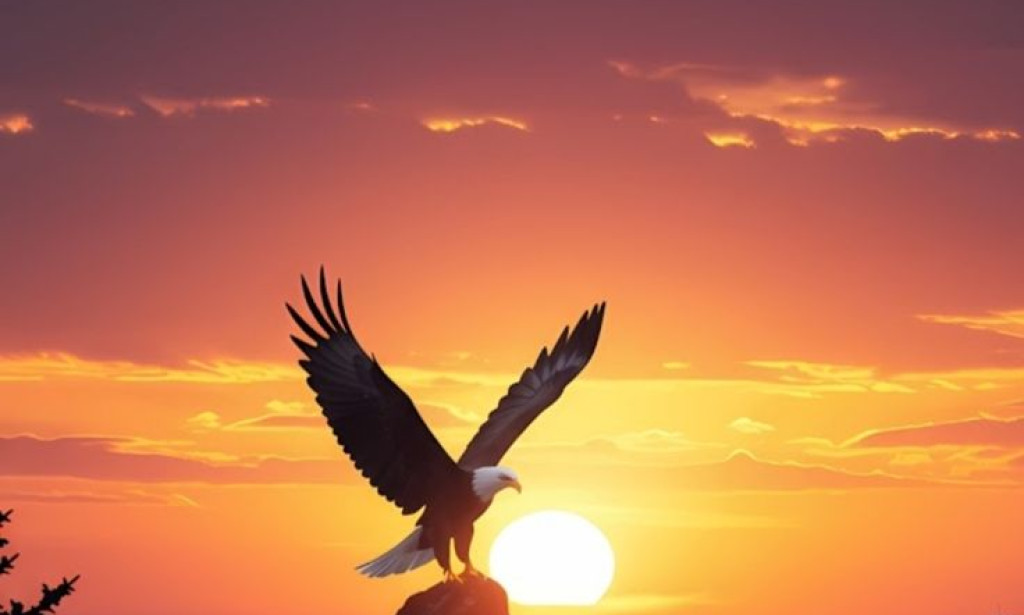
If you've ever watched an eagle soaring high above a mountain or open valley, you may have noticed that it is usually alone. Unlike starlings that gather in large flocks or geese that travel in formation, eagles often spend long periods without the company of other birds.
At first glance, it might seem like they simply prefer solitude. The truth, however, is a little more interesting.
Wildlife researchers have found that an eagle's solitary lifestyle is closely connected to the way it hunts. Eagles rely heavily on exceptional eyesight to locate prey from remarkable distances. Once they identify a target, they need enough space to dive at high speed without interference from other birds. Hunting alone also reduces competition, allowing each eagle to cover a much larger territory in search of food.
Their vision plays an enormous role in this process. An eagle can spot small animals from hundreds of metres away, making patience far more valuable than constant movement. Instead of flying aimlessly, they often spend long periods circling quietly above the landscape, watching and waiting for the right opportunity.
Another fascinating aspect of eagle behaviour is how efficiently they travel. Rather than relying on continuous wingbeats, they use rising columns of warm air known as thermals. These invisible currents lift the bird higher into the sky with very little effort, allowing it to glide for long distances while conserving energy. Scientists believe this ability is one of the reasons eagles can patrol such vast territories without exhausting themselves.
Despite their independent reputation, eagles are not antisocial birds. During the breeding season, many species form strong pairs. Both parents share responsibilities, from building large nests to protecting and feeding their chicks. Some eagle pairs even return to the same nesting site year after year, strengthening a partnership that helps improve the survival of their young.
Outside the breeding season, however, independence becomes an advantage rather than a weakness. Each bird focuses on finding food and protecting its territory, reducing unnecessary conflict with others.
There is an interesting lesson hidden in all of this.
Modern life often encourages us to believe that being constantly busy is the same as being productive. We fill our schedules, check our phones repeatedly, and rush from one task to another. Eagles offer a different perspective. They spend more time observing than reacting. Their success depends less on constant activity and more on choosing the right moment to act.
That doesn't mean people should isolate themselves or avoid teamwork. In fact, eagles clearly demonstrate the importance of cooperation when raising their young. Instead, their behaviour reminds us that there is value in quiet moments. Reflection, preparation, and patience are often just as important as action.
Nature rarely wastes energy, and eagles are a perfect example of that principle. Every movement serves a purpose, every hunt is carefully timed, and every decision increases their chances of survival.
The next time you look up and see an eagle gliding effortlessly across the sky, remember that what appears to be effortless is actually the result of remarkable adaptation. Sometimes the greatest strength isn't found in constant motion, but in knowing when to wait, when to focus, and when the moment is finally right to move.


You must be logged in to post a comment.