

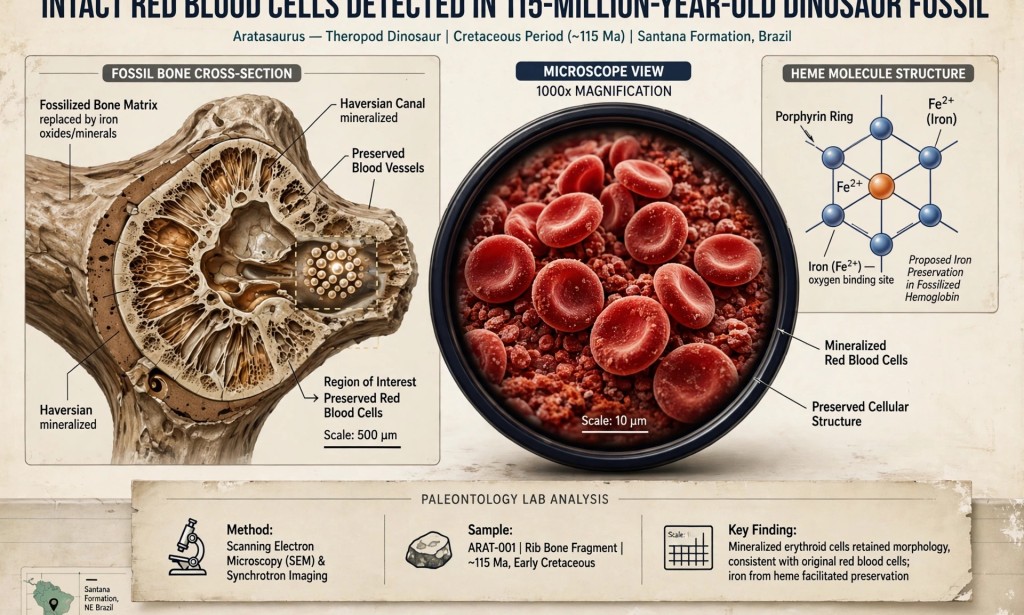
In a breakthrough published today in the Proceedings of the National Academy of Sciences (PNAS), scientists have confirmed the presence of intact red blood cells and blood compounds inside a 115-million-year-old dinosaur fossil.
An international team analyzed the fossilized limb bones of a juvenile Aratasaurus museunacionali, an Early Cretaceous theropod discovered in 2008 in northeastern Brazil. Using advanced chemical and spectroscopic techniques, they identified mineralized red blood cells and heme — the iron-containing molecule that carries oxygen in hemoglobin.
"This really is a landmark discovery," said co-author Kliti Grice, chemist at Curtin University, Australia. "These findings challenge longstanding assumptions that certain biomolecules such as hemoglobin cannot survive deep time."
While previous research hinted at soft tissue preservation in dinosaurs, this study provides the first direct chemical identification of oxygen-carrying blood compounds. Researchers attribute the exceptional preservation to rapid burial and iron-mediated mineralization that sealed the bone's interior and prevented microbial degradation.
The fossil, belonging to a basal coelurosaur that roamed when South America and Africa were still joined, offers unprecedented insight into dinosaur physiology. The presence of intact heme could allow future studies into dinosaur metabolism, respiration, and even disease, bridging a 115-million-year gap between ancient life and modern biology.


You must be logged in to post a comment.