
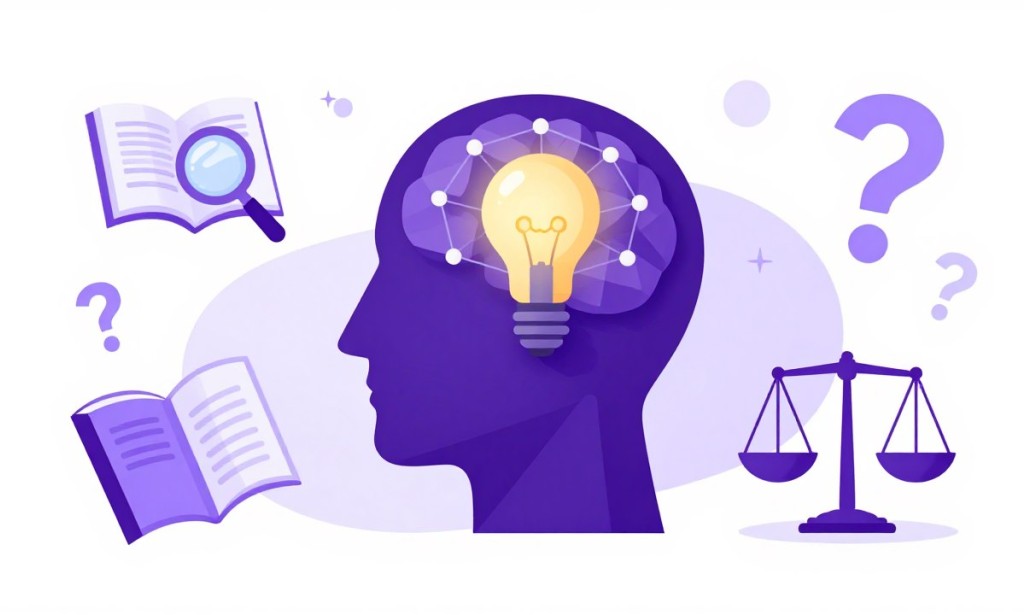
Why Critical Thinking Matters More Than Memorization in Modern Education
For decades, education systems around the world have been built on a simple promise: learn the facts, pass the test, and move forward. Memorization has often been treated as the currency of academic success.
But in a world where almost every answer is just a search away, knowing facts is no longer enough. The real skill that separates people who thrive from those who simply cope is critical thinking.
Critical thinking helps people question assumptions, examine evidence, solve problems, and make informed decisions. As misinformation spreads online and AI-generated content becomes increasingly common, the ability to think independently is becoming more important than ever.
What Is Critical Thinking?
Critical thinking is the ability to question, analyze, and evaluate information before accepting it as true. Instead of believing something simply because it sounds convincing, critical thinkers ask questions such as:
- How do I know this information is correct?
- What evidence supports this claim?
- Who created this information, and why?
- Are there other explanations or perspectives?
- Would I change my opinion if new evidence appeared?
These questions encourage people to examine information carefully rather than accepting every claim they encounter.
In an age of viral misinformation, clickbait headlines, and AI-generated content, critical thinking is no longer just an academic skill. It is an essential tool for everyday life.
Why Do Many Schools Focus More on Memorization?
The answer is uncomfortable but important: critical thinking can be difficult to measure using traditional examinations.
A multiple-choice test can easily measure whether a student remembers a historical date, mathematical formula, or scientific definition. However, it is more difficult to measure whether that student can identify a flawed argument, compare competing perspectives, or reconsider an opinion when presented with new evidence.
Because examinations often influence what teachers prioritize, classrooms can drift toward memorization even when educators recognize the importance of independent thinking.
The problem is not that memorization is useless. The problem is treating memorization as the final goal of education rather than the beginning of understanding.
How Can Schools Teach Critical Thinking?
Critical thinking is a skill that develops through practice. Students need opportunities to ask questions, test ideas, defend their reasoning, and learn from mistakes.
Schools can encourage these skills through practical classroom activities.
1. In History Lessons
Instead of asking students only to memorize historical events, teachers can provide two accounts of the same event and ask students to compare them.
- Which account is more credible?
- What evidence supports each version?
- Could the authors have different perspectives or biases?
This approach encourages students to examine sources rather than simply accept the first explanation they encounter.
2. In Science Lessons
Science offers many opportunities to develop critical thinking. Teachers can ask students to design experiments, test hypotheses, interpret results, and consider what evidence might prove their explanations wrong.
Students learn that scientific understanding depends on evidence, observation, testing, and a willingness to revise conclusions.
3. In Literature Lessons
Literature discussions can encourage students to interpret stories from different perspectives.
Rather than requiring everyone to give the same answer, teachers can ask students to defend their interpretations using examples from the text.
The goal is to move students away from simply asking, "What is the answer?" and toward asking, "How can we determine whether this answer is reasonable?"
Parents Also Have an Important Role
Critical thinking does not develop only in the classroom. Parents and caregivers can help children develop this skill through everyday conversations at home.
One simple habit is to replace the familiar question, "What did you learn today?" with questions that encourage deeper reflection.
- What did you disagree with today, and why?
- What surprised you at school?
- How would you solve a problem differently?
- What evidence would help you prove your point?
- Did you hear an opinion that changed your mind?
Parents should also encourage children to explain their reasoning, not just state their conclusions.
Respectful disagreement can be a valuable learning opportunity. A child who learns to build an argument, listen to opposing views, and reconsider an idea is developing skills that will be useful throughout life.
Five Major Benefits of Critical Thinking
1. Better Problem-Solving Skills
Critical thinkers are more likely to examine the causes of a problem, consider possible solutions, and evaluate the consequences before taking action.
2. Improved Workplace Performance
Employees often face situations that do not have straightforward answers. Critical thinking helps them analyze problems, make informed decisions, and develop practical solutions rather than simply waiting for instructions.
3. Greater Resistance to Misinformation
People who question sources and examine evidence are better equipped to recognize misleading claims, manipulated content, and unsupported conclusions.
4. More Informed Decision-Making
From managing money to choosing a career, everyday life requires people to compare options and consider risks. Critical thinking helps individuals make decisions based on evidence and reason.
5. Greater Intellectual Flexibility
Good critical thinkers understand that they can be wrong. They are willing to reconsider their positions when convincing new evidence becomes available.
This does not mean accepting every new claim. It means remaining open to evidence while evaluating it carefully.
Does Memorization Still Matter?
Absolutely. Critical thinking does not mean abandoning facts or knowledge.
In fact, it is difficult to think critically about a subject without understanding its basic concepts. Students need knowledge of mathematics to solve mathematical problems, scientific principles to evaluate scientific claims, and historical context to understand historical events.
The distinction is that knowledge provides the raw material, while critical thinking helps people examine, connect, and apply that knowledge.
Memorization and critical thinking should work together. Students need to remember important information, understand what it means, and learn how to use it to solve problems.
How Students Can Develop Critical Thinking Every Day
Students do not need to wait for schools to change their teaching methods. They can begin developing critical thinking through simple daily habits.
- Question information: Do not automatically believe every claim you read or hear.
- Check sources: Look for reliable evidence before sharing information.
- Consider different perspectives: Try to understand why someone might disagree with you.
- Explain your reasoning: Practice explaining why you believe something, using evidence where possible.
- Recognize uncertainty: Accept that some questions do not have immediate or simple answers.
- Learn from mistakes: Use incorrect assumptions as opportunities to improve your understanding.
- Think before sharing: Verify surprising online claims before forwarding them to others.
The Future of Education Must Go Beyond Examinations
Education systems need to prepare students for a world that demands more than the ability to repeat information.
Students will encounter unfamiliar problems, conflicting information, rapidly changing technologies, and decisions that require careful judgment. Preparing them for these challenges means giving them opportunities to investigate, question, analyze, and create.
Schools can support this goal by combining subject knowledge with discussion, research, practical projects, open-ended questions, and assessments that reward reasoning as well as correct answers.
Teachers remain essential in this process. Their role is not simply to deliver information but also to guide students as they learn how to evaluate and apply it.
Conclusion: Teach Students How to Think
The future belongs not simply to those who know the most facts, but to those who can think clearly about what they know and use that knowledge wisely.
This does not mean facts are unimportant. It means that facts alone are insufficient without the ability to understand, question, and apply them.
If education is to prepare students for the future, critical thinking must become a central part of learning rather than an optional extra.
The true test of a good education is not only what a student can repeat, but also what a student can question, explain, evaluate, and understand.
What do you think? Should schools give critical thinking the same importance as memorization? Share your opinion in the comments.


You must be logged in to post a comment.