

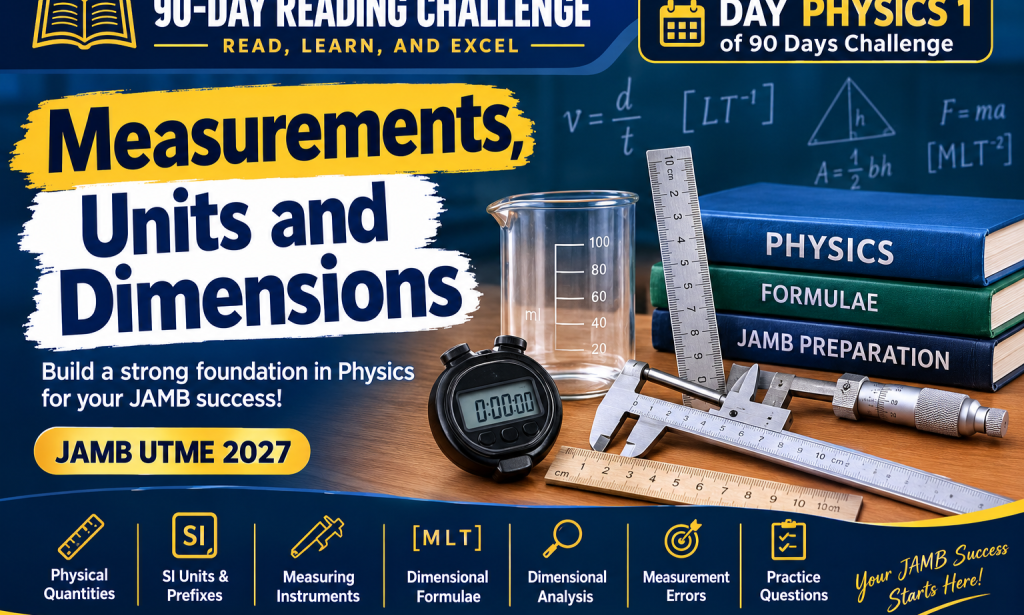
DAY PHYSICS 1 OF 90 DAYS CHALLENGE: MEASUREMENTS, UNITS AND DIMENSIONS
Category: Education / Physics
Target Audience: JAMB UTME 2027 Candidates and Secondary School Students
Challenge: Day Physics 1 of 90 Days Reading Challenge
Introduction
Physics is a branch of science that deals with matter, energy, motion, forces, and their interactions. To understand physical phenomena, scientists must be able to measure quantities accurately and express their measurements using standard units.
Measurements, units and dimensions are among the fundamental topics every Physics student should understand before proceeding to more advanced topics such as motion, force, energy, electricity and waves.
In this lesson, we will explore the meaning of measurement, physical quantities, fundamental and derived quantities, SI units, measuring instruments, dimensional formulae and dimensional analysis. These concepts are important for students preparing for the Joint Admissions and Matriculation Board (JAMB) Unified Tertiary Matriculation Examination (UTME).
1. What Is Measurement?
Measurement is the process of comparing an unknown physical quantity with an accepted standard quantity of the same kind.
For example, when we say that a table is 2 metres long, we have compared its length with the standard unit of length called the metre.
Every physical measurement consists of two important parts: a numerical value and a unit.
For example, in 5 metres:
- 5 is the numerical value.
- Metre (m) is the unit.
Therefore, a physical quantity can be expressed as:
Physical quantity = Numerical value × Unit
Measurement allows us to describe and compare physical properties accurately.
2. Physical Quantities
A physical quantity is a property that can be measured and expressed numerically with a unit.
Examples include length, mass, time, temperature, speed, force, pressure and energy.
Physical quantities are classified into two major groups: fundamental quantities and derived quantities.
A. Fundamental Quantities
Fundamental quantities are independent physical quantities that cannot be expressed in terms of other physical quantities.
There are seven fundamental quantities in the International System of Units (SI).
Fundamental quantity| SI unit| Symbol
Length| Metre| m
Mass| Kilogram| kg
Time| Second| s
Electric current| Ampere| A
Thermodynamic temperature| Kelvin| K
Amount of substance| Mole| mol
Luminous intensity| Candela| cd
Students preparing for JAMB should memorise these seven quantities, their units and their symbols because questions may test their knowledge directly.
B. Derived Quantities
Derived quantities are obtained by combining fundamental quantities mathematically.
Examples include area, volume, speed, acceleration, density, force, pressure and energy.
Some common derived quantities and their SI units are shown below.
Derived quantity| Formula| SI unit
Area| Length × Breadth| m²
Volume| Length × Breadth × Height| m³
Speed| Distance ÷ Time| m/s
Acceleration| Change in velocity ÷ Time| m/s²
Density| Mass ÷ Volume| kg/m³
Force| Mass × Acceleration| newton (N)
Pressure| Force ÷ Area| pascal (Pa)
Work| Force × Distance| joule (J)
The main difference is that fundamental quantities are independent, while derived quantities are calculated from other quantities.
3. The International System of Units (SI)
The International System of Units, commonly called SI, is the internationally accepted system of measurement used in science.
It provides standard units so that measurements can be understood and compared consistently across different countries and scientific fields.
For example, the metre is the SI unit of length, while the kilogram is the SI unit of mass.
Common SI Prefixes
Prefixes help us express very large or very small quantities conveniently.
Prefix| Symbol| Value
Kilo| k| 10³ = 1,000
Centi| c| 10⁻² = 0.01
Milli| m| 10⁻³ = 0.001
Micro| μ| 10⁻⁶
Mega| M| 10⁶
Nano| n| 10⁻⁹
Example 1: Convert Kilometres to Metres
Convert 3.5 kilometres to metres.
Since 1 kilometre equals 1,000 metres:
3.5 × 1,000 = 3,500 metres.
Answer: 3,500 m.
Example 2: Convert Centimetres to Metres
Convert 250 centimetres to metres.
Since 100 centimetres equals 1 metre:
250 ÷ 100 = 2.5 metres.
Answer: 2.5 m.
Always pay attention to the units given in a question. Many calculation errors occur because students forget to convert units before solving a problem.
4. Measuring Instruments and Their Uses
Different instruments are used to measure different physical quantities. Choosing the appropriate instrument helps improve the reliability of a measurement.
A. Metre Rule
A metre rule is used to measure length and distance. It is commonly used in school laboratories to measure the dimensions of objects.
B. Vernier Calipers
Vernier calipers are used to measure internal and external diameters and the depths of objects. They generally provide more precise readings than an ordinary ruler.
C. Micrometer Screw Gauge
A micrometer screw gauge measures very small thicknesses and diameters, such as the diameter of a thin wire.
D. Stopwatch
A stopwatch measures time intervals. It can be used to determine the time taken by a pendulum to complete a number of oscillations.
E. Beam Balance
A beam balance is used to determine mass by comparing an object with known masses.
F. Thermometer
A thermometer measures temperature.
Other measuring instruments include measuring cylinders for liquid volume, ammeters for electric current and voltmeters for potential difference.
Students should understand not only the names of these instruments but also the physical quantities they measure.
5. Accuracy, Precision and Measurement Errors
Accuracy
Accuracy describes how close a measured value is to the true or accepted value.
Precision
Precision describes how closely repeated measurements agree with one another.
A measurement can be precise without being accurate if repeated readings are close together but differ significantly from the accepted value.
Common Types of Measurement Errors
1. Parallax error: This occurs when a scale is viewed from an incorrect angle.
2. Zero error: This occurs when an instrument does not indicate zero when it should.
3. Random error: This causes readings to vary unpredictably.
4. Systematic error: This produces a consistent bias in measurements, often because of an instrument problem or an unsuitable measurement method.
To reduce errors, students should read scales at eye level, check instruments for zero error and repeat measurements when appropriate.
6. Dimensions in Physics
Dimensions express physical quantities in terms of fundamental quantities such as mass, length and time.
The common symbols used in dimensional analysis are:
- Mass: [M]
- Length: [L]
- Time: [T]
- Electric current: [I]
- Thermodynamic temperature: [Θ]
For many introductory mechanics problems, mass, length and time are sufficient to express the dimensions of the quantities involved.
Common Dimensional Formulae
Physical quantity| Dimensional formula
Length| [L]
Area| [L²]
Volume| [L³]
Speed| [LT⁻¹]
Acceleration| [LT⁻²]
Density| [ML⁻³]
Momentum| [MLT⁻¹]
Force| [MLT⁻²]
Work or energy| [ML²T⁻²]
Pressure| [ML⁻¹T⁻²]
These dimensional formulae are useful for understanding relationships between physical quantities and checking equations.
Example 3: Find the Dimension of Speed
Speed is calculated by dividing distance by time.
Speed = Distance ÷ Time
The dimension of distance is [L], while the dimension of time is [T].
Therefore:
Dimension of speed = [L] ÷ [T]
Dimensional formula of speed = [LT⁻¹].
Example 4: Find the Dimension of Force
According to Newton's second law:
Force = Mass × Acceleration
The dimension of mass is [M], and the dimension of acceleration is [LT⁻²].
Therefore:
Dimension of force = [M] × [LT⁻²]
Dimensional formula of force = [MLT⁻²].
This is one of the important dimensional formulae students should know when preparing for JAMB Physics.
7. Dimensional Analysis and Its Applications
Dimensional analysis involves examining the dimensions of physical quantities in mathematical equations.
It is useful for checking whether equations are dimensionally consistent, deriving possible relationships between quantities and helping with certain unit conversions.
Consider the equation:
s = ut + ½at²
Where:
- s represents displacement.
- u represents initial velocity.
- a represents acceleration.
- t represents time.
The dimension of displacement is [L].
For the first term:
Dimension of ut = [LT⁻¹] × [T] = [L].
For the second term:
Dimension of at² = [LT⁻²] × [T²] = [L].
Both terms on the right-hand side have the dimension of length, which agrees with the dimension of displacement on the left-hand side.
Therefore, the equation is dimensionally consistent.
However, dimensional consistency alone does not prove that an equation is physically correct. Dimensional analysis also cannot determine dimensionless numerical constants.
8. Scalars and Vectors
Although scalars and vectors are treated as a separate topic in this reading challenge, their basic meaning is useful when studying physical quantities.
Scalar Quantities
Scalar quantities have magnitude only.
Examples include:
- Mass
- Time
- Distance
- Speed
- Temperature
- Energy
Vector Quantities
Vector quantities have both magnitude and direction.
Examples include:
- Displacement
- Velocity
- Acceleration
- Force
- Momentum
Students should understand the difference between distance and displacement, as well as between speed and velocity.
For example, speed describes how fast an object moves, while velocity describes its speed in a specified direction.
9. Practice Questions for JAMB Candidates
Test your understanding with the following questions.
Question 1: What is the SI unit of mass?
A. Gram
B. Kilogram
C. Newton
D. Pound
Question 2: Which of the following is a derived quantity?
A. Time
B. Length
C. Electric current
D. Density
Question 3: Convert 4.2 km to metres.
A. 42 m
B. 420 m
C. 4,200 m
D. 42,000 m
Question 4: What is the dimensional formula of acceleration?
A. [LT⁻¹]
B. [LT⁻²]
C. [MLT⁻²]
D. [ML⁻³]
Question 5: Which instrument is most suitable for measuring the diameter of a thin wire?
A. Metre rule
B. Thermometer
C. Micrometer screw gauge
D. Stopwatch
Question 6: The dimensional formula of force is:
A. [MLT⁻²]
B. [ML²T⁻²]
C. [ML⁻¹T⁻²]
D. [LT⁻²]
Question 7: What type of error occurs when a scale is viewed from the wrong angle?
A. Zero error
B. Random error
C. Parallax error
D. Conversion error
Question 8: Which of the following is a vector quantity?
A. Distance
B. Speed
C. Mass
D. Velocity
Answers
1. B — Kilogram
2. D — Density
3. C — 4,200 m
4. B — [LT⁻²]
5. C — Micrometer screw gauge
6. A — [MLT⁻²]
7. C — Parallax error
8. D — Velocity
Students are encouraged to attempt the questions before checking the answers.
10. How to Prepare for JAMB Physics Using This Lesson
To master this topic, follow these simple study steps:
1. Memorise the seven fundamental quantities and their SI units.
2. Practise converting between common units.
3. Learn the uses of measuring instruments.
4. Understand how dimensional formulae are obtained from basic equations.
5. Solve objective questions and review your mistakes.
6. Revise the topic regularly instead of studying it only once.
Understanding the principles behind each formula is more useful than memorising formulas without knowing when to apply them.
Conclusion
Measurements, units and dimensions provide the foundation for understanding Physics. They help students describe physical quantities, perform calculations, interpret measurements and check mathematical relationships.
For students preparing for JAMB UTME 2027, mastering this topic is an important first step towards developing confidence in Physics.
As part of the Day Physics 1 of 90 Days Reading Challenge, make sure you understand the lesson, practise the questions and revise the dimensional formulae before moving to the next topic.
Remember: consistent practice, proper revision and a clear understanding of concepts can make Physics easier to learn.
READ, LEARN, AND EXCEL!


You must be logged in to post a comment.