
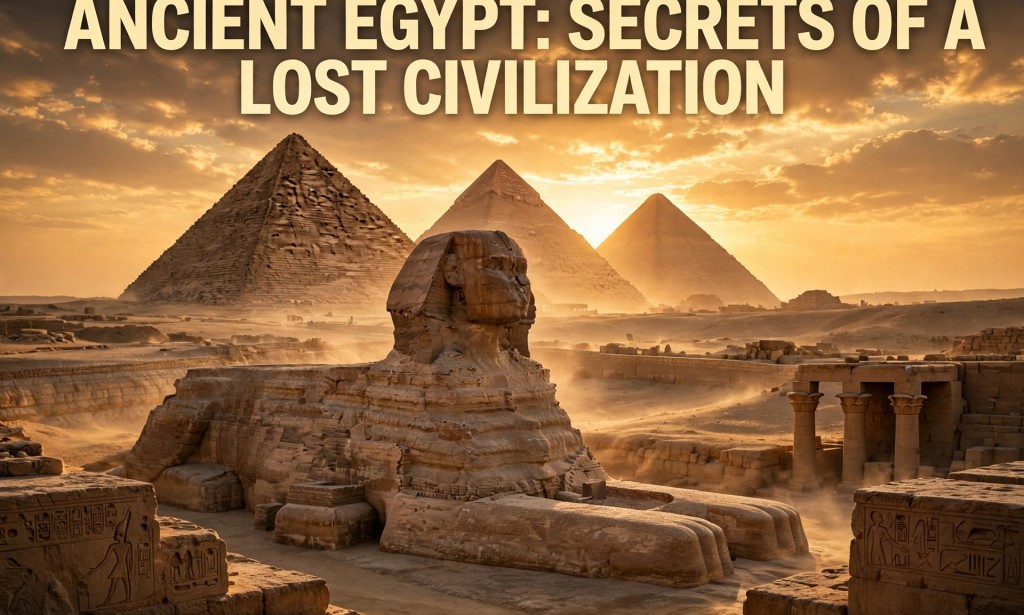
🏺 The Rise and Fall of Ancient Egypt: 10 Fascinating Facts About One of History's Greatest Civilizations
Imagine living in a world without smartphones, electricity, cars, or modern machines. Now imagine building enormous stone monuments that would survive for thousands of years!
It sounds almost impossible, doesn't it?
Yet, thousands of years ago, the people of ancient Egypt created one of the most impressive civilizations the world has ever known. They constructed magnificent pyramids, developed a writing system, studied the stars, and built a society that continues to attract historians, scientists, and curious travelers.
Even today, many people wonder how the ancient Egyptians accomplished so much with the technology available to them.
But there's more to their story than pyramids and pharaohs.
From powerful queens to remarkable medical practices, ancient Egypt was full of fascinating discoveries, achievements, and mysteries.
Let's travel back thousands of years and uncover 10 incredible facts about one of history's greatest civilizations!
🌊 1. The Nile River Helped Build an Extraordinary Civilization
One of the most important reasons ancient Egypt flourished was the Nile River.
Much of Egypt is surrounded by desert, making access to water essential for survival. The Nile provided water for drinking, farming, transportation, and other daily activities.
Its seasonal flooding historically deposited nutrient-rich soil across agricultural land, helping farmers grow crops such as wheat and barley.
The river also served as a natural transportation route. Boats could carry food, building materials, and other goods between settlements.
Without the Nile, supporting Egypt's large population and powerful cities would have been much more difficult.
Amazing fact: The Nile was so important that ancient Egyptian life, agriculture, and religious beliefs were closely connected to its annual flooding.
The river was not simply a source of water. It helped shape an entire civilization.
🔺 2. The Great Pyramid Was Built Thousands of Years Ago
When people think about ancient Egypt, the pyramids are usually the first things that come to mind.
The most famous is the Great Pyramid of Giza, built during the reign of Pharaoh Khufu around the 26th century BCE.
It originally stood approximately 146.6 metres tall, although erosion and the loss of its outer casing have reduced its height.
For thousands of years, it was the tallest human-made structure in the world.
What makes this achievement remarkable is that the pyramid was constructed long before modern cranes, trucks, and powered construction equipment existed.
Workers had to organize the transportation and placement of enormous quantities of stone while managing food supplies, tools, and labor.
Archaeological evidence suggests that skilled workers and organized labor teams played important roles in building Egypt's royal monuments.
Although researchers have developed theories about the construction methods, some details remain debated.
The Great Pyramid is a reminder of what careful planning, engineering knowledge, and large-scale cooperation can accomplish.
👑 3. Pharaohs Were More Than Just Kings
Ancient Egypt was ruled by leaders known as pharaohs.
However, the role of a pharaoh went beyond ordinary political leadership.
Pharaohs were considered central to maintaining order, protecting the kingdom, and preserving the relationship between humans and the gods in ancient Egyptian religious beliefs.
They supervised major building projects, directed military campaigns, and oversaw the administration of the kingdom.
Some pharaohs became famous for expanding Egypt's influence, while others are remembered for religious changes or enormous monuments.
One of the best-known rulers was Ramesses II, often called Ramesses the Great. He ruled for decades during the 13th century BCE and commissioned numerous temples and monuments.
Another famous ruler was Tutankhamun, whose relatively short reign became widely known because his tomb was discovered with many of its treasures still inside.
The lives of these rulers reveal how closely politics, religion, and royal identity were connected in ancient Egypt.
👸 4. Cleopatra Was Not the Only Powerful Woman in Egyptian History
Many people immediately think of Cleopatra VII when they hear about powerful women in ancient Egypt.
Cleopatra was a politically skilled ruler who governed Egypt during the first century BCE. She lived during a period when Rome was becoming increasingly powerful in the Mediterranean world.
However, she was not the only influential woman in Egyptian history.
Hatshepsut, who ruled during the 15th century BCE, was one of ancient Egypt's most successful female pharaohs. Her reign is associated with major construction projects and commercial expeditions.
Other royal women, including Nefertiti, also played important roles in Egyptian political and religious life.
Cleopatra herself belonged to the Ptolemaic dynasty, a royal family of Macedonian Greek origin that ruled Egypt after the conquests of Alexander the Great.
Here's an interesting detail: Cleopatra lived much closer to the modern era than to the construction of the Great Pyramid.
The Great Pyramid was already more than 2,000 years old when Cleopatra was born!
This comparison shows just how long ancient Egyptian civilization lasted.
✍️ 5. Ancient Egyptians Developed a Remarkable Writing System
How do historians know so much about ancient Egypt?
One important reason is that the Egyptians developed writing systems that allowed them to record religious texts, royal achievements, administrative information, and other aspects of life.
Their most famous writing system is known as hieroglyphics.
Hieroglyphic writing used signs representing sounds, words, and ideas. These symbols appeared on temple walls, monuments, tombs, and other surfaces.
For everyday administration, Egyptians also used other forms of writing that were quicker to write than formal hieroglyphics.
Scribes were important members of society because writing was essential for managing government records, collecting taxes, and documenting transactions.
For centuries, scholars struggled to understand Egyptian hieroglyphics.
That changed significantly after the discovery of the Rosetta Stone in 1799. The stone contained a decree written in three scripts, including Greek, which scholars could read.
Using comparisons between the scripts, Jean-François Champollion made a breakthrough in deciphering hieroglyphics in the 1820s.
This achievement opened an extraordinary window into the language and history of ancient Egypt.
⚱️ 6. Mummification Was Connected to Beliefs About the Afterlife
One of the most recognizable features of ancient Egyptian culture is mummification.
The ancient Egyptians believed that life continued after death and that preserving the body could play an important role in the afterlife.
Mummification developed over time, and its methods varied according to the period, resources, and social status of the deceased.
In some cases, the process involved removing certain internal organs, treating the body with natron, a naturally occurring salt mixture, and wrapping it in linen.
Amulets and funerary objects could be placed with the deceased as part of burial practices.
The process was not simply an attempt to preserve a body. It was connected to religious ideas about death, identity, and rebirth.
The elaborate burial practices of rulers and wealthy individuals required specialized workers and considerable resources.
Today, scientific examination of mummies helps researchers learn about ancient diets, diseases, living conditions, and burial customs.
These discoveries provide valuable evidence about people who lived thousands of years ago.
📅 7. Ancient Egypt Had a Calendar and Knowledge of Astronomy
Imagine trying to organize farming, religious festivals, and government activities without a modern calendar.
Ancient Egyptian society needed reliable ways to track time, particularly because agriculture depended on seasonal patterns.
The Egyptians developed a civil calendar consisting of 365 days, divided into 12 months of 30 days, with five additional days at the end of the year.
Although this calendar did not account perfectly for the actual length of the solar year, it was useful for organizing daily and administrative life.
Egyptian observers also paid attention to the movements of celestial objects.
The appearance of the star Sirius, for example, was associated with the seasonal cycle of the Nile in ancient Egyptian tradition.
Their astronomical observations were connected to religious practices, agriculture, and timekeeping.
While their methods differed from modern astronomy, they demonstrate how carefully ancient societies observed the natural world.
🏥 8. Ancient Egyptians Practiced Medicine
Ancient Egypt was also known for its medical knowledge.
Surviving papyrus documents describe treatments, observations, and medical practices used by Egyptian healers.
Some texts discuss injuries, symptoms, and methods for caring for patients.
The Edwin Smith Papyrus, for example, contains descriptions of traumatic injuries and approaches to examining them.
Egyptian medical practices combined practical observations with religious beliefs and remedies made from natural substances.
Some treatments may have been useful, while others were based on ideas that modern medicine does not support.
Nevertheless, these records help historians understand how ancient people tried to identify illnesses, treat injuries, and relieve suffering.
Their medical knowledge was not identical to modern science, but it formed part of a long human effort to understand the body and improve health.
🏛️ 9. Ancient Egyptian Civilization Lasted for Thousands of Years
Ancient Egypt was not a single kingdom that remained unchanged throughout its entire history.
Its civilization developed over many centuries, experiencing periods of political unity, expansion, instability, and foreign rule.
Around 3100 BCE, Egypt became unified under early kings, marking the beginning of the dynastic period.
Over time, the kingdom experienced several major eras, including the Old Kingdom, Middle Kingdom, and New Kingdom.
During these periods, rulers built monuments, expanded trade, developed administration, and fought wars.
Egypt also experienced political fragmentation and foreign invasions.
At different times, Nubian, Libyan, Assyrian, Persian, Greek, and Roman powers influenced or controlled parts of Egypt.
Alexander the Great conquered Egypt in 332 BCE. After his death, the Ptolemaic dynasty ruled the country until the Roman conquest in 30 BCE, following the death of Cleopatra VII.
Egypt continued to matter greatly under Roman and later Byzantine, Arab, and other rulers, although its political and cultural circumstances changed over time.
The long history of ancient Egypt demonstrates that civilizations evolve. They adapt, face challenges, and transform as new powers and ideas emerge.
🌍 10. Ancient Egypt's Influence Can Still Be Seen Today
Thousands of years after its greatest monuments were built, ancient Egypt continues to influence the modern world.
Its architecture attracts visitors from across the globe. Its art appears in museums, books, films, and educational materials.
The study of Egyptian writing, burial practices, and archaeological sites has helped historians understand the beliefs and achievements of ancient people.
Ancient Egyptian mathematics, engineering, medicine, and administration also provide valuable examples of how early societies developed practical knowledge.
However, Egypt's legacy is not limited to famous rulers or enormous monuments.
Ordinary people also shaped its history. Farmers grew food, craftspeople produced goods, scribes maintained records, merchants traded products, and builders constructed homes and temples.
Their everyday activities helped sustain a society that lasted for millennia.
By studying ancient Egypt, we learn not only about the powerful but also about the people whose work made civilization possible.
🤔 Why Did Ancient Egypt's Power Eventually Decline?
After thousands of years of remarkable achievements, ancient Egypt gradually lost its independence.
There was no single event that explains the entire transformation.
Political divisions, struggles over royal authority, economic difficulties, military conflicts, and the growing power of neighboring states all affected Egypt at different times.
Foreign powers eventually conquered and ruled Egypt.
The conquest by Alexander the Great in 332 BCE brought Egypt under Macedonian Greek rule. Later, following Cleopatra VII's death in 30 BCE, Egypt became a province of the Roman Empire.
Yet, the end of Egypt's independence did not mean the disappearance of its civilization or culture.
Egyptian religious traditions, artistic practices, monuments, and cultural influences continued to shape the country's history long after the age of the pharaohs.
The story of ancient Egypt is therefore not simply a story of rise and fall. It is also a story of adaptation, cultural continuity, and a legacy that survived enormous political changes.
🌟 Final Thoughts
Ancient Egypt remains one of the most fascinating civilizations in world history.
Its monumental pyramids, writing systems, medical records, royal dynasties, and religious traditions reveal a society capable of remarkable organization and creativity.
Even after thousands of years, researchers continue to investigate Egyptian archaeological sites and uncover new information about how people lived.
Perhaps the most important lesson from ancient Egypt is that human beings have always searched for ways to understand their world, solve difficult problems, express their beliefs, and leave something meaningful for future generations.
The next time you see a picture of the Great Pyramid, remember that it represents much more than a giant stone structure. It reflects the knowledge, labor, ambitions, and beliefs of the people who built it.
History isn't just about the past. It's about understanding how the world we live in today came to be.
💬 Let's Hear Your Opinion!
If you could travel back in time to ancient Egypt, which of these would you most want to explore?
A. The Great Pyramid of Giza 🔺
B. The royal palace of Cleopatra 👑
C. The temples and ancient writing systems ✍️
D. The daily lives of ordinary Egyptian people 🏺
Tell us your answer in the comments, and explain why!


You must be logged in to post a comment.