
"Hong Kong lift murder "
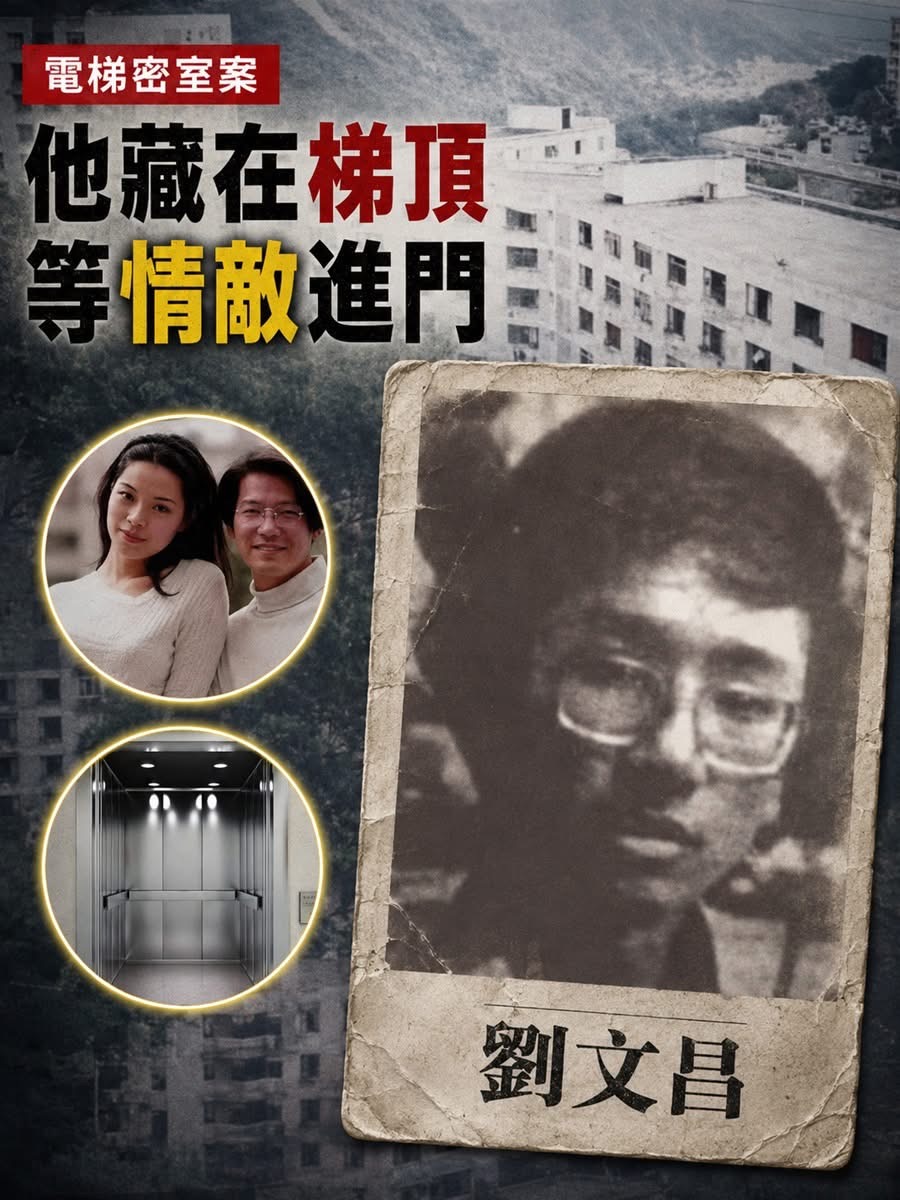
A top electrical engineering student, determined to eliminate his love rival, set up a secret room in an elevator. He hid on the top floor, waiting for his rival to enter. He wedged the elevator between two floors, filled it with carbon dioxide, poured kerosene, set it on fire, stabbed him with a knife, strangled him with a nylon rope, and finally pushed him down the elevator shaft through the emergency exit. He thought his plan was foolproof, but he hadn't anticipated one of his girlfriend's habits, which ruined his perfect crime.
On the evening of December 16, 1984, in Ko Chiu Road Village, Yau Tong, Hong Kong, 24-year-old Ho Ho-yin brought his 20-year-old girlfriend, Zhen Yu, home for dinner to introduce her to his family. Ho Ho-yin was a graduate of the Electrical Engineering Department of a polytechnic, working as an engineer in an electronics factory with a stable income. Zhen Yu studied sociology and worked as a social worker in her spare time. They lived in the same government-built low-rent housing complex; Ho lived on the third floor of Block 8, and Zhen lived on the thirteenth floor of Block 6, the two buildings not far apart. After dinner, he drove her home, sat for a while, drank a bowl of soup, and then got up to say goodbye.
Zhen Yu had a habit. At that time, the building's security was poor, and the elevators frequently malfunctioned. Recently, He Haoran had been trapped in an elevator for over forty minutes, and another time he was robbed at knifepoint in an elevator. Worried about her boyfriend's safety, she would always stand on the balcony after seeing him off, watching him walk out of the building, through the passageway between the two buildings, until he appeared on the other side waving to her before she felt safe enough to go back inside.
But that night, she waited and waited, but he didn't appear. The more she thought about it, the more uneasy she became. Accompanied by her family, she went to check the elevator lobby. The building had two elevators; one was broken, and the other was stuck on the seventh floor, unresponsive no matter how many buttons she pressed. Fearing her boyfriend was trapped inside, she immediately called the police.
When the firefighters arrived, they pried open the elevator doors. The elevator was empty, but the air was thick with the smell of kerosene, and there were bloodstains on the elevator ceiling. Sensing something was wrong, they opened the elevator roof and searched deep inside the elevator shaft. On the third floor, they found a man with an eye injury, covered in oil, and looking dazed on the elevator shaft support, with a travel bag beside him. The firefighters, thinking he was the trapped He Haoran, quickly rescued him. Zhen Yu recognized him immediately—it wasn't He Haoran, but their mutual friend, 24-year-old Liu Wenchang. The three attended the same university; He Haoran and Liu Wenchang were classmates in the same department and also members of the same church, maintaining close contact.
A firefighter lowered a rope to the top of the elevator to retrieve the travel bag, but his flashlight inadvertently shone down—a human-shaped object was vaguely visible at the bottom of the shaft. The group rushed to the basement, opened the elevator door on the lowest floor, and found He Haoran curled up between three shock absorbers, his limbs broken, bleeding from his eyes and nose, multiple stab wounds, and severe blows to the back of his head and back. A nylon rope was wrapped around his neck. He was rushed to the hospital but succumbed to his injuries; the cause of death was strangulation.
Police opened Liu Wenchang's travel bag and found tools including a knife, nylon rope, a carbon dioxide canister, a kerosene bottle, duct tape, and a crowbar. Liu Wenchang claimed that as an electrical engineering student, carrying these items was reasonable and just a coincidence. He said he was going to visit Zhen Yu that evening, but the elevator malfunctioned and got stuck. He opened the air vent and tried to climb out along the steel cable, but lost his grip and fell onto the third-floor support, sustaining injuries. As for why He Haoran was also at the bottom of the trough, he speculated that he might have encountered the same malfunction and tried to escape using the same method, resulting in an accidental fall.
This explanation was full of inconsistencies. Zhen Yu told police that Liu Wenchang had pursued her, but she rejected him because she felt he was scheming, petty, and controlling. Later, He Haoran also began pursuing her, and she felt he was better in every way, and the two became a couple. Liu Wenchang was furious about this, accusing her of cheating, and the two had a fight and broke off contact. After a while, Liu Wenchang contacted them again, saying he had let go and wanted to reconcile. Zhen Yu and He Haoran were overjoyed, believing he had truly come to his senses, and the three resumed their previous relationship.
Zhen Yu now realized that their "reconciliation" had been a sham from beginning to end. Liu Wenchang inquired about what time He Haoran would take her home and what time he would take the elevator; he was likely responsible for He Haoran's robbery and being trapped in the elevator.
Police found a torn page in He Haoran's possession—a fragment of a Bible. This Bible was in Liu Wenchang's travel bag. The detectives opened the back cover, which read, "Respectfully presented to Zhang Zai, Aran, and Ayu"—a Bible the three of them had given to Liu Wenchang; he couldn't deny it. The detectives then turned to the Book of Exodus, where a page was torn out, and that page was in He Haoran's hand. It was the last thing he grabbed when he was pushed off the elevator.
Liu Wenchang finally confessed. He had installed a remote control device in the elevator shaft long ago. On the night of the incident, he stopped the elevator between the sixth and seventh floors, injected carbon dioxide into the car, and attempted to drug He Haoran. However, He Haoran did not pass out. Liu poured kerosene and set it on fire. While He Haoran was busy putting out the fire, he jumped into the car, stabbed him with a knife, strangled him with a nylon rope, and pushed him down the elevator shaft through the emergency exit.
He thought his plan was foolproof; the police would assume He Haoran had climbed up and accidentally fallen. He hadn't anticipated Zhen Yu calling the police so quickly, nor had he foreseen that He Haoran would tear that page of the Bible from his hand before dying.
In January 1985, Liu Wenchang was convicted of murder and sentenced to death. In 1987, his sentence was commuted to 30 years in prison. Two months before the incident, he had used the same method to trap He Haoran in an elevator for over forty minutes; that time, he only wanted to "teach his rival a lesson." He never imagined that it was that lesson that instilled in Zhen Yu the habit of watching her boyfriend leave. Without this habit, she wouldn't have discovered his disappearance so quickly, wouldn't have called the police so soon, and Liu Wenchang would have had enough time to escape. He wanted to kill, but he ended up teaching the victim's girlfriend how to catch him. Perhaps this was fate.
Gaochaodao Village had long since been demolished and rebuilt, and that elevator disappeared along with the entire building. But some things remained—the Bible with a page torn out became evidence. And that "See you tomorrow," would never be fulfilled.

You must be logged in to post a comment.