
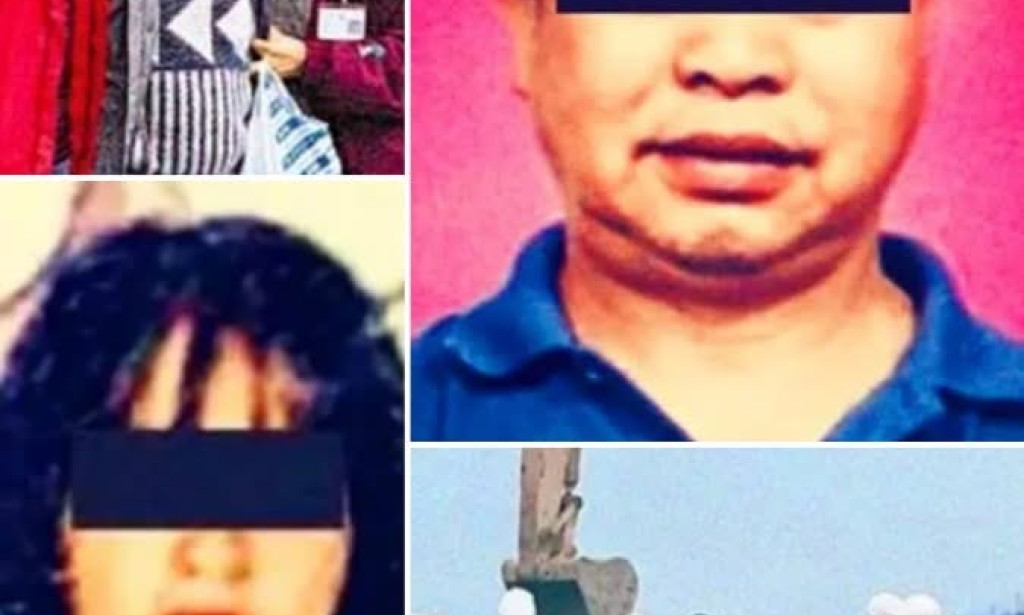
He beheaded his daughter, then went to buy a new pair of sneakers. On his way back, he chatted briefly with a neighbor. Several hours later, he calmly left the building, carrying only a paper bag too small to hold a human head. That head has never been found.
On February 2, 2005, at approximately 4 PM, in Lee Cheung House, Shun Lee Estate, Hong Kong, a call came from a unit on the 20th floor. The man was incoherent: "Help me... my sister has been murdered... her head is missing..."
When the police arrived, the unit's iron gate and wooden door were ajar. The living room walls, floor, and furniture were covered in blood. A bloodstained axe lay near the kitchen door. Wailing could be heard from the bathroom; a man in his twenties was curled up on the floor, blood streaming from his forehead, trembling. Paramedics pushed open the bathroom door and found a woman's body lying between the sink and toilet—her head severed from the neck, blackened blood flowing from her trachea. A stainless steel kitchen knife lay against the wall next to the toilet. The head was nowhere to be found.
The forensic examination revealed the deceased was approximately 15 years old, with over ten knife and axe wounds, a fractured left forearm, and multiple slashes to the neck. She was decapitated within 30 minutes of death. The murder weapons were an axe and a kitchen knife.
The person who reported the incident was the deceased's brother, Li Yongcheng. He was taken to the hospital with a severe injury to his left forehead and an 8-centimeter wound on the back of his right hand. After regaining consciousness, he told the police that his father, Li Zhiteng, had attacked him. His father claimed he was being chased by gangsters and mistakenly believed his son was an assassin, so he attacked him with an axe. However, he didn't know how his sister died.
Li Zhiteng, born in 1938 in Sha Tin, Hong Kong, came from a poor family. His father was an alcoholic, and he never experienced family warmth growing up. He had a volatile temper and couldn't hold down a job for long. In 1981, he returned to Zhongshan, Guangdong, for a blind date, falsely claiming to be a construction supervisor earning over ten thousand yuan a month and owning apartments in Tai Kok Tsui and Tseung Kwan O, presenting himself as a highly eligible bachelor. Lin Peiqin, a young woman from Zhongshan, fell for him, only to discover after marriage that it was all a lie. He wasn't a foreman at all, just a day laborer.
The couple had a son, Li Yongcheng, and a daughter, Li Yuping. In 1997, after Hong Kong's return to China, Lin Peiqin brought her children to Hong Kong to reunite with the family. They lived in a low-rent apartment in Sham Shui Po, later obtaining public housing and moving to Shunli Village. However, Li Zhiteng was laid off from his bar job in 2000 and, in his sixties, couldn't find work, relying on Comprehensive Social Security Assistance (CSSA) to survive. He was proud and felt ashamed of being supported by his wife, son, and the government, leading to an unbalanced mentality and increasingly volatile temper, often taking his anger out on his wife and children. After moving to Lixiang Building, he did no housework except grocery shopping, even taking kickbacks from grocery shopping to gamble on horse racing and lotteries. When he lost all his money, he would demand money from his wife and children, resorting to physical violence if they refused.
After the Major Crimes Unit took over the case, they identified several key suspicious points.
First, the incident occurred around 10:00 AM, but a neighbor saw Li Zhiteng return with new sneakers at 11:30 AM, chat briefly downstairs, and then go upstairs. If someone was already dead and there was blood everywhere at that time, how could he not have seen it? And if he saw it, why didn't he call the police?
Second, the doors and windows were undamaged, and the deceased was wearing pajamas, indicating that someone acquaintance opened the door. The murderer and Li Yuping were very familiar; otherwise, she wouldn't have let someone in while wearing pajamas.
Third, no valuables were stolen, and Li Yuping was not sexually assaulted. The murderer wasn't after money or sex; he was aiming to kill her.
Fourth, Li Yongcheng left with his mother at 8:00 AM and didn't return until 3:40 PM, providing an alibi.
Surveillance footage showed Li Zhiteng entering and leaving the building twice on the day of the incident: once at 8:58 AM for 30 minutes, and again at 11:01 AM for 30 minutes, without carrying anything. When he left at 3:59 PM, he was carrying a white paper bag, just big enough to hold a few books, far too small to fit a human head. Police searched the entire building—the garbage room, flower beds, corridors, parking lot—even using police dogs for hours, but the head never appeared.
Li Zhiteng disappeared. He never returned home.
Police deduced that Li Zhiteng was the murderer. He killed his daughter, decapitated her, and took her away somehow—perhaps in a schoolbag, perhaps wrapped in clothing. But why did he kill his 16-year-old daughter? No one knows. Why did he take the head? No one knows either.
Six months before the incident, the family of four had just moved to this new home. Lin Peiqin worked several jobs daily to support the family, and Li Yongcheng worked as a waiter in a restaurant on weekends to supplement their income. Li Zhiteng spent his days idly at home, his temper worsening, finding fault with everyone, especially his youngest daughter, Li Yuping.
That morning, after Lin Peiqin and her son left, only Li Zhiteng and his daughter remained at home. No one knows what happened through that door. No one heard screams, no one heard cries. When her son returned home, her sister was headless.
Li Yongcheng later suffered a mental breakdown. He repeatedly said that his father had claimed he was being hunted by gangsters and that his son was sent by assassins. When the police asked him about his sister, he said he didn't know.
Li Zhiteng has never been apprehended. In 2015, ten years after the incident, the court declared him dead. But is he really dead? No one knows. Perhaps he has already changed his name and is living a peaceful life in some small town in China. Perhaps he died far from home many years ago. Perhaps his head is buried in some mound of earth along his escape route.
Lin Peiqin returned to that home every day after work. The bloodstains in the living room had long been washed away, and the bathroom tiles had been replaced. But she would always remember the moment she opened the door: her son, covered in blood, curled up in a corner, and her daughter, headless. And that man would never return. She bore him two children and supported the family for over a decade. What he left her was a house without a daughter and a son who had gone mad. Only he knew where the head was.

You must be logged in to post a comment.