

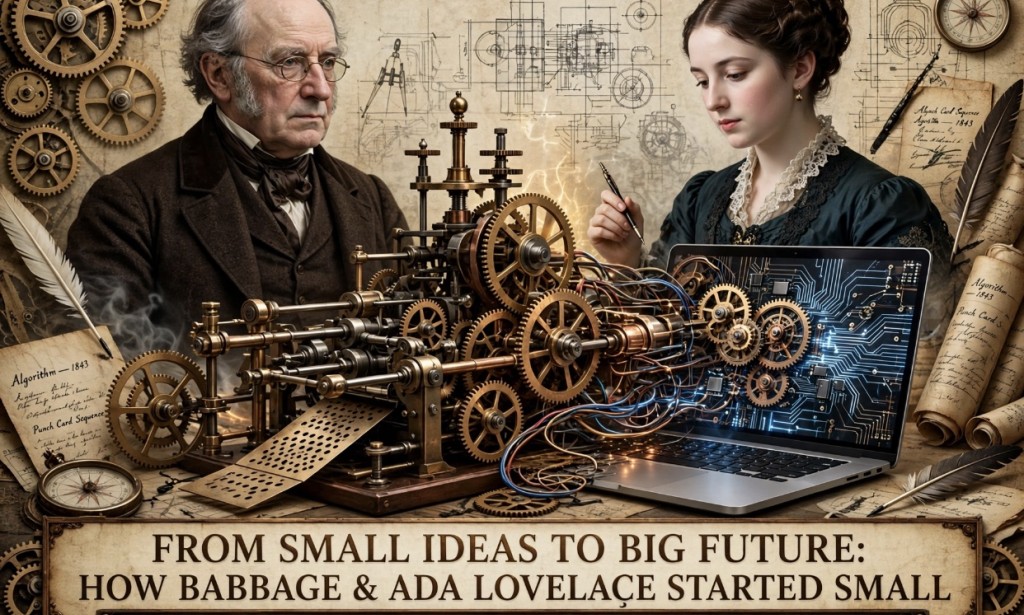
Everyone knows Charles Babbage and Ada Lovelace from textbooks, but nobody tells you how they REALLY started.
They did not start as geniuses. They started as curious people who loved to create small things with what they had.
If they can create the computer in the 1800s, what is stopping you from creating something in 2026 with a smartphone?
LET'S TALK ABOUT THE LEGENDS
1. CHARLES BABBAGE - THE FATHER OF COMPUTER
Charles Babbage was born in 1791 in London. At that time, there was no electricity, no internet, no calculator.
But Babbage hated mistakes. He noticed that mathematical tables made by humans always had errors, and those errors caused ships to have accidents.
So he thought: "What if a machine can do calculations without mistakes?"
He started small. He built a small machine called Difference Engine with gears and handles, like a clock. It could only add numbers. People laughed at him. The British government gave him money and later stopped.
But he did not stop. He then designed a bigger idea - the Analytical Engine. This machine had a Store (like memory), a Mill (like CPU), and Punch Cards (like programming). It is the exact same way your phone works today!
He never finished it before he died, but his idea gave birth to the computer you are using to read this.
Lesson: He started with a small problem - wrong calculations - and turned it into a world-changing invention.
2. ADA LOVELACE - THE FIRST COMPUTER PROGRAMMER
Ada Lovelace was a woman in a time when women were not allowed to go to university. Born in 1815, daughter of poet Lord Byron.
Ada met Babbage and saw his Analytical Engine. While other people saw just a metal machine, Ada saw the future. She said this machine could not just calculate numbers, it could create music, art, and words.
At age 27, she wrote the first computer program in history. She wrote how the machine could calculate Bernoulli numbers. She had no computer to test it, no laptop, no coding school. Just pen and paper!
People called her "The Enchantress of Numbers."
Lesson: Intelligence is not about having all tools. It is about seeing what others cannot see.
3. OTHER SCIENTISTS WHO STARTED SMALL
- THOMAS EDISON: He failed 1,000 times before he made the light bulb work. He sold vegetables as a child to buy lab chemicals.
- MARIE CURIE: She did her experiments in a small leaking shed, not a big lab. She became the first woman to win a Nobel Prize.
- NIKOLA TESLA: He started by fixing machines in a small shop in Croatia before he brought electricity to the world.
- ALBERT EINSTEIN: He was working as a clerk in a small patent office when he wrote his theory that changed physics.
None of them started big. They all started small, broke, and curious.
HOW YOU CAN BE INTELLIGENT LIKE THEM - 5 PRACTICAL STEPS
You don't need to build a computer. You need to build the habit of creation. Here is how:
1. START WITH A SMALL PROBLEM AROUND YOU
Babbage saw wrong tables. What small problem do you see? Maybe no light in your street, or waste in your area, or students failing maths. Write it down.
2. CREATE WITH WHAT YOU HAVE
Don't say "I don't have money or laptop." Ada had no laptop. Use your phone to learn on YouTube, use free AI like ChatGPT, use pen and paper to draw ideas. Start.
3. BE CURIOUS EVERY DAY
Smart people ask questions. Why does this happen? How can I make it better? Read one article daily. Watch one educational video daily. Your brain is like muscle, it grows.
4. FAIL FAST AND LEARN
Edison failed 1,000 times. If your first idea fails, it is not the end. It is data. Try another way. Every creator fails.
5. BUILD SOMETHING AND SHOW PEOPLE
Don't keep your idea in your head. Build a small website, write an article on LodPost, make a small robot with cardboard, make a video teaching something. When you create, you become intelligent.
FINAL GIST FOR YOU
Babbage and Lovelace died over 150 years ago, but we still talk about them today because they created something.
In 100 years, what will people remember you for?
You don't need to be the smartest in class. You just need to start small, stay curious, and keep creating.
The next Charles Babbage or Ada Lovelace could be a boy in Uyo, a girl in Warri, or a student reading this article right now.
It could be YOU.
What small thing are you creating this month? Tell us in the comments, let's inspire each other.
Disclaimer: This article is for educational and inspirational purposes.


You must be logged in to post a comment.