

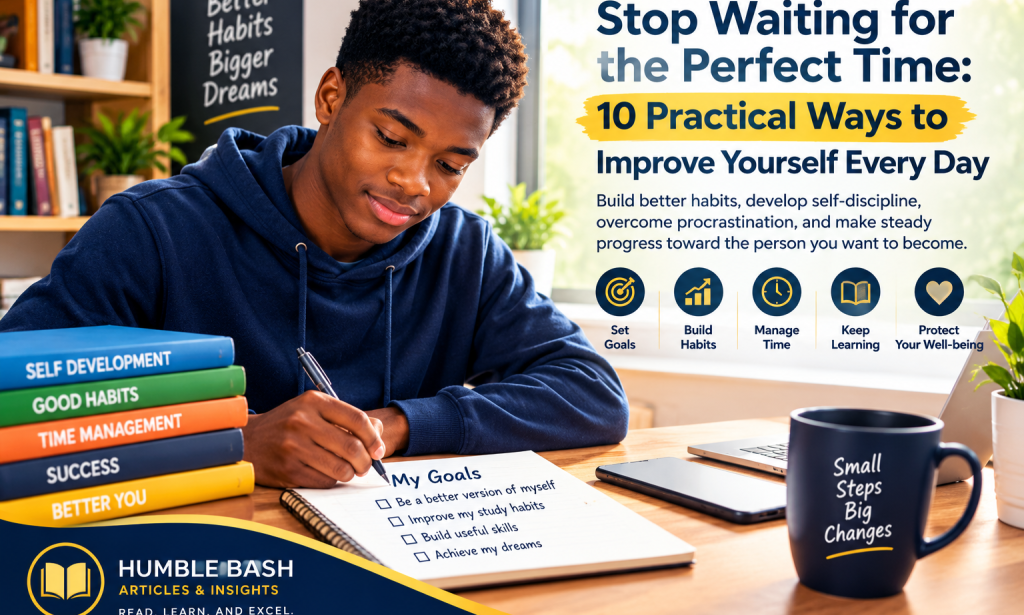
Stop Waiting for the Perfect Time: 10 Practical Ways to Improve Yourself Every Day
Introduction
Personal development is a lifelong journey of learning, improving your habits, understanding yourself, and working toward meaningful goals. It does not require you to become perfect overnight. Instead, it involves making small, intentional choices that gradually improve the way you think, act, learn, and relate to others.
Many people have dreams they want to achieve. Some want to perform better academically, develop valuable skills, improve their confidence, manage their time wisely, or become more responsible. However, knowing what you want is only the beginning. Progress comes when you turn your intentions into consistent actions.
The good news is that you do not need to change your entire life in one day. You can begin with simple steps, learn from your mistakes, and improve as you go.
Here are ten practical ways to invest in yourself and make personal development part of your everyday life.
1. Understand Yourself Before Setting Goals
Personal development begins with self-awareness. Before deciding what to change, take time to understand your strengths, weaknesses, interests, values, and current habits.
Ask yourself questions such as:
- What am I already good at?
- Which skills would I like to improve?
- What habits are helping me?
- What habits are preventing me from making progress?
- What kind of person do I want to become?
Answering these questions honestly can help you identify areas that deserve attention.
For example, a student who struggles to complete assignments may discover that the main problem is poor time management rather than a lack of ability. Recognizing the real challenge makes it easier to choose a useful solution.
Self-awareness is not about criticizing yourself. It is about understanding yourself well enough to make better decisions.
2. Set Clear and Realistic Goals
Without clear goals, it can be difficult to know where to direct your energy. A goal gives you something specific to work toward and helps you measure your progress.
Instead of saying, "I want to become better at studying," choose a more specific target, such as completing a focused revision session each evening.
You can divide larger goals into smaller tasks. If you want to learn a digital skill, for instance, begin by understanding the basics before attempting more advanced projects.
Your goals should challenge you without becoming impossible to manage alongside your responsibilities.
Write down your goals and review them regularly. When circumstances change, adjust your plan rather than abandoning your ambitions completely.
3. Build Small Habits You Can Maintain
Big changes often begin with small actions repeated consistently.
You could read a few pages of a useful book, review your notes, practise a skill, organize your workspace, or spend several minutes planning the next day.
Choose habits that fit your current schedule. Starting with too many changes at once can make your routine difficult to maintain.
For example, if you want to read more, begin with a manageable daily reading target. Once the habit becomes easier to follow, you can gradually increase it.
Remember that missing one day does not erase your progress. The important thing is to return to your routine instead of allowing one setback to become a permanent stop.
4. Learn to Manage Your Time
Time management is an important personal development skill because your daily choices influence how much attention you can give to your priorities.
Start by identifying the activities that require your attention. These may include schoolwork, household responsibilities, rest, exercise, personal interests, and learning new skills.
A simple daily plan can help you organize these responsibilities.
Try writing down three important tasks each morning or the night before. Complete the most urgent or valuable tasks first when possible.
Also, pay attention to activities that regularly consume more time than you intended. Social media, unnecessary interruptions, and unplanned browsing can sometimes make it harder to focus.
You do not have to fill every minute with work. Good time management also leaves room for rest, recreation, and relationships.
5. Develop Self-Discipline
Motivation can make it easier to begin something, but it does not always remain strong. Self-discipline helps you continue working toward your goals even when you do not feel particularly motivated.
One way to develop discipline is to create a routine that reduces the need to make the same decision repeatedly.
For example, setting aside a regular period for studying or practising a skill makes it easier to know when to begin.
You can also reduce distractions before starting. Put away unnecessary notifications, prepare your materials, and choose a suitable place to work.
However, discipline does not mean ignoring your health or refusing to rest. Sustainable progress requires a balance between effort and recovery.
6. Make Learning a Daily Priority
The world continues to change, and learning helps you adapt to new ideas, responsibilities, and opportunities.
You can learn through books, educational articles, school lessons, practical projects, tutorials, and conversations with knowledgeable people.
Choose learning materials carefully, especially when information could influence important decisions. Compare reliable sources rather than accepting every claim you encounter online.
You should also practise what you learn. Reading about communication, for example, becomes more useful when you apply the lessons in real conversations.
You do not need to know everything. Aim to remain curious, ask thoughtful questions, and become more knowledgeable over time.
7. Learn From Mistakes Instead of Hiding Them
Mistakes can be uncomfortable, but they can also reveal what needs to change.
When something goes wrong, avoid judging your entire ability based on one disappointing result. Instead, examine what happened.
Ask yourself:
- What was I trying to achieve?
- What went wrong?
- What could I have done differently?
- What will I try next time?
A student who performs poorly in a test might discover that they relied too heavily on reading without practising questions. That realization can guide a more effective study plan.
Taking responsibility for mistakes is not the same as blaming yourself for everything. Consider the circumstances fairly, identify what you can control, and use the experience to make a better plan.
8. Choose Your Environment Carefully
Your surroundings can influence your habits, attention, and decisions. A supportive environment can make it easier to practise positive behaviours.
Try to spend time with people who respect you, encourage learning, and support your efforts to improve. Seek advice from teachers, mentors, family members, or other trusted people when appropriate.
Organize your physical and digital environments to support your goals. Keeping study materials accessible or limiting distracting notifications can make useful habits easier to follow.
You may not be able to control every part of your environment, but you can often make small changes to improve it.
9. Protect Your Well-Being
Personal development is not only about productivity, achievements, or money. It also involves taking care of your physical and emotional well-being.
Make room for sufficient rest, regular movement, balanced meals, meaningful relationships, and activities that help you relax.
Pay attention to signs that you are taking on too much. Constantly pushing yourself without enough recovery can make it harder to concentrate and maintain your responsibilities.
It is also healthy to ask for help when you face a problem that feels difficult to manage alone.
You are not falling behind simply because you need rest or support. Looking after yourself can help you continue working toward your goals in a more sustainable way.
10. Review Your Progress and Keep Going
Personal development becomes more manageable when you regularly review your progress.
At the end of each week, take a few minutes to consider what went well, what challenged you, and what you want to improve during the following week.
You might record completed tasks, skills practised, books read, or lessons learned from difficult experiences.
Do not measure your progress only by comparing yourself with other people. Everyone has different circumstances, responsibilities, and starting points.
Instead, compare your current habits and abilities with where you began. Celebrate genuine progress while remaining willing to learn.
If a plan is not working, change the plan. Persistence does not require repeating the same ineffective approach forever.
Conclusion
Personal development is not a race, and meaningful improvement rarely depends on one dramatic decision. It grows through self-awareness, clear goals, consistent habits, effective time management, continuous learning, and the willingness to learn from mistakes.
You do not have to practise all ten strategies immediately. Choose one area that matters to you and take a small, practical step today.
If you want to improve academically, begin with a realistic study routine. If you want to develop a new skill, set aside time to practise. If you want to become more organized, start planning your daily priorities.
The goal is not to become perfect. It is to become more intentional about the choices you make and the direction in which you are growing.
Your future is influenced by the actions you take today. Start small, stay willing to learn, and keep moving forward.


You must be logged in to post a comment.