

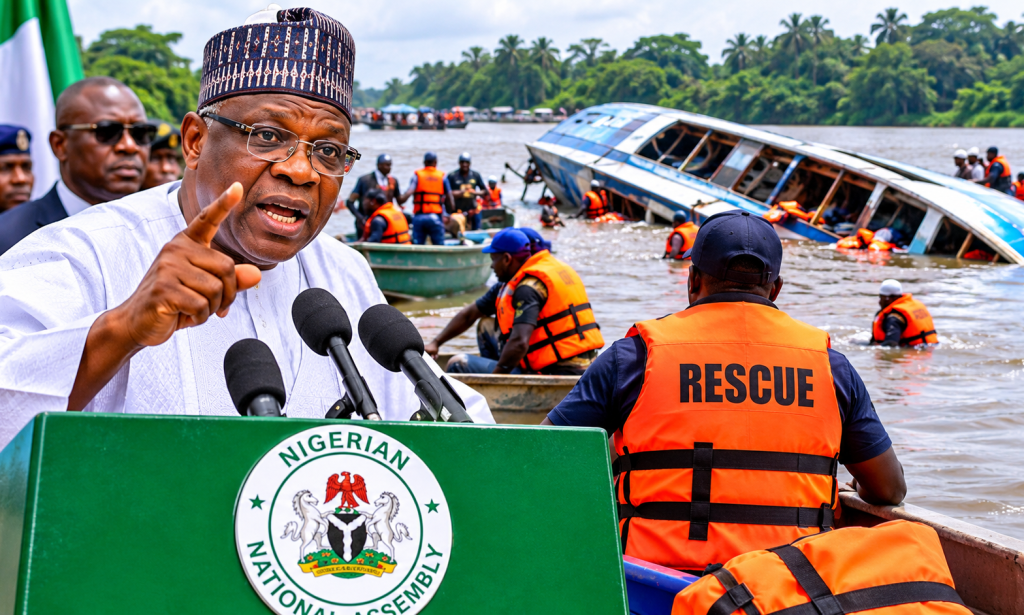
National Assembly Calls for Nationwide Boat Safety Checks After Deadly Bayelsa Accident
Introduction
The National Assembly has called for a nationwide safety audit of boats and ferries operating across Nigeria's waterways following a tragic boat accident in Bayelsa State that claimed 29 lives, including two children.
The incident has raised serious concerns about water transportation safety in Nigeria, particularly in riverine communities where many residents depend on boats to travel from one location to another.
Lawmakers are now demanding stronger safety regulations, regular inspections and stricter enforcement to prevent similar tragedies.
What Happened in Bayelsa State?
The tragic accident occurred on Friday, November 20, 2026, in Southern Ijaw Local Government Area of Bayelsa State.
The boat was carrying passengers travelling from Ayama Community to Ukubie when it capsized around the river junction between Oweikorogha and Otuan.
The passengers were reportedly travelling for a condolence visit.
According to reports presented by lawmakers, the boat was carrying far more passengers than its capacity could safely accommodate.
The accident resulted in the deaths of 29 people, including two children, while more than 50 survivors were rescued and taken for medical attention.
The tragedy has left families and communities mourning the loss of their loved ones.
National Assembly Demands Nationwide Boat Safety Audit
Following the incident, members of the Senate and House of Representatives called for urgent action to improve safety on Nigeria's waterways.
The Senate demanded a nationwide audit of boats and ferries to identify unsafe vessels and ensure that operators follow established safety requirements.
Lawmakers also urged relevant regulatory agencies, including the Nigerian Inland Waterways Authority (NIWA), to conduct regular inspections and ensure that boats are suitable for passenger transportation.
They stressed that safety regulations should not exist only on paper but must be properly enforced.
The lawmakers also called for tougher penalties against operators who ignore safety requirements.
Compulsory Life Jackets and Better Safety Equipment
One of the major concerns raised after the accident was the importance of wearing life jackets during boat journeys.
Lawmakers emphasised that passengers and boat operators should follow safety procedures, including the compulsory use of life jackets.
They also called for the provision of safer boats, floaters and other emergency equipment, especially in communities that depend heavily on water transportation.
According to the lawmakers, being familiar with rivers or knowing how to swim should never be treated as a replacement for proper safety equipment.
Every passenger deserves protection when travelling by water.
Investigation Into the Accident
The House of Representatives has also called for a thorough investigation into the immediate and underlying causes of the tragedy.
Its Committee on Emergency and Disaster Management was directed to work with the National Emergency Management Agency (NEMA) and the Bayelsa State Government.
The investigation is expected to establish what happened and recommend measures that could prevent similar accidents.
Authorities have also raised concerns about overloading, poor vessel conditions and failure to follow safety regulations.
Calls for Better Roads in Riverine Communities
Another important issue raised by lawmakers is the poor road infrastructure in some riverine communities.
In parts of Bayelsa State, residents depend heavily on boats because many communities have limited road connections.
Lawmakers argued that improving road networks could reduce the pressure on water transportation and provide residents with safer alternatives.
They specifically called for support for important road projects, including the proposed Yenagoa-Oporoma Road.
This shows that improving transportation safety requires more than inspecting boats. It also involves providing better infrastructure for communities.
Government Support for Victims' Families
Following the accident, President Bola Tinubu approved N250 million to support affected families and disaster management efforts.
The Federal Government also ordered an investigation and called for stricter enforcement of safety standards on inland waterways.
The Bayelsa State Government announced that it would cover the medical expenses of survivors and established measures to investigate the incident.
These interventions are intended to support affected families and communities as they deal with the consequences of the tragedy.
Why This Incident Should Concern Every Nigerian
Boat accidents are not just problems affecting people who live near rivers. They are national safety concerns.
Thousands of Nigerians depend on water transportation for business, education, farming, fishing and other daily activities.
When boats are overloaded, poorly maintained or operated without proper safety equipment, passengers are exposed to serious danger.
The Bayelsa tragedy is a reminder that safety regulations must be taken seriously.
Boat operators must understand their responsibilities, passengers should insist on basic safety precautions, and regulatory agencies must perform their duties.
Conclusion
The deadly Bayelsa boat accident has renewed calls for stronger safety measures across Nigeria's waterways.
The National Assembly's demand for a nationwide boat safety audit highlights the need for regular inspections, compulsory life jackets, safer vessels and proper enforcement of transportation regulations.
While financial support and condolences are important, preventing another tragedy should remain a priority.
Every Nigerian deserves to travel safely, whether by road, air or water.
No journey should cost a human life.






































You must be logged in to post a comment.