

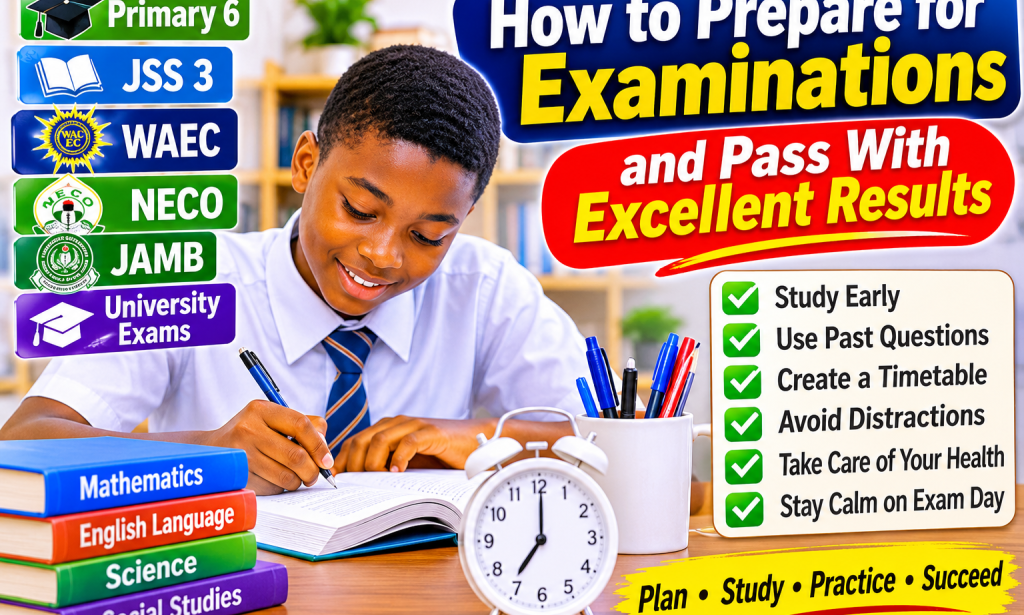
How to Prepare for Examinations and Pass With Excellent Results
Examinations are an important part of education. They help teachers, schools and universities understand how much students have learned and whether they are ready to move to the next stage of their education.
However, many students become nervous whenever examinations are approaching. Some do not know where to begin, while others wait until a few days before the examination before opening their books.
The truth is that passing examinations requires more than intelligence. It requires preparation, discipline, consistency and the right study methods.
Whether you are in Primary 6, JSS3, preparing for WAEC, NECO, JAMB or university examinations, there are practical steps you can follow to improve your performance.
1\. How Primary 6 Students Can Prepare for Examinations
Primary 6 is an important stage because students are preparing to move from primary school to secondary school. Some students also prepare for common entrance examinations.
At this level, students should focus on understanding basic subjects and developing good reading habits.
Here are some helpful tips:
* Read your textbooks regularly instead of waiting until examination week.
* Practise Mathematics questions, including multiplication, division, fractions and word problems.
* Improve your English by reading comprehension passages and practising grammar.
* Study Basic Science and other subjects taught in your school.
* Ask your teachers questions whenever you do not understand a topic.
* Practise past examination questions where available.
Parents can also help by providing a quiet place for their children to study and checking their progress regularly.
2\. How JSS3 Students Can Prepare for Examinations
JSS3 is another important stage because students are preparing for their transition into senior secondary school.
Many students take the Basic Education Certificate Examination (BECE) or other junior secondary school examinations.
To prepare successfully, students should:
* Understand the topics taught throughout JSS1, JSS2 and JSS3.
* Create a timetable that covers all their subjects.
* Practise Mathematics and English questions regularly.
* Study Basic Science, Business Studies, Social Studies and other relevant subjects.
* Revise difficult topics with teachers or classmates.
* Practise previous BECE questions to understand the examination format.
Students should not concentrate on only their favourite subjects. Every subject deserves attention because a good overall performance is important.
3\. How to Prepare for WAEC Examinations
The West African Examinations Council (WAEC) examination is one of the major examinations students take before gaining admission into higher institutions.
Proper preparation is important because students are expected to understand different subjects and answer questions correctly.
Here are some ways to prepare:
Study the WAEC syllabus: Find out the topics covered in each subject and make sure you study them.
Practise past questions: Previous WAEC questions help you understand how questions are presented and identify commonly tested topics.
Understand difficult subjects: If Mathematics, Physics, Chemistry or English is difficult for you, spend additional time studying and practising.
Improve your writing skills: Practise writing essays, letters, reports and other required compositions.
Pay attention to practical subjects: Subjects such as Biology, Chemistry and Physics may require practical knowledge. Do not ignore practical preparation.
Avoid examination malpractice: Depending on leaked questions or examination shortcuts can put your future at risk. Focus on genuine preparation.
4\. How to Prepare for NECO Examinations
The National Examinations Council (NECO) examination is another important examination for secondary school students in Nigeria.
Many students write NECO as part of their efforts to obtain the required qualifications for further education.
To prepare effectively:
* Get the correct NECO syllabus for your subjects.
* Read your class notes and textbooks.
* Practise NECO past questions.
* Study topics you find difficult.
* Learn how to manage your time when answering questions.
* Revise practical topics where necessary.
* Make sure you understand instructions before answering examination questions.
Students should also remember that WAEC and NECO may have different examination questions and arrangements. Preparing for one should not mean ignoring the requirements of the other.
5\. How to Prepare for JAMB Examinations
The Joint Admissions and Matriculation Board (JAMB) examination is important for students seeking admission into universities, polytechnics and colleges of education in Nigeria.
JAMB uses a computer-based testing system, so students need to prepare academically and become comfortable with answering questions on a computer.
Here are some useful preparation tips:
Study the JAMB syllabus: Download or obtain the official syllabus for your chosen subjects. Use it as a guide to know the topics you need to cover.
Practise JAMB past questions: Regular practice helps you understand the examination pattern and become familiar with different types of questions.
Improve your speed: Since JAMB is a timed computer-based examination, practise answering questions within a limited time.
Use recommended textbooks: Read the recommended materials for your subjects instead of depending entirely on summaries.
Practise with CBT applications: Familiarise yourself with computer-based testing so that the examination environment does not feel strange.
Understand all your subjects: Do not concentrate on only one subject. Give attention to English Language and the other subjects required for your chosen course.
Choose your course carefully: Understand the admission requirements for your preferred institution and course before making your choices.
Remember that success in JAMB comes from understanding the subjects, practising regularly and managing examination time properly.
6\. How University Students Can Prepare for Examinations
University examinations can be challenging because students are expected to understand detailed topics, attend lectures and complete assignments.
Unlike some secondary school examinations, university assessments may include essays, calculations, practical work, projects and multiple-choice questions.
Here are useful preparation methods:
Attend lectures regularly: Lecturers often explain important concepts that may not be fully covered in textbooks.
Read your lecture notes: Do not wait until examinations are close before reviewing your notes.
Understand your course materials: Memorising everything without understanding can make it difficult to answer questions that require explanations.
Join a study group: Studying with serious classmates can help you understand difficult topics and exchange useful ideas.
Practise calculations and practical questions: Students in courses involving Mathematics, Engineering, Science and other technical subjects should practise regularly.
Understand the examination format: Find out whether your examinations involve essays, objective questions, calculations or practical assessments.
Start preparing early: University examinations often cover many topics, so early preparation gives you enough time to revise.
7\. Create a Personal Reading Timetable
One of the best ways to prepare for examinations is to create a reading timetable.
A timetable helps you organise your time and prevents you from concentrating on only one subject.
For example:
| Time | Activity |
| ----------------- | ----------------------- |
| 5:00 am – 6:00 am | Morning revision |
| 4:00 pm – 5:00 pm | Study Subject 1 |
| 5:00 pm – 6:00 pm | Study Subject 2 |
| 7:00 pm – 8:00 pm | Practise past questions |
| 8:00 pm – 8:30 pm | Revise what you studied |
You can adjust the timetable according to your school activities, personal responsibilities and examination dates.
The most important thing is to remain consistent.
8\. Practise Past Examination Questions
Past questions are useful because they help students become familiar with examination formats.
They also help you discover areas where you need more practice.
When practising past questions:
* Set a time limit for yourself.
* Answer questions without checking your textbook.
* Mark your answers honestly.
* Identify your mistakes.
* Return to your textbooks to understand the correct answers.
Do not simply memorise answers. Try to understand how each answer is obtained.
9\. Avoid Distractions While Studying
Distractions can prevent students from concentrating.
Mobile phones, social media, television, games and unnecessary conversations can consume valuable study time.
To improve concentration, keep your phone away when studying unless you need it for educational purposes.
Choose a quiet environment, arrange your study materials and focus on one subject at a time.
Even a short period of serious concentration can be more productive than several hours of distracted reading.
10\. Take Care of Your Health Before Examinations
Studying for long hours without resting can affect your concentration and memory.
Students need enough sleep, healthy meals and regular breaks.
Avoid staying awake throughout the night trying to cover every topic. Lack of sleep can make it difficult to remember information during examinations.
Drink enough water, eat properly and give your brain time to rest.
11\. What to Do on Examination Day
Your preparation should continue until the examination day.
Here are some important things to remember:
* Wake up early and prepare yourself.
* Eat something before leaving home if possible.
* Arrive at the examination centre early.
* Bring the required examination materials.
* Listen carefully to the instructions given by invigilators.
* Read every question before answering.
* Manage your time properly.
* Check your answers before submitting your paper.
Most importantly, remain calm. Do not allow fear or pressure to affect your performance.
Conclusion
Preparing for examinations is not something students should begin only when examination dates are announced. It is a continuous process that requires discipline, patience and commitment.
Whether you are in Primary 6, JSS3, preparing for WAEC, NECO, JAMB or university examinations, the principles remain similar: study regularly, practise questions, understand your subjects and manage your time wisely.
Every student has the opportunity to improve academically. You do not need to understand everything in one day. Start with small steps, remain consistent and keep improving.
Remember, examination success is not achieved by reading only on the night before the examination. It comes from the effort you put into learning every day.










































You must be logged in to post a comment.