

How Did Money Become More Important Than Gold in Everyday Trade?
For thousands of years, gold was considered one of the most valuable materials in the world. People used it to store wealth, make jewellery and exchange valuable goods. However, as societies developed and trade expanded, people needed something more convenient for buying and selling everyday products.
Today, people use paper money, coins, bank transfers and digital payments to purchase almost everything. Gold is still valuable, but it is no longer the main payment method in everyday business.
So, how did money become more important than gold in everyday trade? The answer lies in the history of human civilisation, business and economic development.
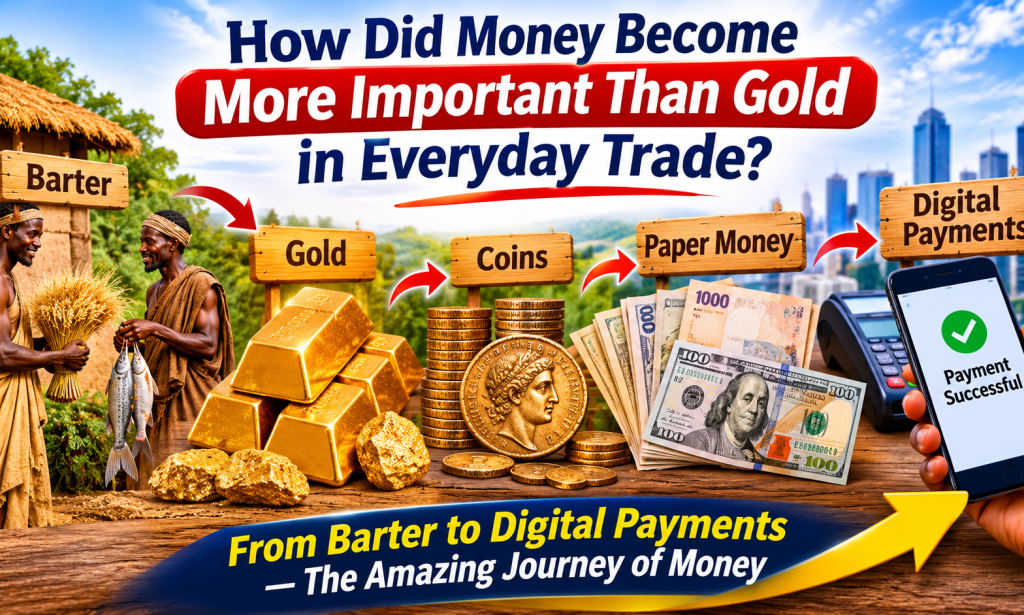
1\. Before Money, People Used Barter
Before modern money existed, people exchanged goods directly. This system was known as barter.
For example, a farmer who had excess rice could exchange it for fish from a fisherman. Someone with livestock could exchange an animal for clothing or other useful products.
Although this system worked in some communities, it had a major problem. Both people needed to want what the other person was offering.
Imagine having a bag of rice but wanting a pair of shoes. You would need to find someone who had shoes and also wanted your rice.
As trade increased, this became difficult. People needed a more convenient way to exchange goods.
2\. Gold and Other Valuable Items Became Money
As people searched for better ways to trade, different communities began using valuable items as forms of payment.
These included gold, silver, salt, cattle and cowrie shells.
Gold became particularly popular because it was durable, rare, easy to recognise and could be divided into smaller amounts.
People trusted gold because it had value beyond its use as money. It could also be used to make jewellery and other valuable objects.
However, carrying gold everywhere was not always convenient, especially when buying ordinary household products.
3\. The Introduction of Coins Changed Trade
One important development in the history of money was the introduction of standardised metal coins.
Around the seventh century BCE, the ancient kingdom of Lydia, in what is now Turkey, produced some of the earliest known standardised coins.
These coins made trading easier because people no longer needed to weigh and assess pieces of precious metal for every transaction.
Instead, they could use recognised coins with established values.
This development helped trade become more organised and convenient.
4\. Paper Money Made Payments Easier
As businesses and trade continued to grow, carrying large quantities of metal coins became inconvenient.
Paper money provided a lighter and easier alternative.
China played an important role in the development of paper money, with early forms appearing more than a thousand years ago.
Paper notes made it possible to carry significant amounts of purchasing power without transporting heavy bags of metal.
Over time, paper money became widely accepted in different parts of the world.
5\. Why Did People Stop Using Gold for Everyday Payments?
Gold did not lose its value. Instead, people discovered that ordinary money was more practical for everyday transactions.
There are several reasons for this:
* Convenience: Paper notes and coins are easier to carry than gold.
* Easy payments: People can pay for food, transportation and other services without weighing precious metals.
* Standard values: Money makes it easier to determine the prices of goods and services.
* Government support: Modern national currencies are issued and managed through established monetary systems.
* Business development: Money makes it easier for companies to pay workers, purchase supplies and serve customers.
These advantages helped money become the preferred method of everyday payment.
6\. Banks and Electronic Payments Changed Everything
The development of banks introduced another major change.
People no longer needed to keep all their money physically at home. They could deposit it in banks and access it when necessary.
Later, cheques, debit cards, mobile banking and electronic transfers made payments even easier.
Today, someone in Nigeria can transfer money to another person using a mobile banking application without physically meeting them.
Businesses can also receive payments from customers across different locations.
Technology has made money more convenient than ever before.
7\. Is Gold Still More Valuable Than Money?
Gold remains an important asset in the modern world.
Many people buy gold as a way of preserving wealth, while investors and financial institutions also use it as part of their investment strategies.
However, gold and everyday money serve different purposes.
Gold is often used to store wealth over long periods, while money is designed to make buying, selling and paying for services easier.
For example, you can use Nigerian naira to purchase food at a supermarket, pay for transportation or settle a restaurant bill. You would rarely use a piece of gold for these everyday transactions.
This does not mean money is always more valuable than gold. It simply means money is more practical for ordinary trade.
8\. What Will Money Look Like in the Future?
Money continues to change as technology develops.
Digital payments, mobile banking and cryptocurrencies are introducing new ways for people to transfer and manage value.
In many places, people now complete transactions using their phones instead of carrying physical cash.
As technology advances, digital payments may become even more common.
However, people will still need reliable systems that allow them to exchange goods and services safely.
Conclusion
The history of money shows how human beings have continuously searched for easier ways to trade.
From barter to gold coins, paper notes, bank accounts and digital payments, every development has made buying and selling more convenient.
Gold remains valuable, but money became the preferred tool for everyday trade because it is easier to carry, use, divide and transfer.
The biggest lesson is that something does not have to be the most expensive thing in the world to become the most useful in everyday life.









































You must be logged in to post a comment.