

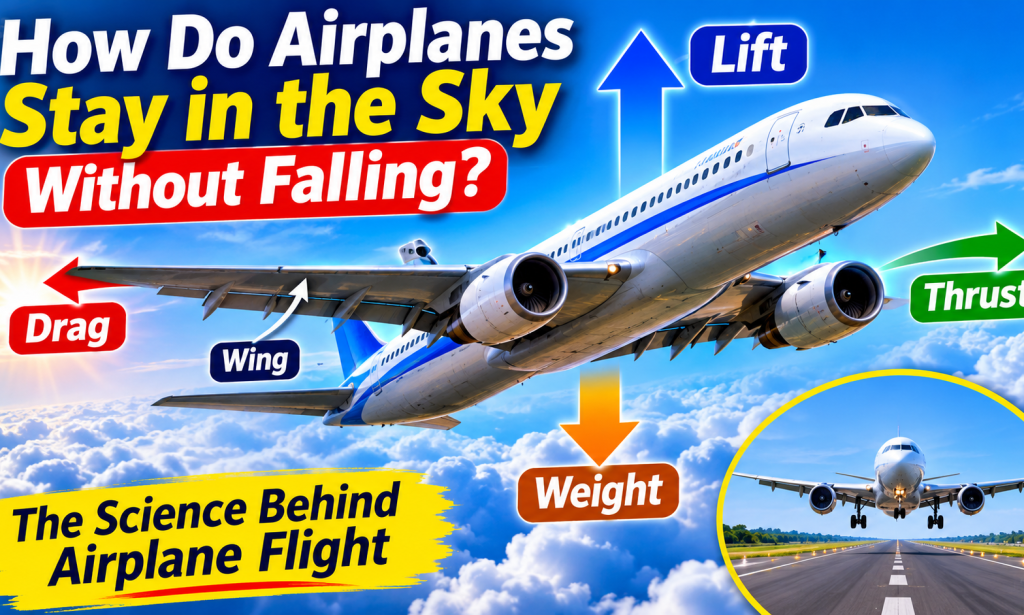
How Do Airplanes Stay in the Sky Without Falling?
Have you ever looked up at the sky and wondered how a huge airplane carrying hundreds of passengers can fly without falling? It may look impossible when you consider how heavy an airplane is compared to the birds flying around it.
Airplanes can weigh thousands of kilograms, yet they can travel high above the clouds for several hours. The secret behind this amazing ability is a combination of science, engineering and carefully designed wings.
But how exactly does it work?
1\. The Secret Is in the Wings
One of the most important parts of an airplane is its wings.
Airplane wings are specially designed to help generate a force called lift. As an airplane moves forward, air flows around its wings, helping produce an upward force.
This upward force helps the airplane rise into the sky and remain airborne.
Without properly designed wings, an airplane would not be able to fly in the way modern aircraft do.
2\. Airplane Engines Push It Forward
Before an airplane can fly, it needs to move along the runway at high speed.
This is where the engines become important.
Most large passenger airplanes use jet engines. These engines take in air, compress it, mix it with fuel and burn the mixture. The hot gases are pushed out backwards at high speed, producing thrust that moves the airplane forward.
As the airplane gains speed, its wings generate enough lift to help it take off.
3\. Four Forces Keep an Airplane Flying
There are four important forces that affect an airplane during flight.
Lift: This is the upward force that helps an airplane rise and stay in the air.
Weight: This is the downward force caused by gravity pulling the airplane towards the Earth.
Thrust: This is the forward force produced by the engines.
Drag: This is the air resistance that pushes against the airplane as it moves forward.
For an airplane to maintain steady level flight, lift balances weight, while thrust balances drag.
These forces work together to make controlled flight possible.
4\. Why Doesn't an Airplane Fall When Its Engines Stop?
Many people believe that an airplane will immediately fall if its engines stop working. However, this is not exactly true.
An airplane can continue moving through the air even without engine power.
Its wings can still generate lift as long as it maintains sufficient forward speed.
In this situation, the airplane can glide towards the ground, much like a glider.
Pilots are trained to handle engine failures and follow emergency procedures to find a safe place to land.
5\. How Do Pilots Control an Airplane?
Flying an airplane requires more than simply starting the engines and moving forward.
Pilots use special controls to change the direction, speed and position of the aircraft.
There are three important control surfaces:
* Ailerons: Help the airplane roll from side to side.
* Elevators: Help the airplane move its nose up or down.
* Rudder: Helps control the airplane's direction by moving its nose left or right.
These controls allow pilots to turn, climb, descend and maintain a stable flight.
6\. Why Do Airplanes Fly So High Above the Clouds?
Most commercial passenger airplanes fly at altitudes of approximately 30,000 to 40,000 feet above sea level.
Flying at these heights has several advantages.
The air is thinner, which reduces drag and allows airplanes to travel more efficiently. It can also help aircraft avoid much of the weather and turbulence found at lower altitudes.
However, airplanes are designed with special systems to keep passengers comfortable and safe in the thin air found at high altitudes.
7\. Why Do Airplanes Sometimes Shake During Flight?
If you have ever travelled by airplane, you may have experienced turbulence.
Turbulence happens when an airplane passes through irregular air movements.
These movements can be caused by storms, mountains, changes in wind speed or other atmospheric conditions.
Although turbulence can make an airplane shake, it is a normal part of flying.
Modern aircraft are designed to withstand turbulence, and pilots receive training on how to manage it.
Passengers are advised to keep their seatbelts fastened whenever they are seated.
8\. How Do Airplanes Land Safely?
Landing is one of the most important stages of a flight.
When an airplane approaches an airport, the pilot gradually reduces speed and prepares the aircraft for landing.
The landing gear, which consists of strong wheels, supports the airplane when it touches the runway.
The pilot also uses special braking systems and other controls to slow the aircraft down safely.
Weather conditions, runway length and aircraft weight are among the factors considered during landing.
9\. Can an Airplane Fly Without a Pilot?
Modern airplanes have advanced technology that can help control many aspects of flight.
Some aircraft use autopilot systems to maintain direction, altitude and speed with limited manual input from pilots.
However, autopilot does not mean that an airplane can operate entirely without human supervision.
Pilots remain responsible for monitoring the aircraft, making important decisions and responding to unexpected situations.
Conclusion
Airplanes stay in the sky because of the combination of lift, thrust, drag and gravity. Their specially designed wings help generate lift, while their engines provide the power needed to move forward.
What looks like magic is actually the result of years of scientific discoveries and engineering improvements.
The next time you see a huge airplane flying above you, remember that every part of its design plays an important role in keeping it safely in the sky.
An airplane does not defeat gravity; it uses the laws of science to fly through the air.









































You must be logged in to post a comment.