

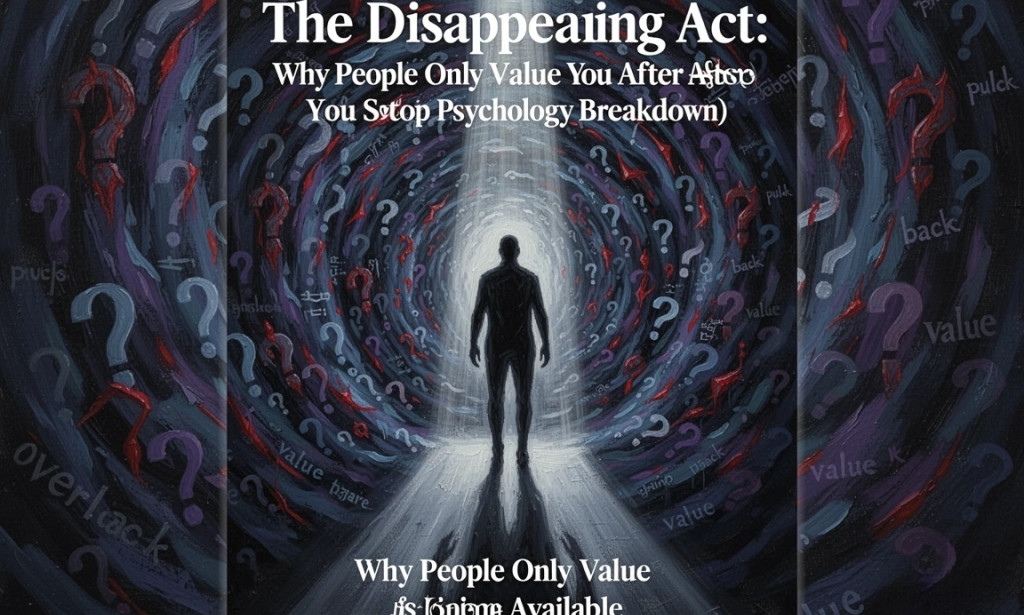
🔥 The Disappearing Act: Why People Only Value You After You Stop Being Available (A Dark Psychology Breakdown)

Introduction
Have you ever noticed a strange pattern in your relationships?
When you are always there—replying instantly, showing up without hesitation, giving your time freely—you often feel overlooked. But the moment you pull back, go silent, or become less available… suddenly people start noticing you again.
Messages increase. Attention returns. Interest spikes.
This isn’t coincidence. It’s psychology.
In this deep-dive, we’ll break down the dark psychological mechanisms behind why people value you more when you’re less available—and how understanding this can completely transform your personal, social, and even professional life.
H2: The Availability Trap – Why Being “Too Available” Lowers Your Value
H3: The Human Brain Doesn’t Value What Feels Guaranteed
Humans are wired to seek reward and uncertainty. When something is always available, it becomes predictable—and predictability reduces perceived value.
Think about it:
Unlimited access = low urgency
Low urgency = low emotional investment
Low investment = low perceived worth
When you are constantly available:
People assume you’ll always be there
They stop prioritizing you
Your presence becomes background noise
H3: Emotional Supply and Demand
Relationships follow a hidden economic rule: emotional supply and demand.
High supply (you’re always there) → low demand
Low supply (you pull back) → high demand
This is why your absence suddenly increases your “value.” It’s not that you changed—it’s that your availability did.
H2: The Scarcity Principle – Why Rarity Creates Desire
H3: Scarcity Triggers Psychological Urgency
One of the most powerful principles in psychology is scarcity.
People instinctively want:
What is rare
What is limited
What they might lose
When you become less available, your time and attention feel scarce.
This triggers:
Curiosity (“Why are they distant?”)
Fear of loss
Increased effort to reconnect
H3: The Fear of Missing Out (FOMO)
Your absence activates FOMO (Fear of Missing Out).
People start thinking:
“Are they giving attention to someone else?”
“Did I lose my place in their life?”
“Why don’t they need me anymore?”
This emotional discomfort pushes them to re-engage with you.
H2: The Dopamine Effect – Why Intermittent Attention Is Addictive
H3: Predictability Kills Excitement
When someone knows exactly when and how you’ll respond, your behavior becomes predictable.
Predictability reduces:
Excitement
Emotional intensity
Attachment
H3: Intermittent Reinforcement Creates Obsession
Psychologically, humans become addicted to unpredictable rewards.
This is called intermittent reinforcement—the same mechanism behind:
Social media addiction
Gambling behavior
Toxic relationships
When you:
Sometimes respond quickly
Sometimes take time
Sometimes disappear
You create emotional unpredictability, which increases:
Attention
Desire
Obsession
H2: The Respect Factor – Boundaries Create Value
H3: People Respect What They Can’t Control
When you’re always available:
You seem easy to access
You appear to have no boundaries
Others unconsciously rank you lower
But when you set limits:
Your time feels valuable
Your presence feels intentional
People respect your boundaries
H3: Over-Giving Signals Low Self-Worth
Constant availability often sends a hidden message:
“I don’t have anything more important than you.”
Even if unintentional, this can:
Reduce perceived status
Lower attraction
Encourage people to take you for granted
H2: The Power Shift – Why Pulling Back Changes Dynamics
H3: Control Moves to the Less Invested Person
In any relationship, the person who is less emotionally dependent holds more power.
When you’re always available:
You appear more invested
You give away control
When you step back:
You regain emotional balance
Others move toward you
H3: Silence Creates Psychological Space
Your absence creates mental space.
That space allows people to:
Think about you
Miss you
Re-evaluate your importance
Without space, there is no reflection.
H2: The Contrast Effect – Why Absence Makes Presence Stronger
H3: Familiarity Breeds Emotional Blindness
When people see you constantly, they stop noticing your value.
You become:
Expected
Routine
Invisible
H3: Absence Resets Perception
When you disappear—even briefly—you create contrast.
Suddenly:
Your presence feels fresh
Your value becomes visible
Your absence is felt
This is why people often realize your worth only after you step away.
H2: The Psychological Mistake Most People Make
H3: Trying Harder When Ignored
When people feel unappreciated, they often:
Text more
Give more
Try harder
This backfires because it:
Increases availability
Decreases perceived value
H3: The Cycle of Over-Giving
This creates a harmful loop:
You give more attention
They value you less
You try even harder
They pull away further
Breaking this cycle requires doing the opposite of your instinct.
H2: The Dark Truth – People Don’t Miss You When You’re Always There
Let’s be direct:
People don’t miss what they never lose.
If you are:
Always present
Always responsive
Always giving
There is no emotional gap for them to feel your absence.
And without absence:
There is no longing
No reflection
No appreciation
H2: Strategic Unavailability – How to Apply This Without Playing Games
This isn’t about manipulation. It’s about self-respect and balance.
H3: Practical Ways to Reduce Over-Availability
Don’t respond instantly to every message
Prioritize your own schedule first
Say “no” without over-explaining
Limit how much emotional energy you give
H3: Build a Life That Doesn’t Revolve Around Others
When your life is full:
You naturally become less available
Your time becomes more valuable
People sense your independence
Focus on:
Personal growth
Goals
Hobbies
Social variety
H2: Emotional Detachment – The Ultimate Attraction Trigger
H3: Why Detachment Increases Value
Emotional detachment doesn’t mean coldness—it means not needing validation.
When you’re detached:
You don’t chase
You don’t over-explain
You don’t depend on responses
This creates:
Mystery
Confidence
Psychological attraction
H3: The Balance Between Care and Control
Healthy detachment means:
You care—but not excessively
You show interest—but not desperation
You’re present—but not always available
H2: When This Backfires – The Risks of Disappearing
H3: Overdoing It Can Break Connections
If you disappear too much:
People may assume disinterest
Relationships can fade completely
H3: Not Everyone Will Chase You
Important truth:
Some people won’t come back—and that’s valuable information.
It reveals:
Who truly values you
Who only valued your availability
H2: The Real Lesson – It’s Not About Disappearing, It’s About Value
The goal isn’t to play mind games.
The goal is to:
Respect your time
Maintain boundaries
Avoid over-investment
When you do this:
You naturally become less available
Others naturally value you more
H2: Signs You’ve Been Too Available
You respond instantly every time
You cancel your plans for others
You feel anxious when ignored
You give more than you receive
You rarely say no
If these feel familiar, you’re likely caught in the availability trap.
H2: How to Reclaim Your Value (Step-by-Step)
H3: Step 1 – Pause the Instant Responses
Create small delays. This shifts perception immediately.
H3: Step 2 – Rebuild Your Routine
Fill your time with meaningful activities.
H3: Step 3 – Set Boundaries
Protect your time without guilt.
H3: Step 4 – Reduce Emotional Over-Investment
Don’t give more than what is reciprocated.
H3: Step 5 – Accept Who Doesn’t Return
Not everyone deserves continued access to you.
H2: Final Thoughts – The Power of Controlled Absence
Your value doesn’t increase because you disappear.
It increases because your absence reveals what your constant presence was hiding.
When you are always available, people adapt to you.
When you step back, people re-evaluate you.
And in that moment of distance, something powerful happens:
They finally see what they were about to lose.


You must be logged in to post a comment.