

A Major Change for Foreign Technology Workers
For technology professionals hoping to build their careers in the United States, immigration rules are an important part of long-term planning. A job offer from a major technology company can open professional opportunities, but moving from temporary work status to permanent residency can involve several stages and years of waiting.
That process has become more uncertain following a decision announced by US officials on October 8, 2026.
The Trump administration has suspended Microsoft, Adobe and six other technology and IT services companies from the US Department of Labor's Permanent Labor Certification programme, commonly known as PERM. The action forms part of a wider government effort to investigate alleged misuse of employment-based immigration programmes and encourage companies to prioritise American workers.
The announcement also brought universities into the spotlight, with federal officials launching investigations into nine institutions over alleged misuse of exchange-visitor visas.
For international workers, students and researchers, understanding exactly what has changed is essential. The restrictions are significant, but they do not automatically cancel every visa or existing green card connected to the affected organisations.
Which Companies Have Been Affected?
According to Reuters, the US government identified eight major technology and IT services companies covered by the suspension.
The companies are:
- Microsoft
- Adobe
- Cognizant
- Infosys
- Tata Consultancy Services (TCS)
- Wipro
- HCL Technologies
- Capgemini
These organisations have substantial operations in the United States and employ professionals in fields such as software development, cloud computing, cybersecurity, consulting and enterprise technology.
Several are also major employers of international technology professionals, including workers from India and other countries.
The decision means that the affected companies cannot submit new applications or have pending applications processed through the specified PERM labour-certification process while the suspension remains in effect.
However, the measure targets a particular immigration procedure. It should not be interpreted as a blanket ban on every foreign national working for these companies.
Source: Reuters report on the green card programme suspension.
Why Has the US Government Taken This Step?
The administration says the action is intended to address alleged abuse of employment-based immigration programmes.
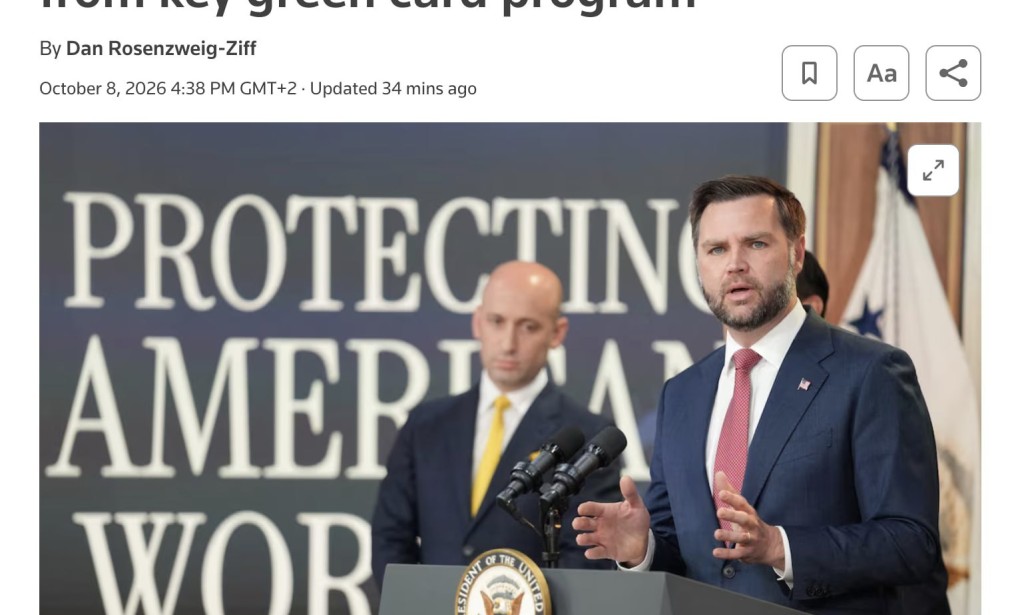
Vice President JD Vance criticised Microsoft's hiring practices during the announcement, arguing that major American companies should prioritise qualified domestic workers.
Labour Secretary Keith Sonderling said the Department of Labor would stop accepting new PERM applications involving the named companies and would not process their pending applications.
Administration officials have raised concerns about the relationship between corporate layoffs, foreign-worker recruitment and applications for permanent residency.
However, these claims must be understood as allegations and government positions rather than proof that every named company committed fraud. The suspension does not, by itself, establish that every application submitted by an affected employer was improper.
Microsoft has also defended its use of the H-1B programme. In reporting about the announcement, the company said most of its recent H-1B applications involved existing employees seeking extensions or changes in status, rather than newly arriving workers.
The broader debate concerns how the United States should balance domestic employment priorities with the role of international talent in industries that recruit workers from around the world.
What Is the PERM Programme?
PERM is a labour-certification process administered by the US Department of Labor. For many employer-sponsored employment-based green cards, it is an important step before the employer can proceed with an immigrant petition.
Generally, employers must demonstrate that there are no qualified, willing and available US workers for the relevant position and that employing a foreign worker will not adversely affect the wages and working conditions of similarly employed American workers.
The process can involve recruitment requirements, documentation and government review.
If labour certification is approved, the employer may proceed to the next stage of the immigration process, which commonly involves a petition filed with US Citizenship and Immigration Services. Further requirements still apply, and approval of PERM alone does not grant permanent residency.
By suspending the processing of new and pending applications involving the eight companies, the government has interrupted an important stage of the process for workers who depend on those employers for sponsorship.
Will Existing H-1B Visas Be Cancelled?
This is one of the most important questions for affected employees.
The H-1B visa programme and the PERM labour-certification process serve different purposes. H-1B status allows eligible foreign professionals to work temporarily in the United States in qualifying specialty occupations. PERM is used in many cases involving employer-sponsored permanent residency.
Consequently, the announced suspension does not automatically cancel every H-1B visa held by an employee of one of the named companies.
Likewise, the announcement does not automatically revoke green cards that have already been granted.
The more immediate concern is for workers whose permanent-residency plans depend on a new or pending PERM application involving one of the affected employers.
Their circumstances may differ depending on whether they have started the process, received labour certification, filed an immigrant petition or reached a later stage. The suspension's practical effect therefore cannot be determined solely from a person's employer or visa category.
Affected workers should seek advice from a qualified US immigration lawyer about their individual circumstances rather than assume that their existing status has automatically changed.
Harvard, Yale and Stanford Also Face Scrutiny
The technology-company suspension was accompanied by a separate development involving higher education.
US officials announced investigations into nine universities, including Harvard University, Yale University and Stanford University, over alleged misuse of J-1 exchange-visitor visas.
The J-1 programme allows eligible foreign nationals to participate in approved educational, research, training and cultural-exchange activities in the United States. Universities may use the programme for visiting researchers, scholars and certain other participants.
The administration has alleged that some institutions may have used the programme in ways that disadvantaged American workers or raised concerns about foreign influence and research relationships.
Officials said investigations would examine potential visa abuse and other compliance concerns. Reports also indicated that subpoenas had been issued.
It is important to distinguish an investigation from a finding of wrongdoing. The announcement does not establish that every university named in it violated immigration law.
The investigations nevertheless add uncertainty for international scholars and researchers considering US academic opportunities, particularly those whose activities depend on exchange-visitor sponsorship.
What Could This Mean for International Students and Researchers?
The university investigations are separate from the PERM suspension affecting the eight technology companies. The two actions involve different programmes and should not be confused.
For international students and researchers, the development highlights the importance of understanding the specific visa category and the conditions attached to a university or research placement.
A J-1 visa is not the same as an H-1B work visa, and neither is equivalent to permanent residency. Each has its own eligibility requirements and rules.
The investigations do not automatically mean that all international students at Harvard, Yale or Stanford must leave the United States. Their effect will depend on the findings, any subsequent government action and the circumstances of individual participants.
Universities and researchers may also need to respond to requests for information or cooperate with official reviews.
For prospective applicants, it is sensible to rely on current university guidance and official immigration information rather than social media claims suggesting that every international student or researcher has been banned.
What Happens Next?
The immediate question is how long the PERM suspension will last and what steps the affected companies may be required to take before processing can resume.
The government has said the measure is connected to concerns about hiring practices and alleged immigration-system abuse. Reuters reported that the suspensions would remain in place until the companies changed their hiring practices.
The consequences will depend on subsequent government decisions, the outcome of any investigations and any legal challenges that may arise.
For the universities, the next stage will involve the investigations into their use of J-1 visas and any further action officials decide is warranted.
For workers and students, the situation remains one to monitor closely. A headline about a programme suspension does not provide enough information to determine the legal position of every person affected.
Final Verdict
The US government's October 8 announcement represents a significant development in employment-based immigration. Microsoft, Adobe, Cognizant, Infosys, TCS, Wipro, HCL Technologies and Capgemini face a suspension affecting new and pending PERM labour-certification applications.
At the same time, nine universities, including Harvard, Yale and Stanford, are facing investigations into alleged misuse of J-1 exchange-visitor visas.
The immediate implications are different for workers, students and researchers, depending on their immigration categories and individual circumstances. The suspension does not automatically cancel all H-1B visas, revoke previously granted green cards or require every international student at a named university to leave the country.
What do you think about these changes to US immigration policy? Share your thoughts in the comments, like this article if you found it informative, and follow the author for more technology, education and international news. If you would like to support more independent writing, you can also consider donating.
Disclaimer: This article provides general news information, not legal advice. Immigration rules and individual cases can differ. Consult official US government guidance or a qualified immigration lawyer for advice about a specific situation.


You must be logged in to post a comment.