
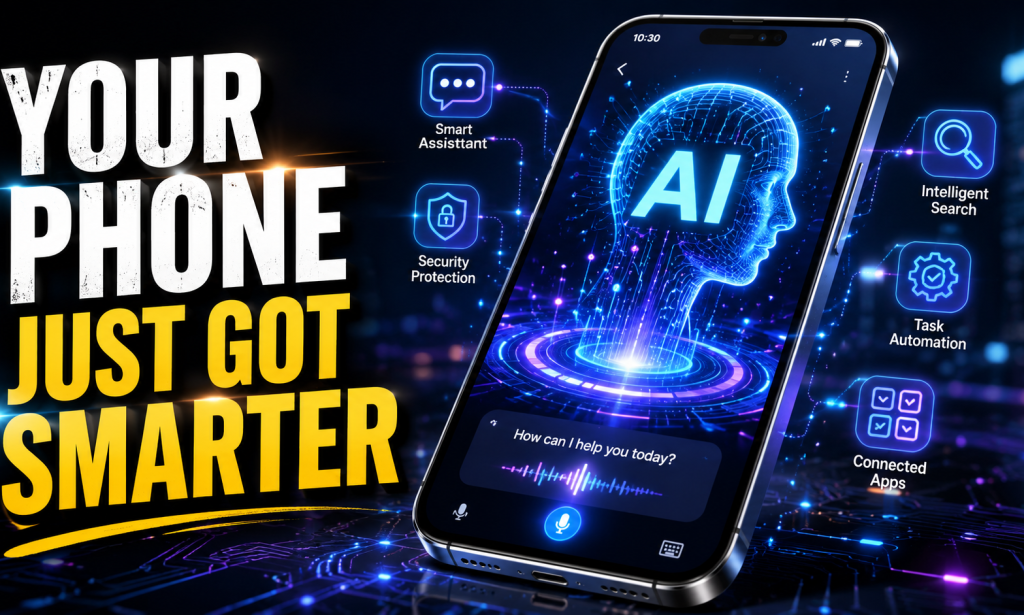
Your Smartphone Is Becoming an AI Assistant: 7 Big Changes You’ll Notice in 2026
For years, smartphones were mainly tools for calling, messaging, taking pictures, watching videos, and browsing the internet. But that is changing quickly. In 2026, the biggest smartphone upgrade may not be a better camera or a faster processor. It may be the way artificial intelligence changes what your phone can actually do for you.
Companies such as Google, Apple, and Samsung are pushing AI deeper into mobile software. Instead of simply waiting for you to open an application and perform every step yourself, newer AI features are being designed to understand what you want, help you find information, summarize content, improve messages, and even assist with certain multi-step tasks.
Here are seven important changes showing where smartphones are heading.
1. Your Phone Can Understand What You Mean
Traditional smartphone assistants usually depend on precise commands. AI assistants are moving toward something much more natural.
Modern AI systems can understand ordinary language and the context behind a request. On Android, Google has continued integrating Gemini more deeply into the mobile experience, allowing users to interact with their phones using natural language and ask questions about what is currently on their screen.
This means you may no longer need to remember exactly which application contains the information you need. Instead, you can describe what you are trying to accomplish and let the AI help you find the answer.
That shift sounds small, but it could completely change how people interact with smartphones.
2. AI Is Starting to Handle Repetitive Tasks
One of the most interesting developments is the move from AI that simply answers questions to AI that can help carry out tasks.
Google demonstrated Gemini features that can handle certain multi-step activities on supported Android devices. For example, eligible users can ask Gemini to help with tasks such as arranging a ride or reordering a meal. The system can work through the process while allowing the user to monitor or stop it. Availability varies by device, application, country, and account.
This is an important step toward what is sometimes called “agentic AI.”
Instead of saying, “Here are the instructions,” an AI system can increasingly move toward, “Tell me what you want done, and I’ll help you complete it.”
Of course, users should still review important actions before anything is finalized.
3. Searching the Web Is Becoming More Intelligent
Another major change is happening inside mobile browsers.
Google announced Gemini features for Chrome on Android that can summarize lengthy webpages, answer questions about content and connect information with other Google applications. It has also introduced agentic browsing capabilities for eligible users in certain markets.
This could be particularly useful when researching something complicated.
Instead of opening ten different pages and trying to compare everything manually, an AI assistant can help organize information and give you a clearer starting point.
However, this does not mean people should blindly trust every AI-generated answer. Important information should still be checked against reliable sources, especially when dealing with money, education, health, security, or major decisions.
4. Smartphones Are Getting Better at Protecting Users
AI is not only about convenience. It is also becoming part of smartphone security.
Google has announced AI-powered scam detection features for supported Android devices. On the Samsung Galaxy S26, for example, Google says on-device intelligence can help detect potential scam calls and alert users.
Google has also announced features designed to detect suspected fake calls and impersonation attempts.
This is especially important because online scams are becoming more sophisticated. A suspicious message or call may look convincing enough to fool someone who is not paying close attention.
AI cannot eliminate every scam, but smarter detection tools could give users another layer of protection.
5. AI Is Changing the Way We Write
You may have already noticed AI writing tools inside smartphones, but their role is becoming more advanced.
Google has demonstrated tools that can transform spoken thoughts into more polished messages. Apple has also continued developing Apple Intelligence and a more capable Siri experience across its devices.
Imagine speaking a rough message into your phone and having it turned into something clearer and easier to understand.
For students, workers, business owners, and creators, this could save time. Instead of struggling to find the perfect wording, people can use AI as a writing assistant and then edit the result themselves.
The best use of this technology is not replacing human thinking. It is helping people communicate their ideas more effectively.
6. Smartphones Are Becoming More Personal
The next generation of AI-powered phones is moving toward more personalized experiences.
Google's 2026 Android announcements include AI features designed to make devices more proactive and helpful, including custom widgets, improved assistance, and tools that respond more intelligently to what users are trying to accomplish.
Apple is taking a similar direction with its next generation of Apple Intelligence and Siri. Apple announced new AI capabilities as part of its 2026 software updates.
The goal is simple: your phone should become more useful without making you work harder to use it.
But personalization also raises an important question: how much information should we allow our devices to understand about us?
That is why privacy settings and permissions will become increasingly important as AI becomes more deeply integrated into everyday technology.
7. The Smartphone May Become Less Dependent on Apps
Perhaps the biggest change is the possibility that the smartphone itself becomes the main interface, while individual apps become less visible.
Today, you might open a ride-sharing app, search for a restaurant, switch to a messaging app, open a browser, and then return to your original task.
An AI assistant could eventually connect these experiences through one conversational interface.
Google's current AI developments already point in this direction, with Gemini being integrated across Android, Chrome, and other parts of the company's ecosystem.
That does not mean traditional apps are disappearing tomorrow. Instead, the way we use them could gradually change.
What This Means for Ordinary Smartphone Users
The AI smartphone revolution is not really about having a phone that can write impressive paragraphs or generate pictures. The bigger story is convenience.
Your phone is gradually becoming something that can understand requests, summarize information, help with repetitive tasks, improve communication, detect certain threats, and adapt more closely to the way you work.
But users should remember that AI is still a tool, not an unquestionable authority. Features can make mistakes, availability differs by country and device, and important information should always be verified.
The smartphone of the future may therefore look surprisingly similar to the phone in your hand today. The biggest difference may be what happens behind the screen.
Instead of simply waiting for you to tell it exactly what to do, your phone is increasingly being designed to understand what you need and help you get there.
And judging by the direction of AI development in 2026, this transformation is only getting started.
Sources
Google, “A smarter, more proactive Android with Gemini Intelligence,” May 12, 2026.
Google, “Gemini in Chrome with auto browse comes to Android,” May 12, 2026.
Google, “A more intelligent Android on Samsung Galaxy S26,” February 25, 2026.
Apple, “WWDC26: Apple unveils next generation of Apple Intelligence, Siri AI, and powerful parental controls,” June 8, 2026.

You must be logged in to post a comment.