
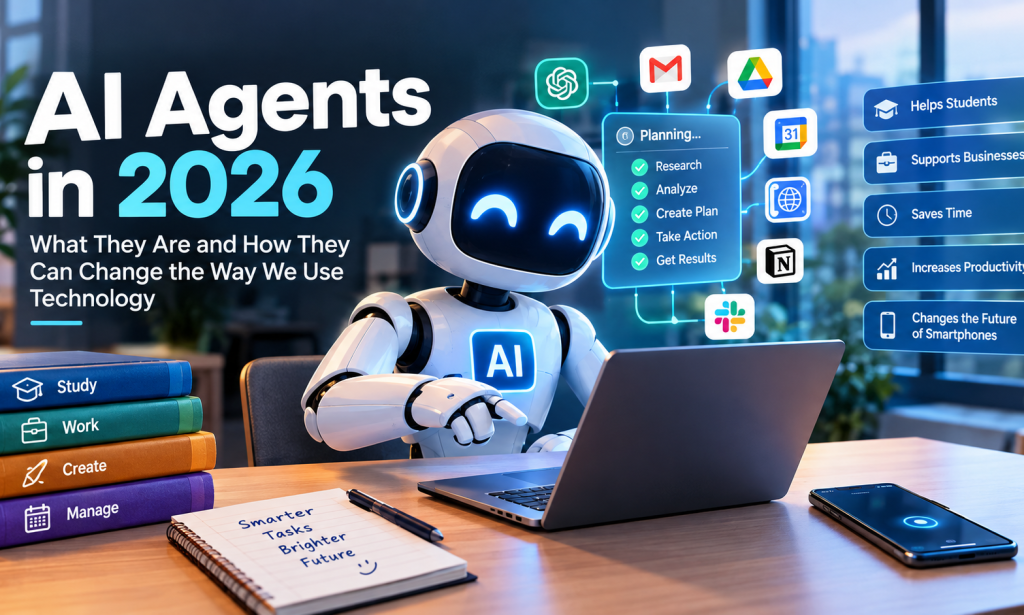
AI Agents in 2026: What They Are and How They Can Change the Way We Use Technology
Artificial intelligence has changed a lot in just a few years. We started with simple chatbots that could answer questions and write text. Then came AI image generators, voice assistants, coding tools, and AI-powered search.
Now, another idea is getting more attention: AI agents.
AI agents are designed to do more than simply give you an answer. They can understand a goal, decide what steps are needed, use digital tools, and complete a task with less human involvement.
For example, instead of asking an AI, “How can I plan a trip?”, an AI agent could potentially help organize the whole process by researching destinations, comparing options, creating an itinerary, and preparing the information in one place.
That difference may sound small, but it can change how people use computers and smartphones.
What Exactly Is an AI Agent?
An AI agent is a software system that can take a goal from a user and work through multiple steps to achieve it.
A traditional chatbot usually follows a simple pattern:
User asks → AI responds
An AI agent can work more like this:
User gives a goal → AI plans → AI uses tools → AI checks the results → AI completes the task
The important part is that an agent can take actions instead of only generating text.
Depending on the system, an AI agent may be able to interact with websites, applications, documents, databases, calendars, coding environments, or other digital tools.
Of course, the exact capabilities depend on the AI system and the permissions given to it.
How Does an AI Agent Work?
The basic process can be easier to understand with an example.
Imagine a student wants to prepare for an upcoming exam.
Instead of asking an AI one question at a time, the student could give an agent a larger goal:
“Help me prepare a study plan for my exam next month.”
The agent could break that goal into smaller tasks:
1. Understand the exam date.
2. Identify the subjects.
3. Organize the available study material.
4. Divide the syllabus into smaller sections.
5. Create a daily schedule.
6. Adjust the plan if some topics take longer than expected.
This is where AI agents become different from ordinary question-and-answer systems.
They are designed to handle a sequence of actions rather than stopping after one response.
AI Chatbots vs AI Agents
The two terms are often confused, but there is a useful distinction.
A normal AI chatbot is mainly focused on conversation. You ask something, and it generates a response.
An AI agent can potentially go further. It may decide what action should happen next and use available tools to perform that action.
For example:
Chatbot:
“Here are five laptop options you could consider.”
AI Agent:
“Here are five suitable options. I compared their specifications, prices and availability and organized the results for you.”
The second system is doing more work on the user's behalf.
That does not mean every AI agent can freely control your device or access every website. Permissions, security restrictions and the design of the specific system still matter.
Why Are AI Agents Becoming Popular in 2026?
One major reason is that AI models have become much better at understanding instructions and working with different types of information.
Modern AI systems can process text, images, audio, documents and code. When these abilities are combined with access to digital tools, AI can potentially handle much more complicated workflows.
Another reason is convenience.
People don't always want another answer. Sometimes they want the task finished.
For example, a business owner may not want an explanation of how to organize customer information. They may want the information organized.
A student may not want a 2,000-word explanation of how to make a study plan. They may simply want a practical plan.
That shift—from answering questions to completing tasks—is one of the main ideas behind AI agents.
How AI Agents Could Help Students
Students are among the groups that could benefit from AI agents.
An AI agent could potentially help with tasks such as:
- Organizing study schedules
- Summarizing personal notes
- Creating revision plans
- Finding information from approved sources
- Organizing assignments
- Helping with coding projects
- Creating practice questions
- Managing reminders and deadlines
However, there is an important difference between using AI as a study assistant and using it to do academic work dishonestly.
If a student uses AI to understand a difficult concept, create practice questions, or organize their notes, it can support learning.
If the student simply submits AI-generated work without understanding it, the technology becomes a shortcut rather than a learning tool.
In other words, the smartest use of AI may still require a human brain in the loop.
AI Agents and Jobs
The effect of AI agents on jobs is one of the biggest questions surrounding the technology.
Some repetitive digital tasks may become easier to automate.
For example, certain tasks involving data entry, basic research, scheduling, customer support, document processing, and routine content work could potentially be handled partly by AI systems.
But automation does not automatically mean that every job disappears.
In many cases, the work itself may change.
A person who previously spent hours collecting information might spend more time checking AI-generated results and making decisions.
This could create a new skill requirement: knowing how to work effectively with AI.
People may increasingly need to understand how to give clear instructions, verify information, identify mistakes, and decide when an AI system should or should not be trusted.
Can AI Agents Make Mistakes?
Absolutely.
This is one part that often gets ignored when people talk about AI.
An AI agent can misunderstand an instruction, use incorrect information, make a bad decision, or perform an action that the user did not actually intend.
The more freedom an AI system has to take actions, the more important safety controls become.
Imagine giving an AI access to your email, calendar, files and online accounts. A mistake would be much more serious than a wrong answer in a normal chat.
That is why permissions and human approval matter.
For important actions, users should have the ability to review what the AI is about to do before allowing it to proceed.
Privacy Is Another Big Issue
AI agents may need access to personal information to perform useful tasks.
That could include documents, emails, calendars, contacts or other data.
This creates an obvious privacy question:
How much access should an AI agent have?
The answer depends on the task.
Giving an AI access to information it doesn't need creates unnecessary risk. Users should understand what permissions an application requires and what it does with their information.
AI may become more useful as it gets access to more data, but convenience should not mean giving every application unlimited access to your digital life.
Will AI Agents Replace Smartphones?
Probably not in the simple way some headlines suggest.
However, AI could change how people interact with smartphones.
Today, users often open an application first and then perform a task.
In the future, people may increasingly describe what they want and let an AI system coordinate several applications to complete the task.
Instead of thinking:
“Which app should I open?”
The user may think:
“What do I want to get done?”
That is a much bigger change in user experience.
The apps may still exist in the background, but the AI could become the layer through which people interact with them.
AI Agents for Businesses
Businesses are also interested in AI agents because many business processes involve repetitive digital tasks.
An agent could potentially help with customer queries, internal documents, research, scheduling, data analysis, software development and other workflows.
A small business that cannot afford a large team for every administrative task may find AI tools useful for handling some routine work.
But businesses also have to consider accuracy, privacy, security and accountability.
If an AI system makes a mistake in a business process, someone still needs to be responsible for checking and correcting it.
The Future of AI Agents
The future of AI agents will probably depend on how reliable, secure and easy to control they become.
The technology itself is developing quickly, but real-world adoption depends on trust.
People may be comfortable asking an AI to write an email.
They may be much less comfortable giving the same AI permission to send that email without checking it.
That difference matters.
For AI agents to become part of everyday life, users will likely want clear permissions, transparent actions, easy ways to stop a task, and reliable ways to review what the system has done.
Final Thoughts
AI agents represent a shift in the way we think about artificial intelligence.
Traditional AI often gives us information.
AI agents aim to help us act on that information.
That could make many digital tasks faster and easier. Students could use them for organization and learning, businesses could use them for repetitive workflows, and everyday users could eventually use them to handle complicated digital tasks.
But AI agents are not magic.
They can make mistakes, misunderstand instructions and create privacy or security risks when given too much access.
The most useful approach is probably a balanced one: let AI handle repetitive work, but keep humans responsible for important decisions.
The technology is still evolving, and 2026 may be remembered as a period when AI started moving from simply answering our questions to helping us complete the work itself.


You must be logged in to post a comment.