

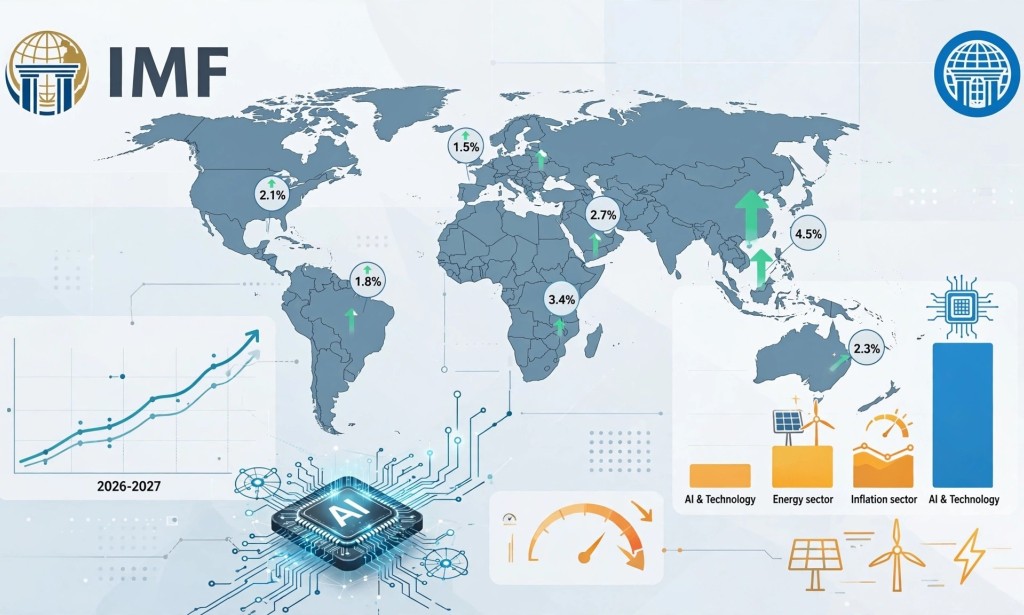
The International Monetary Fund (IMF) has released its October 2026 World Economic Outlook titled "Resilience Under Strain, Urgent Choices," providing the most authoritative global growth projections for today.
Global growth is projected to slow to 3.1 percent in 2026 and rebound to 3.4 percent in 2027. Global headline inflation is projected to rise notably to 4.7 percent in 2026 before easing to 4.1 percent in 2027.
Key Projections from IMF October 2026 WEO:
1. Global Overview
- 2025: 3.5%
- 2026: 3.1% (up 0.1pp from July update, unchanged from April)
- 2027: 3.4% (up 0.2pp from April)
The slight upgrade from July is driven almost entirely by investment in AI infrastructure, which is offsetting the drag from Middle East energy shocks.
2. Advanced vs Emerging Economies
According to the IMF, advanced economies were upgraded to 2.1% in 2026 on the AI-driven technology cycle, while emerging and developing economies were cut to 3.7%, dragged by higher energy bills.
- United States: 2.3% in both 2026 and 2027, resilient despite tariffs
- Euro Area: 1.1% in 2026 and 1.2% in 2027
- Japan: 0.7% in 2026 and 2027
- China: 4.5% in 2026 and 4.0% in 2027
- India: 7.0% in both 2026 and 2027 (fastest major economy, up 0.6pp revision)
3. World Bank Comparison
The World Bank's latest Global Economic Prospects sees slower growth of 2.6% in 2026 and 2.7% in 2027, noting this would still make the 2020s the weakest decade for growth since the 1960s. It estimates US growth at 2.2% in 2026.
4. Risks: Why Resilience Is Fragile
The IMF warns that buffers that helped absorb shocks are shrinking:
- Energy shock: Baseline assumes oil at $96/bbl in 2026 and $87/bbl in 2027, with Strait of Hormuz reopening March 2027. Worst case of $130 oil could cut growth by 0.2pp in 2026 and 0.5pp in 2027, pushing 2027 inflation to 5.2%
- Fiscal vulnerability: Public debt remains elevated, borrowing costs high
- AI risks: Two-sided — over-optimistic expectations could cause market corrections, while productivity gains could boost growth
- Geopolitics: Further escalation in conflicts, renewed trade tensions
Countries benefiting from AI supply chains (Mexico, Malaysia, Thailand) are doing relatively well, while energy-importing economies outside the tech value chain face the most difficult outlook.
Policy Takeaway: The IMF says fiscal frameworks must rebuild buffers through revenue measures, preserve price signals during cost-of-living crises with temporary targeted support, and monetary policy must stay focused on persistent inflation.
Bottom Line: Growth is holding at 3.1%, but the divide is growing. AI is currently saving global growth, but the margins of adjustment are rapidly narrowing.


You must be logged in to post a comment.