

Investigating Morita Forestry: A Due Diligence Review of a Fast-Growing Investment Platform
Over the past few months, Morita Forestry has attracted growing attention across South Africa and several other countries. The company promotes investment opportunities through social media, WhatsApp groups, and referral networks, claiming that investors can earn returns through forestry projects, timber operations, land appreciation, and carbon credits.
As an OSINT (Open-Source Intelligence) investigator, I decided to conduct an independent due diligence review using only publicly available information. The purpose of this investigation was not to prove or disprove allegations, but rather to determine what information could be verified and what questions remained unanswered.
Why This Investigation Started
The investigation began after I was approached with information about an investment opportunity associated with Morita Forestry. Like any responsible investigator, I approached the matter from a neutral position.
The goal was simple:
- Does the company exist?
- Who is behind it?
- Are its claims verifiable?
- Are there any risk indicators investors should be aware of?
Company Registration Findings
The first step was to verify whether Morita Forestry existed as a registered business.
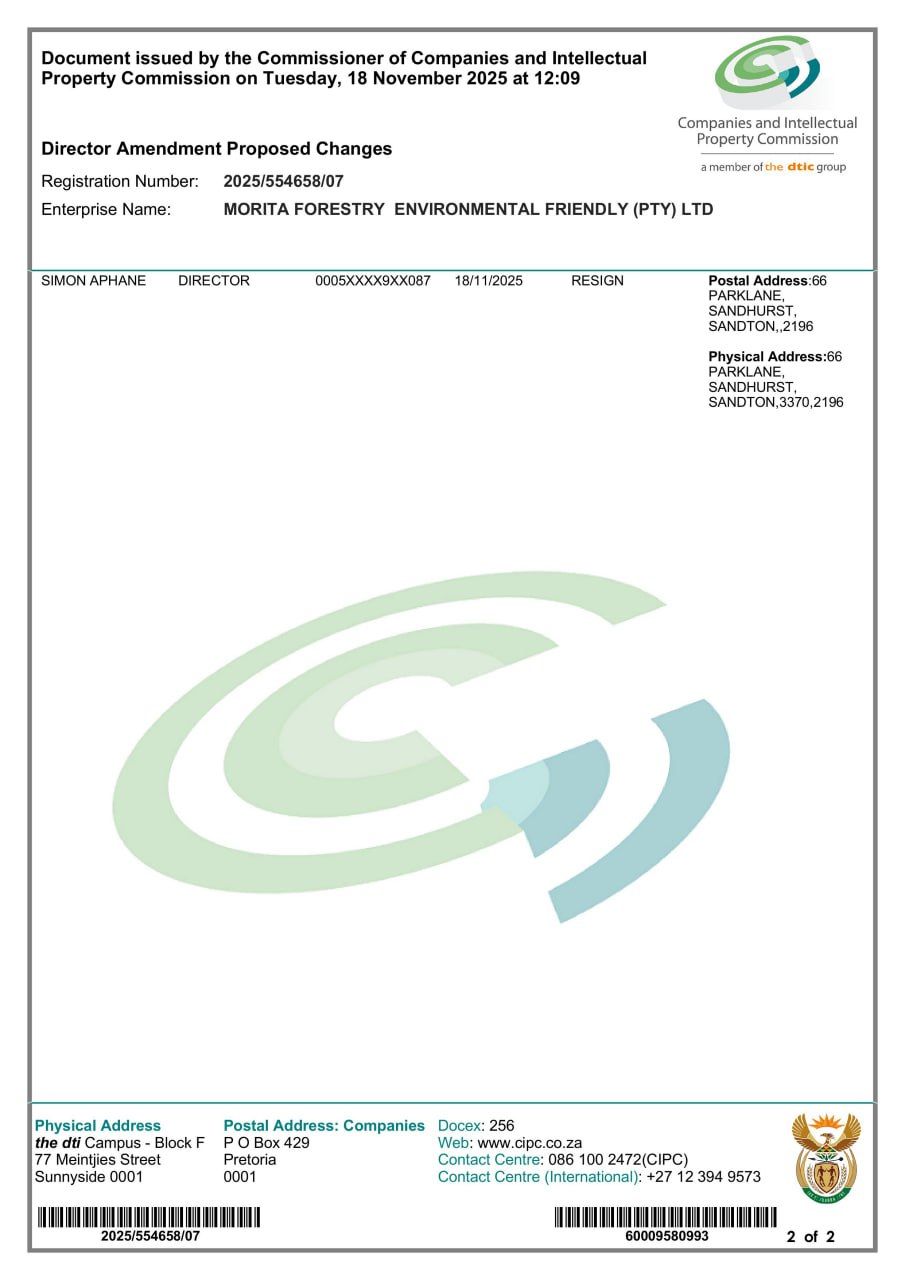
Research identified a South African company called Morita Forestry Environmental Friendly, incorporated during July 2025. Public records showed that the company was legally registered and initially listed Simon Aphane as a director.
Later in the investigation, I located documentation showing a director amendment. According to the available records, Simon Aphane resigned on 18 November 2025 and was replaced by Puleng Violet Phakisi. The company address also appeared to change to 66 Park Lane, Sandhurst, Johannesburg.
The existence of a registered company is a positive indicator because many fraudulent operations do not bother establishing legal entities. However, company registration alone does not prove legitimacy. It simply confirms that a legal entity exists.
The Discovery That Changed the Investigation
One of the most significant findings came when I located a company called Morita Forestry registered in Colorado, United States.
Public records show that this company was incorporated in August 2019 and uses an address at 1200 17th Street, Denver, Colorado.
This discovery immediately stood out because Morita Forestry's marketing materials repeatedly reference the same Denver address and claim the organization was founded in 2019.
For the first time, there appeared to be a possible explanation for both claims.
However, an important limitation remains.
Although the addresses and dates match, I could not independently verify whether the South African operation is owned by, controlled by, or officially affiliated with the Colorado company. At this stage, the relationship remains unconfirmed.
Digital Footprint Analysis
The company maintains a presence across multiple social media platforms, including Instagram, Facebook, TikTok, WhatsApp, and Telegram.
One of the first observations was that the public digital footprint appears relatively recent compared to some of the historical claims being made.
While social media activity exists and appears active, I found limited independent evidence supporting claims of large-scale international forestry operations.
The company's websites also raised questions.
Several domains were identified, including:
- moritaforestry.com
- moritaforestry.vip
- moritaforestry.info
Some of these domains were registered during 2025 despite references to a company history dating back to 2019.
Domain ownership information was hidden, making independent verification more difficult.
Understanding the Investment Model
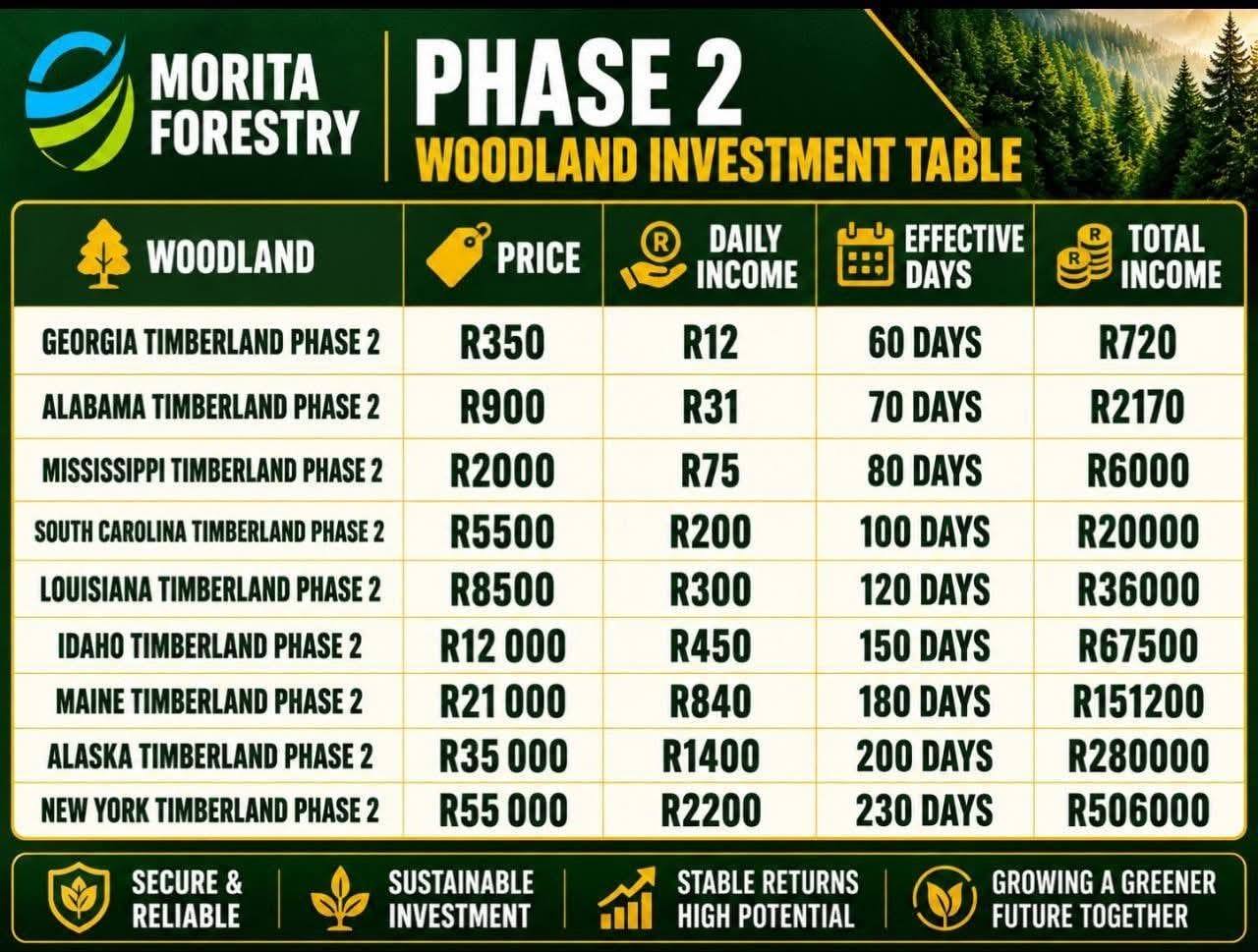
Morita Forestry promotes a woodland investment model where users purchase packages linked to forestry projects.
According to company materials, revenue is generated through:
- Timber premiums
- Land appreciation
- Carbon credits
The company states that investor capital helps expand forestry operations, with profits later distributed to investors.
Various investment packages advertise fixed daily returns over predetermined periods.
At face value, the model appears straightforward. However, the challenge for any investigator is verifying the underlying revenue-generating activities.
What Could Not Be Verified
This became the most important section of the investigation.
I attempted to locate evidence supporting:
- Active forestry projects
- Timber production operations
- Carbon credit programs
- Independent audits
- Forestry permits
- Environmental certifications
- Public project documentation
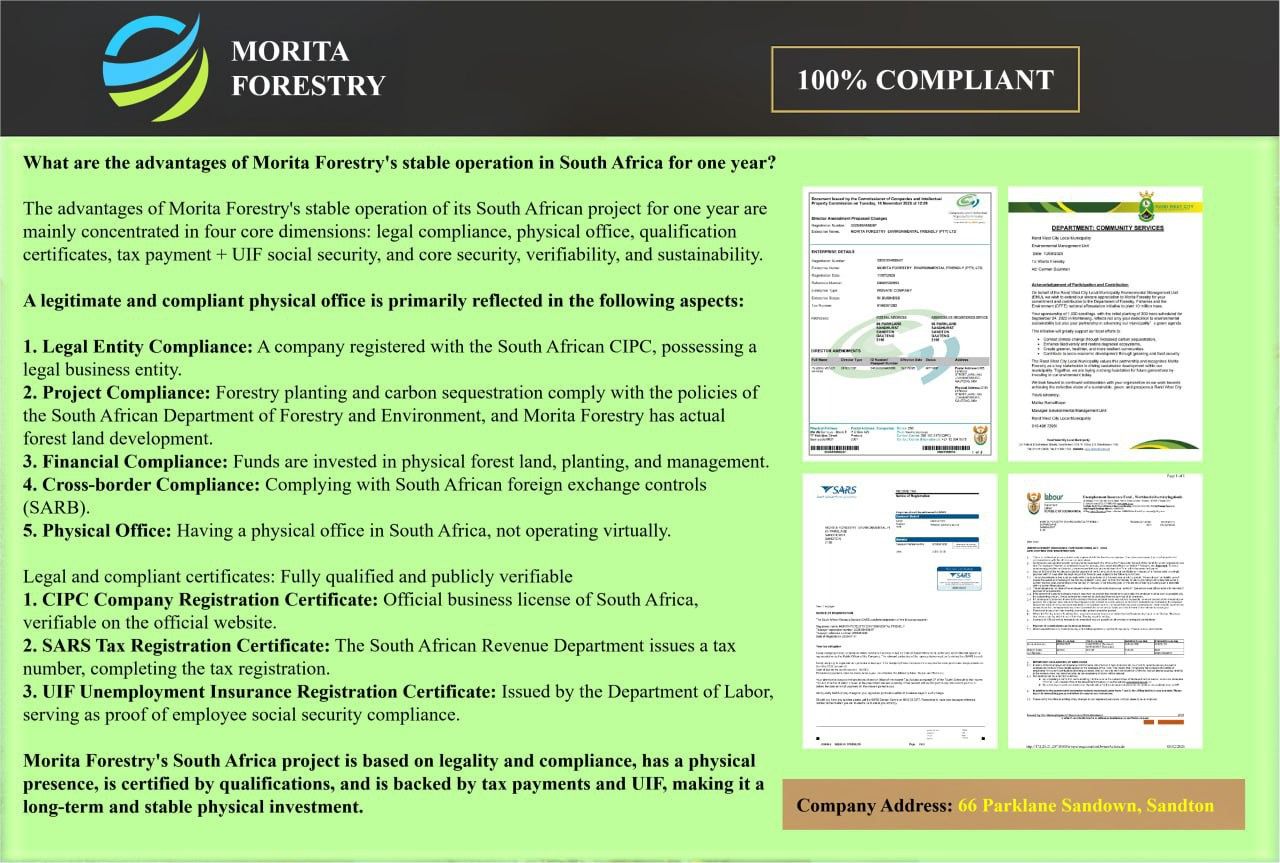
Despite extensive searches, I was unable to independently verify these activities through publicly available sources.
This does not prove such operations do not exist.
However, it does mean that the core activities used to justify investor returns could not be independently confirmed during this investigation.
Regulatory Questions
Given that the company promotes investment opportunities, regulatory status became an important area of inquiry.
Searches were conducted using company names and director names against publicly available regulatory resources.
At the time of the investigation, no Financial Services Provider (FSP) registration could be identified using the names reviewed.
This finding should be interpreted carefully.
The absence of a publicly identifiable FSP registration does not automatically indicate unlawful conduct. However, it does raise questions that prospective investors may wish to clarify directly with the company.
Referral Structure
The investigation also identified a referral-based component.
Users appear to require invitation codes to register, and promotional materials reference referral commissions across multiple levels.
Referral structures are not inherently problematic and are used by many legitimate businesses.
However, where investment opportunities are involved, referral incentives become an important factor to consider during due diligence.
Overall Assessment
After reviewing company records, websites, domains, directors, social media activity, and available marketing materials, several conclusions can be drawn.
On the positive side:
- A registered South African company exists.
- Publicly identifiable directors exist.
- A Colorado company with the same name exists.
- Social media activity and business infrastructure are present.
On the other hand:
- The relationship between the South African and U.S. entities remains unverified.
- Core revenue-generating activities could not be independently verified.
- Regulatory status remains unclear.
- Domain history and company timelines raise questions requiring further clarification.
- Significant reliance on referral-driven growth appears present.
Final Conclusion
Based solely on publicly available information, I found insufficient evidence to conclude that Morita Forestry is fraudulent.
However, I also found insufficient evidence to independently verify the company's primary claims regarding forestry operations, carbon credit activities, and the source of investor returns.
For that reason, I believe prospective investors should conduct additional due diligence and obtain further clarification before committing funds.
The most important finding of this investigation is not that the company is legitimate or illegitimate. Rather, it is that key claims remain unverified, and those unanswered questions should be addressed before any investment decision is made.

You must be logged in to post a comment.