
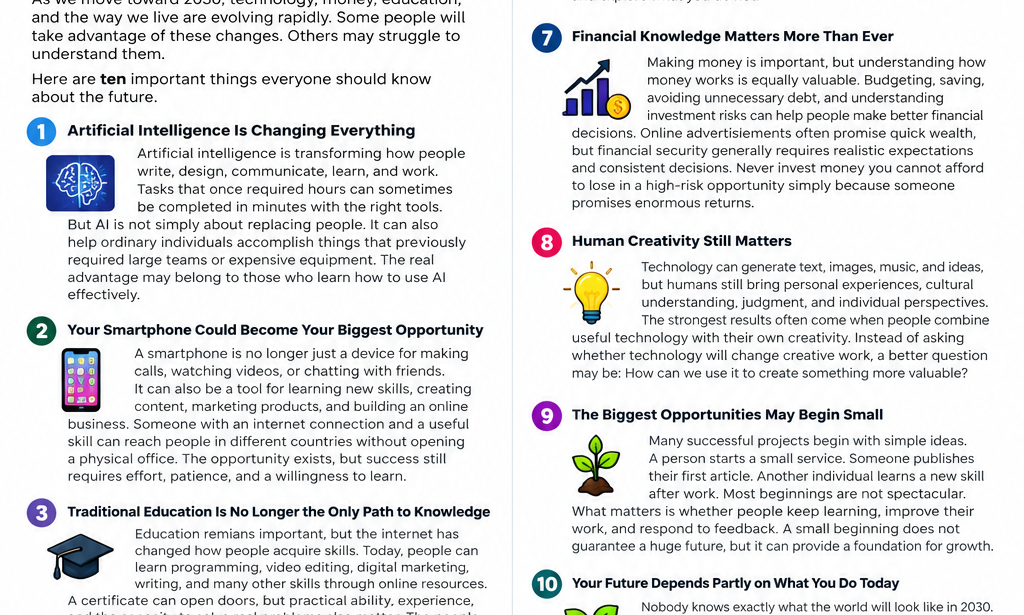
The World Is Changing Faster Than You Think — 10 Things Everyone Needs to Know Before 2030
The future is coming faster than most people realize. Are you preparing for it, or will you be left wondering what happened?
Imagine waking up one morning and discovering that the job you spent years learning how to do can now be performed partly by artificial intelligence. Imagine a teenager building a business from a smartphone while someone with decades of experience struggles to keep up with new technology.
This isn't a science-fiction movie. It is a world that is already changing.
As we move toward 2030, technology, money, education, and the way we live are evolving rapidly. Some people will take advantage of these changes, while others may struggle to understand them.
Here are ten important things everyone should know about the future.
1. Artificial Intelligence Is Changing Everything
Artificial intelligence is transforming how people write, design, communicate, learn, and work.
Tasks that once required hours can sometimes be completed in minutes with the right tools.
But AI is not simply about replacing people. It can also help ordinary individuals accomplish things that previously required large teams, specialised knowledge, or expensive equipment.
The real advantage may belong to those who learn how to use AI effectively while developing their own judgment, creativity, and problem-solving abilities.
2. Your Smartphone Could Become Your Biggest Opportunity
A smartphone is no longer just a device for making calls, watching videos, or chatting with friends.
It can also be a tool for learning new skills, creating content, marketing products, offering services, and building an online business.
Someone with an internet connection and a useful skill can reach people in different countries without opening a physical office.
The opportunity exists, but success still requires effort, patience, and a willingness to learn. Owning a smartphone alone does not guarantee income.
3. Traditional Education Is No Longer the Only Path to Knowledge
Formal education remains important, but the internet has changed how people acquire knowledge and practical skills.
Today, people can learn programming, video editing, digital marketing, writing, graphic design, and many other skills through online courses, tutorials, and educational resources.
A certificate can open doors, but practical ability, experience, and the capacity to solve real problems also matter.
The people who continue learning may be better prepared for a changing economy. Rather than treating education as something that ends with graduation, we should see learning as a lifelong process.
4. The Internet Has Created New Ways to Earn Money
People now earn money through freelancing, online businesses, content creation, remote work, digital products, and other internet-based services.
For example, a person who knows how to write can offer writing services. Someone who understands video editing can work with content creators. Another person can create an ebook or a practical guide and sell it online.
However, the internet is also filled with scams and unrealistic promises.
There is no guaranteed method to become rich overnight. Real online income usually comes from providing something valuable, finding people who need it, and building trust over time.
Before joining an earning platform or online business, research it carefully. Be suspicious of schemes that demand payment to unlock promised earnings or guarantee unusually high returns.
5. Attention Has Become One of the Most Valuable Resources
Every day, millions of people scroll through social media looking for something interesting.
Some stop for funny videos. Others stop for shocking discoveries, inspiring stories, useful advice, educational content, or emotional moments.
For creators and businesses, understanding what captures attention can make a significant difference. A strong headline, an interesting image, and a useful message can help content reach more people.
But attracting attention is only the beginning. Keeping an audience requires delivering something worth their time.
In a world full of information, trust and genuine value can be more important than simply going viral.
6. The Future Will Reward People Who Adapt
Change can be uncomfortable.
People naturally become attached to familiar routines, even when the world around them is evolving. Learning a new tool or changing an old habit may feel difficult at first.
But refusing to learn new skills can make it harder to take advantage of emerging opportunities.
Adapting does not mean abandoning everything you know. It means being willing to improve what you know and explore what you do not.
You may not need to change your entire career. Sometimes, learning one new skill or finding a better way to perform an existing task can make a meaningful difference.
7. Financial Knowledge Matters More Than Ever
Making money is important, but understanding how money works is equally valuable.
Budgeting, saving, avoiding unnecessary debt, and understanding investment risks can help people make better financial decisions.
Online advertisements often promise quick wealth, but financial security generally requires realistic expectations, careful planning, and consistent decisions.
It is also important to understand the difference between investing and gambling on risky opportunities. Never invest money you cannot afford to lose in a high-risk opportunity simply because someone promises enormous returns.
Financial knowledge cannot eliminate every problem, but it can help you recognise risks, avoid costly mistakes, and make better use of the money you earn.
8. Human Creativity Still Matters
Technology can generate text, images, music, and ideas, but humans bring personal experiences, cultural understanding, judgment, emotions, and individual perspectives.
The strongest results often come when people combine useful technology with their own creativity.
A writer can use AI to brainstorm ideas and then add original insights. A designer can use digital tools to explore concepts while making thoughtful creative decisions. A business owner can automate repetitive tasks while focusing on customers and strategy.
Instead of asking whether technology will change creative work, a better question may be: How can we use it to create something more valuable?
9. The Biggest Opportunities May Begin Small
Many successful projects begin with simple ideas.
A person starts a small service. Someone publishes their first article. Another individual learns a new skill after work and gradually builds a portfolio.
Most beginnings are not spectacular. They may involve limited resources, mistakes, and slow progress.
What matters is whether people keep learning, improve their work, and respond to feedback.
A small beginning does not guarantee a huge future, but it can provide a foundation for growth. You do not always need to wait until you have a lot of money before taking the first practical step.
10. Your Future Depends Partly on What You Do Today
Nobody knows exactly what the world will look like in 2030.
Some predictions will be correct. Others will be completely wrong. New technologies may create opportunities that we cannot yet imagine, while some expected changes may happen more slowly than anticipated.
But there are steps almost anyone can take to prepare:
- Learn continuously and develop useful skills.
- Understand how to use new technologies responsibly.
- Protect your personal information and online accounts.
- Manage money carefully and avoid unnecessary debt.
- Research opportunities before committing your money or time.
- Build relationships and learn to communicate effectively.
- Remain open to new ideas and be willing to improve.
You do not need to predict every future trend. You need to be willing to respond when the world changes.
Final Thoughts: The Future Is Not Just Something You Wait For
The world will continue to change, whether we are ready or not.
New technologies will appear. Businesses will evolve. New opportunities will emerge, and some familiar ways of doing things will disappear or become less common.
You cannot control every change, and you cannot guarantee success.
But you can control how you learn, how you prepare, and how you respond to new challenges.
Perhaps the most important question is not whether the world will change before 2030.
It is this: When the world changes, will you be ready to change with it?
Share Your Thoughts
What do you think will change the world the most before 2030: artificial intelligence, money, education, or social media?
Share your opinion in the comments and send this article to someone who needs to start thinking about the future today.


You must be logged in to post a comment.