

LISTEN
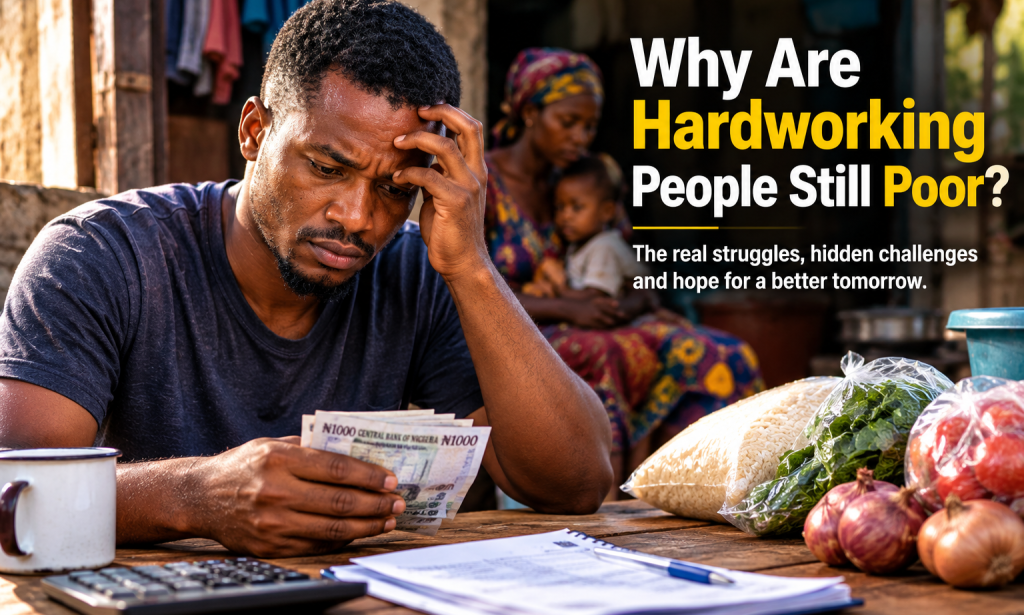
Every morning, millions of people wake up early, work long hours, and return home exhausted. Some sell in markets, drive buses, work on farms, clean offices, or sit in shops for the entire day.
Yet, when the day ends, many still struggle to afford food, pay rent, support their children, or save a little money.
If hard work is the road to success, why are so many hardworking people still poor?
The painful truth is that effort matters, but effort alone does not guarantee financial security.
1. When Your Income Cannot Meet Your Needs
Imagine working all month and receiving your salary, only to discover that rent, food, transport, electricity, and family responsibilities have already consumed most of it.
You are working. You are trying. But your income cannot keep up with your expenses.
This is a serious challenge for many households in Nigeria. The World Bank's October 2026 development update highlights that, although economic conditions have improved in some areas, poverty remains high and many household incomes have not recovered sufficiently.
Economic growth means little to a family if it cannot feel the improvement in its daily life.
2. Hard Work Does Not Always Pay Fairly
A person can work ten hours a day and still earn too little to meet basic needs.
Some people have limited access to better-paying jobs, reliable electricity, affordable transport, quality education, or the money needed to start a small business.
Others work in informal jobs where income changes from one day to another.
The problem is not always a lack of effort. Sometimes, the opportunities available simply do not reward that effort fairly.
3. Poverty Can Become a Difficult Cycle
When a family has little money, unexpected expenses can cause serious problems.
A medical bill, a damaged phone needed for work, a rent increase, or a period without customers can wipe out the little money saved.
Without savings, borrowing may become necessary. Repaying that debt then makes it harder to save for the future.
Over time, people can find themselves working continuously just to remain where they are.
4. The Emotional Pain People Rarely Talk About
Poverty is not only about money. It can also affect a person's confidence, relationships, and peace of mind.
A parent may smile in public while worrying about what the children will eat. A young person may feel ashamed of asking relatives for help. Someone who has worked for years may wonder why life has not improved.
These struggles deserve understanding, not insults.
Never assume that a person is lazy simply because they are poor. You may not know how much they are carrying.
5. What Can Help People Move Forward?
There is no single solution that works for everyone, but practical steps can help where opportunities exist.
- Build a useful skill: Writing, repairs, digital services, tailoring, or other marketable skills may open additional income opportunities.
- Protect what you earn: Track expenses and save small amounts when possible. Some people cannot save regularly, and that does not mean they have failed.
- Be careful with promises of quick money: Avoid schemes that demand upfront payments or guarantee unrealistic returns.
- Look for better opportunities: Explore legitimate work, training, business networks, and ways to improve existing skills.
- Support one another: Sharing reliable job leads, teaching a skill, or helping a struggling neighbour can make a meaningful difference.
Individual action can help, but lasting progress also requires more productive jobs, fair opportunities, effective public services, and policies that improve people's living standards.
6. A Final Message to Anyone Who Is Struggling
If you are working hard but have little to show for it, do not measure your worth only by the money in your account.
Your struggle does not make you useless. Your current situation does not tell the whole story of your life.
At the same time, people should not have to work endlessly and remain unable to afford their basic needs. A society becomes stronger when honest work offers people a realistic chance to live with dignity.
Sometimes, the person who needs encouragement most is the one who keeps saying, "I am fine," because they do not want anyone to know how difficult life has become.
Let us stop judging people by their possessions and start understanding the stories behind their struggles.
A Question for Every Reader
Do you believe that hard work is enough to escape poverty today, or must opportunities and the economic system change as well?
Share your thoughts. Your experience may help someone else feel less alone.


You must be logged in to post a comment.