
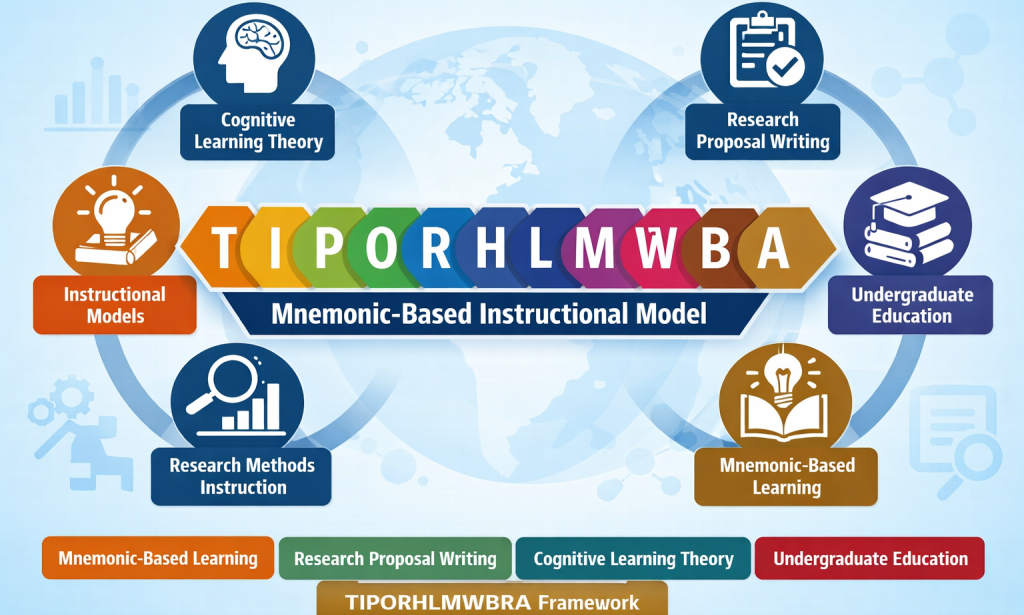
A Mnemonic-Based Instructional Model for Enhancing Undergraduate Understanding of Research Proposal Structure
Nephiny.M. Nyagaka, Meru university of Science and Technology
School of Agriculture and Food Sciences,Department of Agriculture
Abstract
This paper presents a mnemonic-based instructional model designed to assist undergraduate students in memorizing and organizing research proposal components. The TIPORHLMWBRA framework is discussed as a pedagogical tool grounded in cognitive learning theory. The model’s relevance for research methods instruction is explored, with implications for teaching practice.
Key words: Mnemonic-based learning; Research proposal writing; Research methods instruction; Cognitive learning theory; Undergraduate education; Instructional models; TIPORHLMWBRA framework
1. Introduction
Research proposal writing is a critical academic skill that underpins effective inquiry and scholarly work. However, many undergraduate students experience challenges in structuring proposals, articulating research problems, and applying appropriate methodologies. These challenges highlight the need for instructional innovations that enhance clarity, engagement, and competence in research proposal development.
2. Literature Review
The literature on teaching research methods emphasizes the need for instructional strategies that enhance comprehension and practical skill development. Studies on cognitive learning highlight the effectiveness of mnemonics in improving information retention and recall. In higher education, memory aids have been widely used to support learning in complex and content-heavy subjects, demonstrating positive effects on student engagement and academic performance.
3. Development of the Mnemonic Framework
The mnemonic framework was developed to simplify and structure the research proposal process for improved understanding and recall. The selection of components was guided by their relevance, completeness, and alignment with standard research proposal requirements. The elements were logically sequenced to reflect the natural progression of a research proposal, ensuring coherence and ease of use. TIPORHLMWBRA encapsulates these essential components in a concise and memorable format to support effective learning and application.
4. Pedagogical Application
How lecturers can use the framework
Classroom and revision integration
Benefits for learners
5. Discussion
The findings of this study underscore the strengths of mnemonic-based learning as an effective instructional approach. Mnemonic strategies enhance information retention, promote quicker recall, and support deeper understanding by organizing complex concepts into manageable and memorable structures. This approach is particularly valuable in research methods education, where learners are often required to master abstract concepts, procedural steps, and technical terminology.
A key advantage of mnemonic-based learning is its flexibility across disciplines. The strategy can be readily adapted to diverse fields of study, including education, agriculture, health sciences, and social sciences, without compromising content depth or academic rigor. Its adaptability allows instructors to contextualize learning materials according to disciplinary needs, learner backgrounds, and instructional goals, thereby improving accessibility and learner engagement.
Despite these strengths, several limitations and considerations must be acknowledged. Mnemonic-based learning may oversimplify complex concepts if not carefully designed and supplemented with critical analysis and practical application. Additionally, its effectiveness may vary depending on learners’ cognitive preferences, prior knowledge, and learning environments. Therefore, educators are encouraged to integrate mnemonic strategies alongside complementary pedagogical approaches to ensure balanced, comprehensive learning outcomes.
6. Conclusion
This study makes a meaningful contribution to research methods pedagogy by highlighting key insights and approaches that enhance the teaching and learning of research skills. The findings demonstrate the relevance of structured, context-responsive methodologies in improving learners’ conceptual understanding, practical competence, and overall engagement with research processes.
Based on the outcomes of the study, it is recommended that the proposed approaches be adopted within similar academic and training contexts to strengthen research capacity and methodological rigor. Further research is encouraged to test the applicability of these methods across diverse disciplines, institutions, and learner populations, as well as to examine their long-term impact on research competence and academic performance.
References
Creswell, J. W., & Creswell, J. D. (2018). Research design: Qualitative, quantitative, and mixed methods approaches (5th ed.). SAGE Publications.
Kothari, C. R. (2004). Research methodology: Methods and techniques (2nd ed.). New Age International.
Mayer, R. E. (2009). Multimedia learning (2nd ed.). Cambridge University Press.
McCabe, J. A. (2015). Demonstrating the mnemonic benefit of the method of loci. Teaching of Psychology, 42(2), 169–173. https://doi.org/10.1177/0098628315569937
Sweller, J., Ayres, P., & Kalyuga, S. (2011). Cognitive load theory. Springer.


You must be logged in to post a comment.