
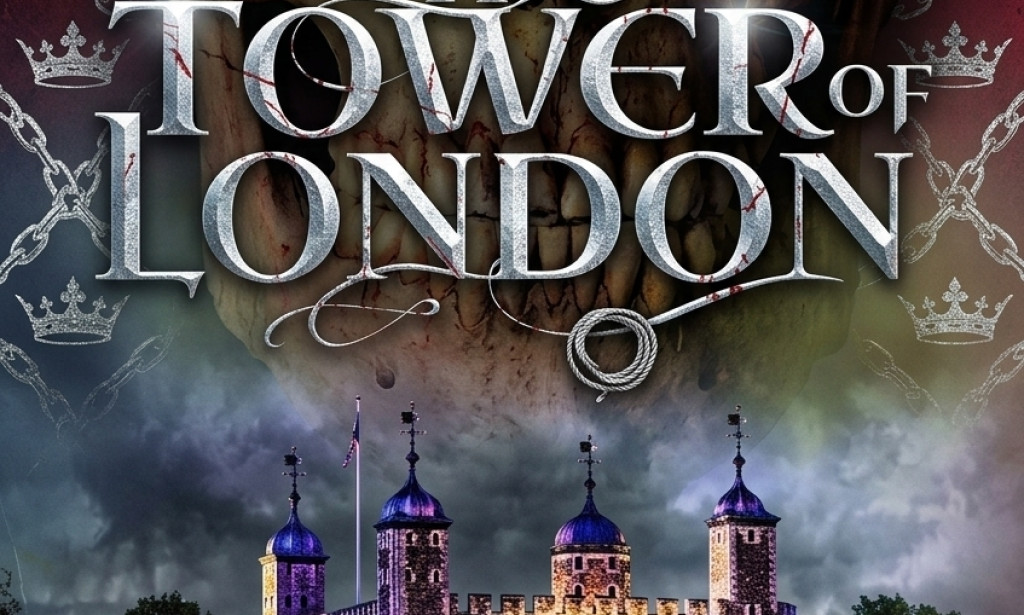
Rating: 5/5 - what a wicked way to begin a book about one of the most intriguing buildings in the whole country!
In the introduction, we are aptly brought into the world of the Tower of London and get to see why it was built in the first place. John Paul Davis teaches us about its Norman History and how nobody had yet seen anything quite like it in the country. It was changed and changed again until being really completed in the 14th century. Though it is a bit here and there about what exactly it was used for - John Paul Davis definitely makes it one of the most interesting and fun topics to learn about when it comes to the history of one of the most enigmatic cities of the world. It has been directly and indirectly involved with so much, there are the crown jewels kept there but there are also engraved names on the stone showing us the horrors of those who were housed there, awaiting execution. I think the author does well of explaining of how this book means 'so many things to so many people' as he says himself in the text.
He begins by stating that the known dates of the start and end of the intial building of the Tower of London is somewhat shoddy. There's no real dates and so, we sort of take it from 1066 or 1078 and go from there because we know it is Norman. The first thing we take a good look into is one of the most incredible legends of the tower, one which many a Brit would know. It is that of the ravens and the raven master which states that as long as the ravens stick around, Britain will remain standing. Hence, the raven master. And the fact that nobody is allowed to mess with the ravens. Through the myths and legends of how it was built, we get to also see how the French built it up to what it is. It was, in fact, a French architect and the French were the first use it. Though William the Conquerer would never really see it built in its entirety, he did see some of it.
We see the prisoner Ranulf Flambard. Flambard was a chaplain and he had considerable financial control over the kingdom - so considerable that we would relate his ways to the role of the Chancellor today. Chroniclers wrote about him in a way that made him seem like a man who stole from both rich and poor and ultimately, he did not concern himself with justice even though he was supposed to. He was also a builder and charged with crime of embezzlement eventually, being imprisoned in 1100 in the Tower of London.
The author writes his imprisonment as something of a hotel-situation in which he was fed well, he was allowed to hold banquets and also repaired his reputation. But upon making his jailers drunk, he scaled a wall of the Tower and thus, he escaped all the way to France. It was so much fun learning about this because I'm not going to lie, he actually goes back and gets at least, some of his grace returned to him. I think that people were just surprised that he was able to do what he did. You have to respect the hustle. They actually had to change the Tower to make sure people didn't escape in the same way neOf course, throughout this we get a brief overview of the monarchy as well, looking at William the Conqueror and his children. Then, we also get the post-White Ship disaster kingship with the fights between Stephen and Matilda. And though this may seem all very obvious, it also makes sense because at least we get something remotely contextual that helps us with where we are in the history of the country and thus, the construction of the Tower. Loyalties and politics change and thus, the Tower will change with them. Outer defenses are built, paused and built again - showing that there are people who clearly have their sights set on this becoming a fortress. It not only had to keep people out, but it had to keep people in as well. Richard I's reign would double the size of the Tower.
When we move on to Henry III, we see politics take over as Henry is yet too young to reign himself. I'm not going to lie, there was a legitimate wrestling match happening on the grounds of the Tower. After this, there were imprisonments and hangings. You can't make this up. I was genuinely surprised that this even happened at all let alone between just random people. There was so much built during the time of Henry III - these included many of the towers and halls, enhancing decorations and religious iconography throughout the whole place. There was also once a whole collection of animals there, a menagerie of lions and others. But the crown jewels began their storage life there during this reign and the author definitely shows us the expansive nature of the Tower during this time.
We get the history of a man who tried to escape the tower in the same way as Flambard before him, but his sheets became untangled and he plunged to his death. We also see the history of the Mint. Many people take refuge in the Tower, and yet members of the Jewish community were imprisoned there during the 1280s with many of them being executed afterwards. There was also a man who had committed suicide within the walls by banging his head repeatedly on its walls. Needless to say, this is a building with an odd, horrific and often dark history.xt time.

You must be logged in to post a comment.