
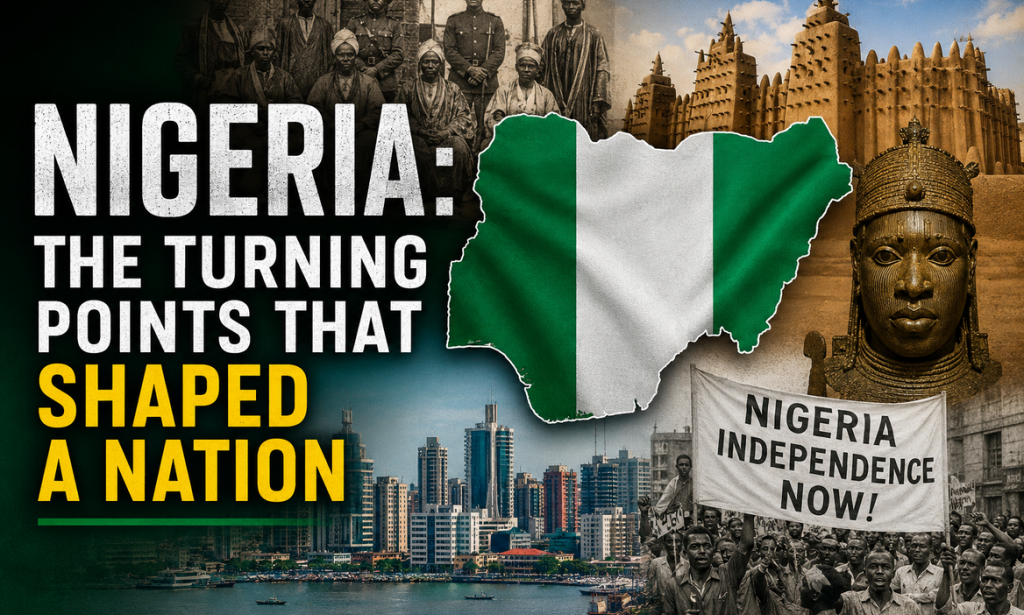
Nigeria: The History and Turning Points That Shaped the Country
Nigeria is often described as Africa's most populous country and one of the continent's most important political, economic, cultural, and diplomatic powers.
But modern Nigeria did not appear overnight.
The country that exists today is the product of centuries of migration, trade, warfare, state formation, religion, cultural exchange, European intervention, colonial administration, nationalism, military rule, civil war, oil wealth, democratic struggles, and continuous negotiation among hundreds of communities.
Understanding Nigeria therefore requires going further back than October 1, 1960.
Independence is one of the most important dates in Nigerian history, but it was not the beginning of Nigeria.
It was one of the consequences of a much longer historical process.
The modern Nigerian state brought together territories containing people with very different histories.
Some communities had centralized kingdoms.
Others were organized through councils, villages, families, age grades, religious institutions, or other decentralized systems.
Some regions had been strongly influenced by Islam for centuries before British colonialism.
Other communities had developed their own religious and political traditions.
Christianity later became particularly influential in many southern areas, while Islam remained deeply rooted across much of the north.
European traders interacted with coastal communities for centuries before Britain established formal colonial control.
All of these layers eventually became part of one country.
That is why Nigeria's history is not simply a story of one people.
It is a story of many peoples becoming politically connected within the same state.
And the process has never been completely simple.
Nigeria Before Nigeria
One of the biggest mistakes people make when discussing Nigerian history is to assume that the modern country existed before colonialism.
It did not.
The name Nigeria describes a modern political territory.
Before colonial rule, there was no single Nigerian government controlling the entire area now known as Nigeria.
Instead, the region contained numerous societies and political systems.
Among the best-known were:
-
The Kingdom of Benin
-
The Oyo Empire
-
The Hausa states
-
The Sokoto Caliphate
-
Kanem-Bornu
-
The Nupe states
-
The Igbo communities
-
The Yoruba kingdoms
-
Niger Delta city-states
-
Tiv communities
-
Jukun states
-
Edo-speaking communities
-
Efik and Ibibio communities
-
Ijaw communities
-
Many other societies and smaller political units
These societies did not all share the same political structure.
Some had kings.
Some had emirs.
Some had powerful aristocracies.
Some operated through councils and community institutions.
Some were centralized.
Others were highly decentralized.
This diversity is extremely important because modern Nigerian politics still reflects some of these historical differences.
The Ancient Roots of Nigerian Civilization
Archaeological discoveries demonstrate that the region that is now Nigeria has supported complex human societies for thousands of years.
One of the most famous archaeological traditions associated with present-day Nigeria is the Nok culture.
Nok is particularly famous for its terracotta sculptures and evidence of sophisticated early societies.
The exact relationship between the Nok culture and later Nigerian peoples should not be oversimplified, however.
It is safer to say that Nok demonstrates the existence of complex societies in the region long before European colonialism.
This matters because old stereotypes once portrayed Africa as having no significant civilizations before European intervention.
Nigeria's archaeological and historical record contradicts that idea.
The region had long-established farming communities, metalworking traditions, trading networks, political institutions, artistic traditions, and urban centers.
The Kingdom of Benin
One of the most famous precolonial states in the region was the Kingdom of Benin.
The kingdom was centered in what is now Edo State.
Its capital, Benin City, became an important political and artistic center.
The Oba was the central political authority, while a complex system of chiefs, palace officials, guilds, and other institutions supported the kingdom.
Benin became particularly famous for its artistic traditions.
Its bronze and brass works became internationally renowned.
The famous Benin Bronzes are not simply beautiful objects.
They are historical evidence of a sophisticated court culture and highly developed artistic system.
European visitors encountered Benin centuries before British colonial conquest.
Portuguese contacts with the kingdom date back to the late fifteenth century.
Trade developed between Benin and European merchants.
But these relationships were not initially equivalent to colonial rule.
The British conquest came much later.
In 1897, a British military expedition attacked Benin after a previous British diplomatic expedition was killed.
Benin City was captured and the palace was looted.
The Oba was subsequently removed from power.
The event marked a major turning point in the history of the kingdom.
Today, the history of Benin also remains connected to the international debate over the return of looted cultural objects commonly known as the Benin Bronzes.
The Oyo Empire
Another major precolonial power was the Oyo Empire.
Oyo developed among Yoruba-speaking peoples in what is now southwestern Nigeria and neighboring areas.
At its height, Oyo became a powerful political and military state.
Its political structure was not simply the rule of one individual without limits.
The Alaafin occupied the throne, but other institutions and powerful officials played important roles in governance.
This is significant because it demonstrates that precolonial African political systems could contain complex checks, competing interests, administrative structures, and political traditions.
Oyo's influence extended beyond the territory of present-day Nigeria.
Its political and economic relationships connected it to neighboring regions.
However, like other large states, Oyo eventually experienced internal struggles and external pressures.
Its decline contributed to major political changes across Yorubaland during the nineteenth century.
The Hausa States
Northern Nigeria had its own long history of urban development and political organization.
Several Hausa states became important centers of trade and Islamic scholarship.
Among them were:
-
Kano
-
Katsina
-
Zazzau
-
Gobir
-
Kebbi
-
Rano
-
Daura
These states were connected through commerce, politics, warfare, religion, and migration.
Cities such as Kano became major commercial and intellectual centers.
Trans-Saharan trade connected northern Nigerian societies to North Africa and the wider Muslim world.
Goods, ideas, scholars, religious practices, and political influences moved across these networks.
Islam had already been present in parts of northern Nigeria for centuries before British colonialism.
This is an important fact when discussing Nigeria's religious history.
Islam was not introduced to northern Nigeria by the British.
Its roots in the region go back many centuries.
Kanem-Bornu and the Lake Chad Region
The Kanem-Bornu civilization is another major part of the history of the area around northeastern Nigeria.
Its roots extend far beyond the borders of modern Nigeria.
The state developed around the Lake Chad region and became an important center of political power, trade, scholarship, and Islamic culture.
Its influence lasted for centuries.
By the nineteenth century, Kanem-Bornu was dealing with major political changes in the region, including the rise of the Sokoto movement.
The history of northeastern Nigeria therefore cannot be understood simply through the modern borders of Borno State.
The region has historically been connected to neighboring areas around Lake Chad.
The Sokoto Jihad and the Rise of the Sokoto Caliphate
One of the most important turning points in nineteenth-century West African history was the movement associated with Usman dan Fodio.
In 1804, a major conflict began in the Hausa state of Gobir.
Dan Fodio was a Muslim scholar and reformer who criticized the political and religious practices of the rulers of the region.
The movement eventually became a major military and political transformation.
His followers defeated Gobir and expanded into other Hausa territories.
A large political system known as the Sokoto Caliphate emerged.
Sokoto became its political and intellectual center.
The caliphate eventually became one of the largest political formations in nineteenth-century West Africa. (Encyclopedia.com)
The caliphate was not simply an ethnic project.
Although Fulani leaders played major roles, the political system involved Hausa and other communities as well.
It also created a network of emirates.
These emirates became extremely important in the political history of northern Nigeria.
Why the Sokoto Caliphate Still Matters Today
The historical influence of the Sokoto Caliphate did not disappear when British colonialism arrived.
The British eventually conquered the caliphate's territories.
However, British colonial administrators recognized that existing political structures could be useful to them.
This contributed to the development of British indirect rule in northern Nigeria.
Traditional rulers, particularly emirs, continued to exercise local authority under colonial supervision.
The arrangement was politically convenient for the British because they could govern large populations through existing institutions rather than attempting to replace every local structure.
The legacy of this system remains visible in northern Nigeria today.
Traditional rulers do not possess the same constitutional powers they once had, but institutions such as emirates and traditional councils continue to have cultural and social importance.
The Atlantic Slave Trade
Nigeria's history also has a painful connection to the transatlantic slave trade.
Between the sixteenth and nineteenth centuries, European traders participated in extensive slave trading along the West African coast.
People were captured through warfare, raids, kidnapping, political conflict, and other forms of coercion.
They were transported toward the coast and sold into the Atlantic system.
Different African political authorities and commercial networks became involved in different ways.
It is important not to reduce the history to the simplistic claim that one ethnic group "sold another."
The Atlantic slave trade was a large international economic system involving European merchants, African political authorities, local traders, military forces, and plantation economies in the Americas.
Millions of Africans were transported across the Atlantic.
The consequences were enormous.
Communities lost people.
Political relationships changed.
Warfare could become economically valuable because captives could be sold.
Some states became more powerful through participation in the trade.
Others were devastated.
The effects continued long after abolition.
Lagos and British Expansion
Lagos became particularly important during the nineteenth century.
The British increasingly opposed the Atlantic slave trade and also sought to expand their political and commercial influence.
Britain annexed Lagos in 1861.
This was a major turning point.
But British control did not immediately cover the entire territory of modern Nigeria.
Instead, British influence expanded gradually.
Military campaigns, treaties, commercial agreements, political pressure, and administrative changes brought more territories under British authority.
The Royal Niger Company
British commercial expansion was also closely connected to the Royal Niger Company.
The company played a major role in Britain's expansion along the Niger River and surrounding territories.
In 1900, territories administered by the company were transferred to direct British government control.
This helped establish the framework for formal colonial administration.
British expansion was not simply a peaceful administrative process.
It involved military campaigns and resistance.
Some communities resisted British occupation.
Others negotiated.
Some rulers cooperated because they believed cooperation would protect their interests.
Colonial conquest therefore looked different in different parts of the territory.
The British Conquest of Northern Nigeria
British forces defeated the Sokoto Caliphate and related political structures in the early twentieth century.
Sokoto fell in 1903.
This brought one of the most powerful political systems in the region under British colonial authority. (Encyclopedia.com)
But Britain did not completely destroy the existing administrative system.
Instead, colonial officials frequently worked through traditional rulers.
This became one of the defining features of colonial northern Nigeria.
The British Conquest of Benin
The British expedition against Benin in 1897 was another decisive event.
The British military captured Benin City.
The palace was looted.
The Oba was exiled.
Thousands of artworks were taken.
Many of these objects eventually entered European and American museums and private collections.
The consequences of the expedition are still discussed today because of the continuing debate over cultural restitution and ownership.
This demonstrates something important about history:
Events that happened more than a century ago can still affect international politics today.
How Nigeria Got Its Name
The name "Nigeria" is generally associated with the Niger River.
The term was popularized in the colonial period.
It did not represent a precolonial nation-state.
This distinction is important.
Nigeria as a political country was constructed during the colonial era from territories that had previously belonged to different political and cultural systems.
That does not make Nigeria artificial in the sense that its people or cultures are artificial.
It means the country's modern political borders were created through colonial processes.
Many countries around the world have similar histories.
The 1914 Amalgamation
One of the most consequential events in Nigerian history occurred in 1914.
The British merged the Northern Nigeria Protectorate and Southern Nigeria Protectorate.
The new political unit became known as the Colony and Protectorate of Nigeria. (Encyclopedia.com)
This is commonly called the amalgamation of Nigeria.
The decision was largely administrative and colonial.
It was not the result of a referendum in which the peoples of northern and southern Nigeria voted to form one country.
That distinction is important.
The British colonial government created a single administrative unit.
Yet this new territory contained enormous cultural, linguistic, religious, economic, and political differences.
Those differences would later become some of the central questions of Nigerian nation-building.
The North and South Developed Differently
Colonial Nigeria was not governed identically everywhere.
British officials relied heavily on indirect rule in northern Nigeria.
In parts of southern Nigeria, the system encountered different political structures.
The British therefore adapted their methods.
Education also developed differently.
Christian missionary organizations played major roles in education in many southern areas.
Northern Muslim leaders were often more cautious about missionary education.
The result was an uneven pattern of educational development.
These differences later influenced Nigeria's regional politics.
The Growth of Nigerian Nationalism
By the twentieth century, educated Nigerians increasingly began demanding political representation.
Newspapers became important.
Professional associations became important.
Trade unions became important.
Student organizations became important.
Political organizations began to develop.
Nigerian nationalism did not come from one person.
Many individuals and movements contributed to it.
Among the important figures were:
-
Herbert Macaulay
-
Nnamdi Azikiwe
-
Obafemi Awolowo
-
Ahmadu Bello
-
Abubakar Tafawa Balewa
-
Anthony Enahoro
-
Funmilayo Ransome-Kuti
-
Margaret Ekpo
-
Many other political activists, journalists, workers, students, and community leaders
These people did not always agree with each other.
That is an important point.
Nigerian nationalism was not a single political ideology.
Different leaders had different visions of what Nigeria should become.
Herbert Macaulay and Early Political Activism
Herbert Macaulay is often described as one of the fathers of Nigerian nationalism.
He became an important critic of colonial rule.
He helped establish political organizations and used journalism and political activism to challenge colonial policies.
His political career helped create the foundation for later nationalist movements.
Nnamdi Azikiwe
Nnamdi Azikiwe became one of the most influential nationalist figures in Nigeria.
Known popularly as "Zik," he was a journalist, politician, and major advocate of Nigerian self-government.
His influence extended particularly strongly among Igbo communities, but his political ambitions were national.
He later became Nigeria's first indigenous Governor-General and, after independence, its first President under the republican system.
His career illustrates the gradual transition from colonial politics to Nigerian self-government.
Obafemi Awolowo
Obafemi Awolowo became one of the most important political figures in southwestern Nigeria.
He was closely associated with the Action Group.
His political program emphasized education, regional development, and social welfare.
The Western Region became known for major educational initiatives during his period of political influence.
Awolowo also became one of the most important political thinkers in Nigerian history.
His political ideas continued to influence Nigerian politics long after his active political career.
Ahmadu Bello
Ahmadu Bello, the Sardauna of Sokoto, became the dominant political figure in northern Nigeria during the First Republic.
He was associated with the Northern People's Congress.
Unlike some southern nationalist leaders, Bello placed considerable emphasis on the political interests and autonomy of northern Nigeria.
His political influence was enormous.
He was also connected to the traditional authority of the Sokoto region.
His political legacy remains significant in northern Nigeria.
Tafawa Balewa and the Road to Independence
Abubakar Tafawa Balewa became Nigeria's first Prime Minister after independence.
He was an important figure in the Northern People's Congress and worked with other nationalist leaders in the transition toward independence.
Nigeria's independence did not happen because one political party defeated colonialism.
It came after years of constitutional negotiations, political pressure, elections, regional competition, and British decisions about decolonization.
The Constitutional Conferences
Before independence, Britain and Nigerian political leaders negotiated a series of constitutional arrangements.
Nigeria gradually gained greater internal self-government.
Political parties competed across regions.
The question of federalism became extremely important.
Why?
Because Nigeria was too diverse for many political leaders to believe that a highly centralized government would work smoothly.
The federal system allowed regions to maintain considerable authority.
Nigeria became independent as a federation.
October 1, 1960
Nigeria gained independence from Britain on October 1, 1960.
This was one of the most important dates in the country's history.
The United States, for example, formally recognized Nigerian independence on October 1, 1960. (Office of the Historian)
Nigeria began its independent existence as a parliamentary federation.
Tafawa Balewa became Prime Minister.
Nnamdi Azikiwe became Governor-General and later President when Nigeria became a republic.
Independence Did Not Solve Everything
There is sometimes a romantic way of discussing independence.
People imagine that once colonial rule ended, Nigeria simply became a successful democracy and then later experienced problems.
The reality was much more complicated.
At independence, Nigeria inherited:
-
Regional political divisions
-
Uneven educational development
-
Economic inequalities
-
Ethnic competition
-
Constitutional disagreements
-
Weak national institutions
-
A colonial administrative structure
-
A complicated relationship between traditional authority and modern government
The country was free, but nation-building had only begun.
The First Republic
Nigeria's First Republic lasted from 1963 until the military coup of January 1966.
The major political parties were strongly associated with different regions.
The Northern People's Congress was powerful in the north.
The Action Group was dominant in the west.
The National Council of Nigeria and the Cameroons, later associated with Azikiwe's political movement, had strong support in the east.
Political competition became increasingly intense.
The problem was not simply ethnicity.
It was also about control of government, resources, regional power, elections, ideology, and political survival.
Reducing every political conflict to "tribalism" hides the economic and institutional dimensions of the disputes.
The 1964 Federal Election Crisis
The 1964 federal election became deeply controversial.
Political alliances changed.
Opposition parties questioned the electoral process.
Boycotts and political disagreements created serious instability.
The crisis demonstrated that Nigeria's young democratic institutions were under enormous pressure.
This was one of the warning signs that the political system was becoming fragile.
The Western Region Crisis
The Western Region experienced its own major political crisis.
Political divisions within the Action Group became intense.
Violence and disorder increased.
The crisis became known as Operation Wetie, a reference associated with the use of fire and violence during political conflicts in the region.
The events damaged public confidence in the political system.
They also contributed to the atmosphere in which military intervention became more likely.
The First Military Coup — 1966
On January 15, 1966, a group of military officers staged a coup.
Several senior political leaders were killed.
Among those killed were Prime Minister Tafawa Balewa, Northern Premier Ahmadu Bello, and Western Premier Samuel Ladoke Akintola.
The coup dramatically changed Nigeria.
Major General Johnson Aguiyi-Ironsi became Head of State.
The military had entered national politics.
Nigeria's democratic experiment had suffered a devastating blow.
Why the 1966 Coup Was So Dangerous
The January coup was interpreted differently across Nigeria.
Some officers involved in the coup were associated with particular regional and ethnic backgrounds.
Because several prominent northern political leaders had been killed while some southern political leaders survived, many people in northern Nigeria believed the coup was an Igbo-led attempt to dominate the country.
Whether that interpretation accurately described the motives of every officer involved is a separate historical question.
But politically, perception became extremely important.
Suspicion increased.
Trust collapsed.
The Counter-Coup
In July 1966, northern officers launched a counter-coup.
General Aguiyi-Ironsi was killed.
Yakubu Gowon became Head of State.
The country entered an even more dangerous period.
Violence against Igbo people and other easterners occurred in parts of northern Nigeria.
Large numbers of people fled toward the Eastern Region.
This migration deepened the political crisis.
The Road to Civil War
Nigeria's leaders attempted negotiations.
One major attempt was the Aburi Accord in Ghana in January 1967.
The agreement failed to produce a lasting settlement.
The political situation continued to deteriorate.
The Eastern Region increasingly moved toward separation.
In May 1967, Lieutenant Colonel Odumegwu Ojukwu declared the independence of the Republic of Biafra.
The Federal Government rejected the secession.
War followed.
The Nigerian Civil War
The Nigerian Civil War lasted from 1967 to 1970.
It is also known as the Biafran War.
The conflict was one of the most devastating events in Nigerian history.
Millions of people were affected.
Large numbers of civilians died.
Starvation became a major feature of the conflict, particularly in Biafra.
Children suffering from severe malnutrition became one of the most internationally recognized images of the war.
The war also created one of the most important humanitarian crises of twentieth-century Africa.
Why the Civil War Still Matters
The Civil War is not simply a historical chapter.
Its memories remain alive.
For many Igbo families, the war is remembered as a period of enormous suffering and loss.
For many other Nigerians, it represents the preservation of the country's territorial integrity.
Different communities therefore remember the war differently.
That does not mean one side's suffering was imaginary.
It means national memory can be complicated.
A serious discussion of Nigeria must be willing to acknowledge those different memories.
The End of the War
Federal forces eventually defeated Biafran forces.
Biafra surrendered in January 1970.
Ojukwu fled to Côte d'Ivoire and later returned to Nigeria after receiving a pardon in the 1980s.
Gowon's government adopted a policy popularly associated with the phrase:
"No victor, no vanquished."
The intention was to promote reconciliation.
The country remained united.
But the consequences of the war did not disappear.
Questions about political representation, regional inequality, military power, and national identity remained.
The Oil Boom Changes Nigeria
Another enormous turning point was the rise of petroleum.
Nigeria had discovered oil before independence, but petroleum became increasingly important to government revenue and exports after independence.
The oil boom of the 1970s transformed the Nigerian economy.
Government revenue increased dramatically.
The country invested in infrastructure and major development projects.
But oil also created new problems.
Nigeria became increasingly dependent on petroleum exports.
This dependence meant that government finances became highly sensitive to international oil prices.
Oil and the Niger Delta
The region where much of Nigeria's oil is produced is the Niger Delta.
The area is environmentally sensitive and densely populated.
Oil production brought enormous national revenue.
But many communities in oil-producing areas complained about:
-
Pollution
-
Environmental degradation
-
Inadequate infrastructure
-
Limited local economic benefits
-
Loss of traditional livelihoods
-
Government neglect
These grievances contributed to political activism and later militancy in the Niger Delta.
The history of oil in Nigeria therefore contains both wealth and conflict.
Military Rule Returns
In 1975, Yakubu Gowon was overthrown.
General Murtala Mohammed became Head of State.
His government launched major reforms.
Murtala was assassinated during a failed coup attempt in February 1976.
Olusegun Obasanjo succeeded him.
Obasanjo continued the transition toward civilian rule.
This period eventually produced the Second Republic.
The Second Republic
Nigeria returned to civilian government in 1979.
Shehu Shagari became President.
The country adopted a presidential system modeled partly on the United States system.
Political parties competed nationally.
But economic problems grew.
Oil prices fell.
Government spending remained high.
Political corruption became a major public concern.
The civilian government was overthrown in December 1983.
The military returned to power.
Muhammadu Buhari's First Military Government
Major General Muhammadu Buhari became Head of State after the 1983 coup.
His government introduced an anti-corruption campaign and attempted to impose stricter discipline.
But military rule also restricted political freedoms.
The government was eventually overthrown in 1985 by General Ibrahim Babangida.
Ibrahim Babangida and the Long Transition
Babangida ruled Nigeria from 1985 to 1993.
His government introduced significant economic reforms.
Nigeria adopted structural adjustment policies.
The government also promised a return to democracy.
Political parties were created and later dissolved.
A complicated transition program was introduced.
But the transition became increasingly controversial.
The most famous event was the 1993 presidential election.
The June 12 Election
The June 12, 1993 presidential election is one of the most controversial events in Nigerian political history.
Moshood Kashimawo Olawale Abiola, popularly known as M.K.O. Abiola, was widely regarded as the leading candidate.
The election was annulled before the final result could be formally completed.
The annulment created enormous political anger.
Many Nigerians regarded June 12 as a stolen democratic mandate.
Abiola was later imprisoned after declaring himself president-elect.
The crisis contributed to the eventual collapse of Babangida's government.
The Abacha Years
General Sani Abacha took power in 1993.
His government became one of the most authoritarian periods in Nigerian history.
Political opposition was suppressed.
Activists were arrested.
Journalists faced restrictions.
One of the most internationally famous cases was the execution of writer and environmental activist Ken Saro-Wiwa and eight other Ogoni activists in 1995.
The executions generated international condemnation.
Nigeria's international reputation suffered.
Ken Saro-Wiwa and the Ogoni Struggle
Ken Saro-Wiwa became a symbol of environmental activism in the Niger Delta.
The Ogoni people had complained for years about the environmental effects of oil production.
Saro-Wiwa and the Movement for the Survival of the Ogoni People demanded environmental justice and greater control over local resources.
His execution transformed him into an international symbol of environmental and human rights activism.
The controversy also highlighted a central Nigerian question:
Who should benefit from the country's natural resources?
That question remains relevant.
Abacha's Death and the Road to Democracy
Sani Abacha died suddenly in 1998.
General Abdulsalami Abubakar became Head of State.
Unlike his predecessor, Abubakar moved relatively quickly toward civilian rule.
Political prisoners were released.
A new constitution was developed.
Elections were held.
In 1999, Nigeria returned to civilian government.
The Fourth Republic had begun.
1999: The Beginning of the Fourth Republic
Olusegun Obasanjo became President in 1999.
For many Nigerians, this was a historic moment.
The country had experienced years of military dictatorship.
Now political power had returned to elected civilians.
The Fourth Republic survived.
That fact alone is significant.
Nigeria has experienced many political crises since 1999, but the constitutional order has remained civilian.
Nigeria's Democratic Journey Since 1999
The Fourth Republic has had several presidents.
They include:
-
Olusegun Obasanjo
-
Umaru Musa Yar'Adua
-
Goodluck Jonathan
-
Muhammadu Buhari
-
Bola Ahmed Tinubu
Each administration faced different challenges.
Nigeria's democracy has never been perfect.
There have been allegations of electoral irregularities, corruption, insecurity, political intimidation, and institutional weaknesses.
But elections have continued.
Political parties have changed.
Presidents have changed.
Most importantly, Nigeria has experienced repeated transfers of power through constitutional processes.
Obasanjo's Presidency
Obasanjo governed from 1999 to 2007.
His administration focused heavily on economic reform, debt relief, institutional reform, and rebuilding Nigeria's international reputation after military rule.
Nigeria eventually secured significant debt relief from international creditors.
Obasanjo also played a major role in African diplomacy.
However, his presidency was not without controversy.
His attempt to alter the constitutional rules surrounding presidential tenure was widely criticized and ultimately unsuccessful.
Umaru Musa Yar'Adua
Umaru Musa Yar'Adua became President in 2007.
His administration emphasized the Seven-Point Agenda and the Niger Delta issue.
One of his most important political actions was the Niger Delta amnesty program.
The program offered former militants an opportunity to surrender weapons in exchange for rehabilitation and reintegration.
Yar'Adua's health later deteriorated significantly.
He died in 2010.
Goodluck Jonathan
Goodluck Jonathan became President after Yar'Adua's death.
He later won the 2011 presidential election.
Jonathan's presidency was marked by economic growth, the expansion of the telecommunications sector, and continuing oil production.
But his government also faced major security problems.
The Boko Haram insurgency became increasingly dangerous.
In 2014, the kidnapping of more than 200 schoolgirls from Chibok attracted global attention.
The phrase "Bring Back Our Girls" became an international campaign.
Boko Haram and the Security Crisis
The Boko Haram insurgency has been one of the most serious security challenges in modern Nigerian history.
The group emerged in northeastern Nigeria and became increasingly violent.
It carried out attacks against civilians, security forces, schools, religious institutions, and government targets.
The conflict displaced millions of people and affected neighboring countries around the Lake Chad region.
The insurgency also demonstrated that Nigeria's security challenges were not purely political.
They involved poverty, governance, ideology, regional instability, borders, unemployment, military capacity, and international terrorism.
The 2015 Election
Nigeria experienced one of the most important democratic transitions in 2015.
Muhammadu Buhari defeated incumbent President Goodluck Jonathan.
Jonathan conceded defeat.
This peaceful transfer of power was widely praised.
It demonstrated that Nigeria's democratic institutions could produce a change in national leadership without a military coup.
The 2015 election therefore became another major turning point.
Muhammadu Buhari's Presidency
Buhari governed from 2015 to 2023.
His administration focused heavily on:
-
Anti-corruption
-
Security
-
Infrastructure
-
Economic diversification
-
Agriculture
-
Fighting Boko Haram
The government also introduced major infrastructure projects.
But Nigeria continued to face serious economic difficulties.
Oil prices fluctuated.
The country experienced recession in 2016.
Later, the COVID-19 pandemic created additional economic pressure.
Security problems also expanded beyond the northeast.
Kidnapping and banditry became major problems in several parts of the country.
The 2020 EndSARS Protests
In October 2020, Nigeria experienced nationwide protests against police brutality.
The movement became known as EndSARS, referring to the campaign against the Special Anti-Robbery Squad.
Young Nigerians organized demonstrations across the country.
The protests were initially focused on police abuse but eventually became broader expressions of frustration about governance, unemployment, corruption, and economic conditions.
The Lekki tollgate incident became one of the most controversial events associated with the protests.
EndSARS became one of the most important examples of Nigerian youth political activism in the digital era.
The 2023 Election
Nigeria held another presidential election in February 2023.
There were 18 presidential candidates.
The election featured a highly competitive three-way contest involving:
-
Bola Ahmed Tinubu of the APC
-
Atiku Abubakar of the PDP
-
Peter Obi of the Labour Party
INEC's official election materials confirm that the 2023 presidential election was the seventh presidential election since Nigeria's return to civilian rule in 1999. (INEC Nigeria)
The election generated intense political debate.
There were disputes about electoral administration and the transmission and collation of results.
The legal challenges eventually went through Nigeria's judicial system.
The election nevertheless resulted in the transfer of presidential authority through the constitutional process.
Bola Ahmed Tinubu Becomes President
Bola Ahmed Tinubu was inaugurated as President on May 29, 2023.
As of 2026, he remains Nigeria's President.
The State House identifies Bola Ahmed Tinubu as the President of the Federal Republic of Nigeria and Kashim Shettima as Vice President. (State House Abuja)
Tinubu entered office promising major economic reforms.
One of his most important early decisions was the removal of the long-standing petrol subsidy.
The government also introduced major foreign-exchange and fiscal reforms.
These policies were designed to address structural problems in the Nigerian economy.
However, they also produced serious short-term hardship for many households.
The Reality of Economic Reform
This is where the "true talk" about Nigeria becomes important.
Economic reforms are rarely simple.
Removing a subsidy can reduce government expenditure and potentially improve fiscal sustainability.
But if fuel prices rise sharply, transportation costs can rise.
When transportation becomes more expensive, the cost of food and other goods can also increase.
Exchange-rate reforms can have similar effects.
A weaker currency can make imports more expensive.
So an economic policy can have a long-term objective while causing painful short-term consequences.
This is one reason Nigerian politics is often difficult.
Government decisions affect millions of people in very different ways.
Nigeria's Population
Nigeria's population is one of the country's greatest defining characteristics.
The World Bank's latest available data currently place Nigeria's population at about 237.5 million people in 2025. (World Bank Open Data)
This makes Nigeria one of the world's largest countries by population.
But population is more than a number.
Nigeria has an exceptionally young population.
Millions of young people enter the labor market every year.
This creates enormous potential.
A large young population can provide:
-
Workers
-
Entrepreneurs
-
Consumers
-
Scientists
-
Artists
-
Engineers
-
Technology professionals
-
Political leaders
But it also creates enormous pressure.
The country must provide:
-
Jobs
-
Education
-
Healthcare
-
Housing
-
Transportation
-
Electricity
-
Security
-
Infrastructure
If economic opportunities do not grow fast enough, population growth can become a source of frustration.
Nigeria's Ethnic Diversity
Nigeria is one of the most culturally diverse countries in the world.
The three largest ethnolinguistic groups commonly discussed are:
-
Hausa-Fulani
-
Yoruba
-
Igbo
But Nigeria is far more diverse than these three categories suggest.
The country contains hundreds of ethnic groups and languages.
Among them are:
-
Ijaw
-
Kanuri
-
Tiv
-
Ibibio
-
Edo
-
Nupe
-
Gbagyi
-
Efik
-
Urhobo
-
Itsekiri
-
Idoma
-
Igala
-
Isoko
-
Annang
-
Jukun
-
many others
Each has its own traditions, histories, languages, cuisines, festivals, political institutions, and cultural identities.
Why Saying "Nigeria Has Only Three Tribes" Is Misleading
The Hausa-Fulani, Yoruba, and Igbo are extremely important.
But describing Nigeria as consisting only of these three groups gives an incomplete picture.
Nigeria's political history cannot be understood without recognizing smaller ethnic communities.
Many minority communities have historically complained that national politics is dominated by larger groups.
This has contributed to debates about:
-
Federal character
-
Political representation
-
Resource allocation
-
State creation
-
Local government boundaries
-
Minority rights
-
Revenue sharing
The creation of additional states was partly connected to these concerns.
Nigeria's 36 States
Nigeria currently has 36 states plus the Federal Capital Territory, Abuja.
The states were not all created at the same time.
State creation was used by successive governments to address political representation, administration, regional grievances, and demands from communities seeking greater autonomy.
This is why Nigerian state boundaries are politically important.
A community's location within a particular state can affect:
-
Government appointments
-
Budget allocations
-
Political representation
-
Access to institutions
-
Competition over resources
Abuja and the Federal Capital
Lagos served as Nigeria's colonial capital and remained the national capital after independence.
In 1991, the federal capital moved from Lagos to Abuja.
The decision reflected a desire for a more centrally located capital.
Abuja was also intended to reduce some of the political and geographic tensions associated with Lagos.
Today, Lagos remains Nigeria's largest commercial and financial center, while Abuja is the political capital.
This distinction is important.
Nigeria effectively has different centers of influence.
Lagos: The Commercial Giant
Lagos is one of the most important cities in Africa.
It is Nigeria's largest commercial center and a major hub for:
-
Finance
-
Entertainment
-
Technology
-
Manufacturing
-
Shipping
-
Media
-
Fashion
-
Real estate
-
Tourism
Lagos also has an extraordinary cultural history.
The city has been influenced by Yoruba traditions, Brazilian returnees, Hausa communities, Igbo communities, coastal peoples, Europeans, Lebanese communities, and many other groups.
This multicultural character helped shape Lagos into one of Nigeria's most globally connected cities.
Kano: A Historic Commercial Center
Kano has a very different historical character.
It has been an important trading center for centuries.
Its history is connected to trans-Saharan trade and Islamic scholarship.
Kano's markets historically linked northern Nigeria with wider West Africa and North Africa.
The city remains one of the major commercial centers of northern Nigeria.
Its cultural identity is deeply connected to Hausa traditions and Islamic heritage.
Ibadan and the Yoruba Region
Ibadan grew dramatically during the nineteenth century.
It became one of the largest urban centers in West Africa.
The city was deeply connected to Yoruba political struggles after the decline of Oyo.
Ibadan later became a major colonial administrative and educational center.
The University of Ibadan, established in 1948 as a university college and later becoming independent, became one of Nigeria's most important educational institutions.
Enugu and the Eastern Region
Enugu developed rapidly during the colonial period because of coal mining.
Coal became economically important in the region.
Enugu later became the political capital of the Eastern Region.
Its history is closely connected to the development of southeastern Nigeria.
The city also played an important role during the Nigerian Civil War.
Port Harcourt and the Oil Economy
Port Harcourt became one of the major centers of Nigeria's petroleum industry.
Its location in the Niger Delta made it strategically important for oil production and transportation.
The city's growth demonstrates how petroleum reshaped Nigerian geography.
Oil did not simply change government revenue.
It changed cities.
It changed migration.
It changed employment.
It changed politics.
It changed infrastructure.
It changed the relationship between the federal government and producing regions.
Religion in Nigeria
Religion is another major part of Nigerian identity.
The two largest religious traditions are Christianity and Islam.
There are also communities that follow indigenous African religions and traditional belief systems.
Christianity is particularly strong in many southern areas.
Islam has deep historical roots across northern Nigeria and is also practiced by large populations elsewhere.
But the geographical divide should not be exaggerated.
Nigeria's religious map is much more complicated.
There are Christians in northern Nigeria.
There are Muslims in southern Nigeria.
There are mixed communities.
There are families containing members of different religious traditions.
There are also people who combine aspects of traditional culture with Christianity or Islam.
Traditional Religion Did Not Simply Disappear
Even after the spread of Christianity and Islam, traditional cultural practices remained important.
Traditional festivals, naming ceremonies, marriage customs, burial practices, titles, royal institutions, music, dance, and oral traditions continue in many communities.
Sometimes these practices exist alongside Christianity or Islam.
This demonstrates that cultural identity is not always divided into simple categories.
A Nigerian can be deeply Christian or Muslim while also participating in cultural traditions inherited from earlier generations.
Nigerian Languages
English is Nigeria's official language.
But English is not the only language Nigerians speak.
Major Nigerian languages include:
-
Hausa
-
Yoruba
-
Igbo
-
Fulfulde
-
Kanuri
-
Tiv
-
Edo
-
Ibibio
-
Ijaw languages
-
Nupe
-
Gbagyi
-
Igala
-
many others
Nigeria's linguistic diversity is extraordinary.
Pidgin English is also widely spoken.
Nigerian Pidgin has become an important means of communication across ethnic and social boundaries.
It is particularly influential in urban areas and popular culture.
Nigerian Food Culture
Food is another way Nigerian history can be understood.
Different regions have developed distinctive culinary traditions.
Examples include:
-
Jollof rice
-
Egusi soup
-
Afang soup
-
Edikang ikong
-
Tuwo
-
Pounded yam
-
Amala
-
Eba
-
Moi moi
-
Akara
-
Suya
-
Pepper soup
-
Ofada rice
-
Banga soup
-
Ofe nsala
-
many others
Food traditions often cross ethnic boundaries.
A dish can originate strongly from one community and become popular throughout the country.
This is one of the ways Nigerian culture continuously evolves.
Nigerian Music and Cultural Influence
Nigeria's cultural influence has expanded dramatically around the world.
Afrobeats has become one of Nigeria's most internationally recognized cultural exports.
Artists such as Fela Kuti helped create politically powerful forms of Nigerian music.
Later generations of artists expanded Nigerian popular music globally.
Today Nigerian music is consumed across Africa, Europe, North America, the Middle East, and other parts of the world.
This is a remarkable example of Nigerian soft power.
Nollywood
Nigeria's film industry, popularly known as Nollywood, is another major cultural force.
Nigerian filmmakers produce enormous quantities of movies and television content.
Nollywood has helped Nigerian stories reach international audiences.
It has also created employment for:
-
Actors
-
Directors
-
Writers
-
Producers
-
Editors
-
Camera operators
-
Costume designers
-
Makeup artists
-
Musicians
-
Distributors
The industry has become an important part of Nigeria's creative economy.
Nigerian Politics and the Question of Ethnicity
Ethnicity is frequently discussed in Nigerian politics.
But ethnicity alone does not explain everything.
Political parties frequently build alliances across ethnic and religious boundaries.
Politicians can win support outside their home regions.
Economic interests, religion, personality, ideology, local political networks, incumbency, social media, and campaign organization all matter.
Therefore, saying:
"Nigerians vote only according to tribe"
is too simplistic.
At the same time, pretending ethnicity has no political influence would also be inaccurate.
The truth lies somewhere in between.
Ethnic identity matters.
But it is only one part of a much larger political picture.
Federal Character
Nigeria developed the principle of federal character partly in response to the country's diversity.
The idea is that government institutions should reflect the diversity of the federation.
This principle has influenced appointments and representation.
Supporters argue that it helps prevent domination by one region or group.
Critics argue that it can sometimes encourage political patronage or reduce the emphasis on merit.
Like many Nigerian political systems, federal character is an attempt to solve a real problem while creating debates of its own.
The Resource Control Question
Another major issue is natural resource ownership.
Nigeria's constitution places substantial control over natural resources under the federal system.
Oil-producing states receive derivation revenue from petroleum production.
But many communities in producing areas argue that they deserve greater control over their resources.
This issue has repeatedly appeared in Nigerian politics.
It connects directly to the history of the Niger Delta.
Why Nigeria Has Remained United
Considering the enormous diversity of Nigeria, one of the most interesting historical questions is:
Why has Nigeria remained one country?
The answer is complicated.
Several factors have contributed.
There are economic connections.
There are national institutions.
There is intermarriage.
There is internal migration.
There are shared cultural influences.
There is a national military.
There is a federal political system.
There are national businesses.
There are national sports teams.
There is a shared history.
And there is the fact that generations of Nigerians have grown up identifying both with their communities and with Nigeria as a whole.
But National Unity Is Not Automatic
Nigeria's unity should not be treated as something guaranteed forever.
The Civil War demonstrated how serious national division can become.
Later conflicts in the Niger Delta, northeastern Nigeria, Middle Belt, and other areas have shown that grievances remain.
The country continues to face debates over:
-
Security
-
Resource distribution
-
Political representation
-
Corruption
-
Poverty
-
Federalism
-
State creation
-
Regional inequality
-
Religious tensions
-
Ethnic competition
National unity therefore requires continuous political work.
Nigeria's Economy Beyond Oil
Oil is extremely important, but Nigeria is not simply an oil economy.
The country has major activities in:
-
Agriculture
-
Telecommunications
-
Banking
-
Financial technology
-
Manufacturing
-
Construction
-
Entertainment
-
Retail
-
Transportation
-
Real estate
-
Services
-
Technology
The rise of Nigerian fintech companies is particularly significant.
Nigeria has become one of Africa's most important technology ecosystems.
Lagos, in particular, has developed a reputation as a major technology and startup center.
The Population Challenge
Nigeria's population growth provides enormous opportunities but also creates pressure.
The World Bank reports Nigeria's population at approximately 237.5 million in 2025 and a population growth rate of about 2.1 percent for that year. (World Bank Open Data)
A country of this size requires massive infrastructure.
Nigeria needs more:
-
Schools
-
Hospitals
-
Roads
-
Electricity
-
Housing
-
Public transportation
-
Water systems
-
Digital infrastructure
-
Jobs
This is one reason Nigeria's political future will depend heavily on economic productivity.
Electricity: A Long-Running Problem
Electricity has been one of Nigeria's most persistent development problems.
The country has enormous energy resources.
It has:
-
Natural gas
-
Oil
-
Hydroelectric potential
-
Solar potential
-
Other renewable resources
Yet reliable electricity supply has remained difficult.
Businesses have often had to rely on generators and alternative power systems.
This increases production costs.
It also affects households.
Improving electricity supply is therefore not simply an engineering issue.
It is an economic issue.
Corruption and Governance
Corruption has been one of the most persistent political criticisms in Nigeria.
Successive governments have promised to fight it.
Nigeria has established institutions such as:
-
Economic and Financial Crimes Commission
-
Independent Corrupt Practices and Other Related Offences Commission
-
Auditor-General institutions
-
Anti-corruption laws and agencies
Yet corruption remains a serious concern.
The reality is not that every Nigerian official is corrupt.
That would be an unfair and inaccurate statement.
The real issue is that corruption risks exist across political, administrative, procurement, and business systems.
The challenge is creating institutions strong enough to detect wrongdoing, prosecute cases, recover stolen assets, and prevent abuse.
Nigeria and Democracy Today
Nigeria's democracy in 2026 is the continuation of a process that began in 1999.
The country has now experienced more than two decades of uninterrupted civilian government.
That is historically significant.
But democratic government is more than holding elections.
A strong democracy also requires:
-
Independent institutions
-
Rule of law
-
Free political competition
-
Credible elections
-
Independent journalism
-
Civil liberties
-
Accountable government
-
Judicial independence
-
Peaceful transfer of power
Nigeria continues to develop in these areas.
The Current Political Era
President Bola Ahmed Tinubu's administration has entered its fourth year in 2026.
In his May 29, 2026 anniversary statement, Tinubu described the challenges inherited by his government as including fiscal pressure, fuel subsidies, declining revenues, exchange-rate distortions, debt-servicing costs, insecurity, energy constraints, and declining public confidence. (State House Abuja)
That statement represents the government's own assessment.
But the public experience can be different.
For ordinary Nigerians, economic reforms are often judged through questions such as:
Can I afford food?
Can I find work?
Can my business survive?
Can I afford transportation?
Is electricity available?
Is my community safe?
These questions are just as important as government economic statistics.
Nigeria's Greatest Strength
Nigeria's greatest strength may be its people.
The country has an enormous pool of:
-
Entrepreneurs
-
Professionals
-
Engineers
-
Doctors
-
Teachers
-
Scientists
-
Artists
-
Musicians
-
Writers
-
Technologists
-
Traders
-
Farmers
-
Students
Nigerians have also created successful communities outside the country.
The Nigerian diaspora is active in:
-
Britain
-
United States
-
Canada
-
South Africa
-
Ghana
-
Germany
-
Ireland
-
Australia
-
United Arab Emirates
-
many other countries
Remittances from Nigerians abroad are economically significant.
This means Nigeria's influence extends far beyond its borders.
Nigeria's Greatest Challenge
At the same time, Nigeria's greatest challenge is turning potential into broad-based prosperity.
The country has:
-
A huge population
-
Large natural resources
-
A strategic geographic position
-
Strong cultural influence
-
A large consumer market
-
Major entrepreneurial energy
But potential is not the same as performance.
A country can have oil without becoming wealthy.
A country can have millions of young people without creating enough jobs.
A country can have democracy without having strong institutions.
A country can have natural resources without ensuring that communities benefit fairly.
Nigeria's central challenge is therefore institutional.
How can the country transform its enormous human and natural resources into better living standards for ordinary citizens?
The Long Story of Nigeria
When Nigerian history is viewed across centuries, several major turning points become clear.
The development of early civilizations showed that complex societies existed long before colonialism.
The growth of Benin and Oyo demonstrated the political sophistication of major West African states.
The expansion of Islam and the rise of the Sokoto Caliphate transformed northern politics.
The Atlantic slave trade connected the region to a brutal global economic system.
British expansion transformed political boundaries.
The 1914 amalgamation created the territorial framework of modern Nigeria.
Nationalism challenged colonial rule.
Independence in 1960 created a sovereign Nigerian state.
The coups of 1966 destroyed the First Republic.
The Civil War tested the country's survival.
Oil transformed the economy.
Military rule dominated much of the country's post-independence history.
The June 12 crisis became a symbol of democratic struggle.
The death of Abacha opened the path to civilian rule.
The return to democracy in 1999 created the Fourth Republic.
The 2015 election demonstrated that power could change hands peacefully between major political parties.
The 2023 election brought Bola Tinubu to power.
And in 2026, Nigeria continues the difficult process of building a stronger economy and more effective democracy.
What Nigeria's History Teaches Us
Nigeria's history teaches several important lessons.
First: Nigeria is older than colonialism
The territory contained sophisticated societies long before Britain arrived.
Second: Nigeria has never been one single culture
The country has always contained enormous diversity.
Third: Colonialism fundamentally changed political geography
The 1914 amalgamation brought different territories into one administrative structure.
Fourth: Independence did not automatically create national unity
Nation-building continued after 1960.
Fifth: Military rule changed Nigerian politics permanently
The coups and subsequent decades of military rule affected institutions, political culture, and civil-military relations.
Sixth: The Civil War remains a crucial part of national memory
Understanding the war is essential to understanding modern Nigeria.
Seventh: Oil brought wealth but also dependency and conflict
Petroleum transformed Nigeria but did not eliminate poverty or inequality.
Eighth: Democracy requires more than elections
Strong institutions and accountability matter.
Ninth: Nigeria's diversity can be an advantage
Different languages, cultures, religions, and traditions can create enormous cultural and economic strength.
Tenth: Nigeria's future is still being written
The country's history has not reached its final chapter.
The Nigeria of Tomorrow
The Nigeria of the future will be shaped by today's decisions.
If the country improves education, it can turn population growth into human capital.
If it improves electricity, businesses can become more competitive.
If it improves transportation, internal trade can expand.
If it strengthens institutions, investors and citizens can have greater confidence.
If it improves security, economic activity can spread.
If it reduces corruption and improves public administration, government resources can reach more people.
If it manages its diversity fairly, national unity can become stronger.
And if Nigerian entrepreneurs continue developing businesses and technology, the country's economic influence could expand considerably.
But Nigerians Should Also Remember the Past
A country that forgets its history can repeat its mistakes.
Nigeria has experienced:
-
Colonial conquest
-
Political instability
-
Military coups
-
Ethnic violence
-
Civil war
-
Dictatorship
-
Democratic struggles
-
Economic crises
-
Oil-related conflict
-
Terrorism
-
Youth protests
-
Political transitions
These experiences should not be remembered simply as dates in a textbook.
They should be understood as lessons.
The 1966 coups demonstrate the danger of destroying democratic institutions.
The Civil War demonstrates the terrible consequences of political breakdown.
The Niger Delta experience demonstrates the consequences of resource inequality and environmental damage.
June 12 demonstrates the importance of respecting democratic mandates.
The return to democracy in 1999 demonstrates that political institutions can recover after periods of authoritarian rule.
Nigeria Is Still a Work in Progress
Perhaps the most accurate description of Nigeria is not that it is a failed country, a perfect democracy, an economic giant, or a hopeless case.
None of those simple descriptions captures the whole reality.
Nigeria is a country of contradictions.
It has extreme wealth and extreme poverty.
It has world-class entrepreneurs and serious unemployment.
It has enormous natural resources and energy shortages.
It has democratic elections and deep political distrust.
It has world-famous culture and major infrastructure problems.
It has highly educated professionals and communities struggling to access basic services.
It has enormous national pride and serious internal disagreements.
These contradictions are real.
But they are not the whole story.
Nigeria is also a country that has repeatedly adapted.
It survived colonialism.
It survived civil war.
It survived decades of military rule.
It returned to democracy.
It has maintained a large and increasingly sophisticated economy.
Its cultural influence has expanded globally.
Its people continue to build businesses, create music, produce films, develop technology, and participate in politics.
Final Thoughts
Nigeria's history cannot be reduced to one ethnic group, one religion, one political party, one president, or one event.
It is the history of many peoples and civilizations whose paths eventually became connected inside one modern state.
Long before Nigeria became a country, communities in the region had developed their own systems of government, commerce, agriculture, religion, art, scholarship, and warfare.
The Kingdom of Benin developed a remarkable court culture and artistic tradition.
Oyo became a powerful Yoruba empire.
The Hausa states developed major commercial and intellectual centers.
Kanem-Bornu became a major power around Lake Chad.
The Sokoto Caliphate transformed northern politics and religion.
European involvement expanded through trade and eventually colonial conquest.
Britain created a unified colonial administration through the 1914 amalgamation.
Nigerian nationalists then challenged colonial rule.
On October 1, 1960, Nigeria became independent.
But independence did not end the country's problems.
The First Republic collapsed.
Military coups followed.
The country experienced a devastating civil war.
Oil transformed government finances and national politics.
Military governments dominated the country for decades.
The June 12 crisis became a defining moment in the struggle for democracy.
The 1999 return to civilian rule created the Fourth Republic.
Since then, Nigeria has continued to experience elections, political competition, economic reforms, security challenges, and social change.
Today, President Bola Ahmed Tinubu leads the country, with Kashim Shettima serving as Vice President. (State House Abuja)
Nigeria's population has also continued to grow rapidly, reaching an estimated 237.5 million in 2025 according to World Bank data. (World Bank Open Data)
That population represents both an enormous challenge and an enormous opportunity.
Nigeria's future will depend on whether it can convert its population, natural resources, cultural diversity, entrepreneurial energy, and strategic position into lasting prosperity.
The country's history shows that Nigeria has already survived enormous challenges.
But history also shows that national unity, democracy, economic stability, and good governance cannot be taken for granted.
They must be built and defended by every generation.
The most important thing to understand about Nigeria is therefore this:
Nigeria is not a finished story.
The country is still being shaped.
Every election, every reform, every protest, every business created, every school built, every road constructed, every cultural tradition preserved, and every generation that chooses cooperation over division becomes another part of the country's history.
The Nigeria of tomorrow will eventually become the history that future Nigerians study.
And that means the story of Nigeria is not only about what happened yesterday.
It is also about what Nigerians choose to do next.

You must be logged in to post a comment.