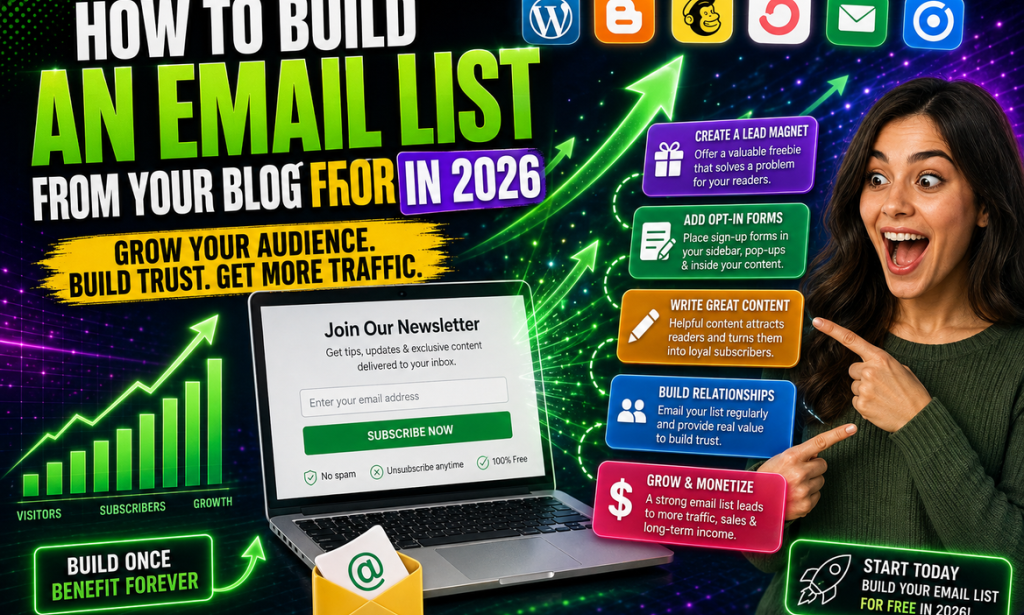
How to Build an Email List from Your Blog for Free in 2026
(Complete Step-by-Step Guide)
Building an email list is one of the smartest things a blogger can do in 2026.
You can get thousands of visitors to your blog, but there is no guarantee those visitors will ever come back. Search rankings can change, social media algorithms can change, and platforms can become less effective over time.
An email list gives you a direct way to stay connected with people who are genuinely interested in your content.
The good news is that you do not need a large budget to get started. You can build an email list from your blog for free by using simple signup forms, useful free resources, and consistent content.
This guide shows you exactly how to do it.
Why Every Blogger Should Build an Email List
When someone visits your blog and leaves, you may never see that person again.
But if that visitor voluntarily gives you their email address, you have an opportunity to build a relationship with them.
An email list can help you:
-
Bring readers back to your newest articles
-
Build a loyal audience
-
Promote useful products and services
-
Increase repeat traffic
-
Develop trust with your readers
-
Eventually create additional income
Unlike relying entirely on search engines or social media, your email list is an audience you can communicate with directly.
You do not need thousands of subscribers to benefit from email marketing. A small list of engaged readers can be more valuable than a huge list of people who never open your emails.
Step 1: Choose a Clear Blog Topic
Before trying to collect emails, make sure your blog has a clear focus.
People are more likely to subscribe when they immediately understand what they will receive.
For example, instead of having a general blog about everything, you could focus on:
-
Blogging
-
Personal finance
-
Digital marketing
-
Fitness
-
Gardening
-
Technology
-
Freelancing
-
Travel
-
Online business
-
Career advice
Your topic does not have to be extremely narrow, but it should be clear enough that visitors know why they should stay connected.
Ask yourself:
“What type of information does my reader want from me repeatedly?”
The answer can become the foundation of your email list.
Step 2: Create a Simple Free Lead Magnet
One of the easiest ways to convince visitors to subscribe is to give them something useful for free.
This is commonly called a lead magnet.
A lead magnet does not need to be complicated.
You could create:
-
A PDF checklist
-
A beginner's guide
-
A free template
-
A worksheet
-
A collection of useful resources
-
A cheat sheet
-
A list of ideas
-
A simple email course
-
A free spreadsheet
-
A step-by-step tutorial
For example, if you run a blogging website, you could offer:
“50 Free Blog Post Ideas for Beginners”
If your website is about personal finance, you could offer:
“Free Monthly Budget Template”
The important thing is that your free resource should solve a real problem.
Do not create a lead magnet simply because you think you need one. Create something your target reader would actually want.
Step 3: Keep Your Lead Magnet Simple
A common mistake is spending weeks creating a huge ebook when a simple checklist could work just as well.
Your first lead magnet should be useful rather than enormous.
For example:
Bad approach:
“Ultimate 200-Page Guide to Everything About Blogging”
Better approach:
“25-Step Blog Launch Checklist”
The second option is specific, easy to understand, and immediately useful.
People are busy. A resource that helps them accomplish something quickly can be very attractive.
Step 4: Choose a Free Email Marketing Platform
You need an email marketing service to collect subscriber addresses and send emails.
Several email marketing platforms offer free plans or free starting options. The exact limits and features can change, so compare the current free plans before choosing one.
Look for features such as:
-
Signup forms
-
Subscriber management
-
Automated welcome emails
-
Email newsletters
-
Basic analytics
-
Landing pages
-
Lead magnet delivery
Do not worry about choosing the perfect platform on day one.
Your main goal is to create a simple system that allows visitors to subscribe and receive your content.
Step 5: Create Your Signup Form
Once your email platform is ready, create a simple signup form.
Your form should clearly answer three questions:
What am I getting?
Why should I want it?
What do I need to do?
For example:
Get 25 Free Blog Ideas
Receive a free list of blog topics you can use this month.
[Enter your email]
[Get the Free Ideas]
Keep the form simple.
In most cases, you do not need to ask for a lot of information. An email address is enough to get started.
Step 6: Add Signup Forms to Your Blog
Creating a signup form is only half the job.
You also need to put it where visitors can see it.
Consider adding signup opportunities in several locations.
At the End of Blog Posts
Someone who reaches the end of an article has already demonstrated interest in the topic.
This makes the end of your article a natural place to invite them to subscribe.
For example:
Want more blogging tips?
Join our free email newsletter and receive practical blogging strategies every week.
Inside Your Content
You can also place a relevant signup invitation in the middle of longer articles.
For example, an article about keyword research could offer:
Free Keyword Research Checklist
Get our simple checklist for finding low-competition topics.
Sidebar
If your blog design includes a sidebar, you can place a signup form there.
However, make sure it does not distract readers from your actual content.
Homepage
Your homepage is another important opportunity.
Make it immediately obvious what visitors will receive if they join your list.
Step 7: Create a Strong Call to Action
A call to action tells your reader what to do next.
Weak:
Subscribe to our newsletter.
Better:
Get Free Blogging Tips Every Week
Even better:
Get 10 Free Blog Post Ideas + Weekly Blogging Tips
The more specific your offer is, the easier it is for visitors to understand its value.
Experiment with different headlines and calls to action over time.
Step 8: Create a Welcome Email
After someone subscribes, send a welcome email.
This is one of the most important emails you can create because it is often the first direct communication between you and your new subscriber.
Your welcome email can include:
-
A thank-you message
-
The promised free resource
-
A short introduction
-
What subscribers can expect
-
A link to your best article
-
A simple question
For example:
Subject: Welcome — here's your free guide
Thanks for joining the community!
Here is the free guide I promised.
Over the next few weeks, I'll send you practical tips to help you grow your blog and get more traffic.
If there is a particular blogging problem you're struggling with, simply reply and let me know.
This makes your email feel more personal and starts a relationship instead of immediately trying to sell something.
Step 9: Send Useful Emails Consistently
Getting subscribers is important, but keeping them engaged is even more important.
You do not have to email your audience every day.
For a new blog, one useful email per week can be a good starting point.
Your emails could contain:
-
A new blog post
-
A useful tip
-
A tutorial
-
A case study
-
A mistake to avoid
-
A helpful resource
-
A personal lesson
-
A useful tool
-
A curated list of ideas
The goal is to make subscribers feel that opening your emails is worthwhile.
Step 10: Turn Your Blog Posts into Emails
You do not need to create completely new content for every email.
One of the easiest strategies is to repurpose your existing blog posts.
For example, if you publish an article called:
“10 Ways to Get More Traffic to Your Blog”
Your email could highlight three of the strategies and then invite readers to read the full article.
This gives your existing content a second life while bringing more traffic back to your website.
Step 11: Add Content Upgrades
A content upgrade is a free resource specifically related to the article someone is reading.
For example, imagine you publish:
“How to Plan Your Blog Content for 30 Days”
You could offer:
Free 30-Day Content Calendar
Readers who want the calendar enter their email address to receive it.
This works because the offer is directly connected to what the reader is already interested in.
The more relevant the offer, the more likely someone is to subscribe.
Step 12: Use Your Most Popular Articles
Not every blog post will generate the same number of subscribers.
Check which articles receive the most traffic.
Then add stronger signup offers to those pages.
For example, if one article receives 1,000 visitors per month and another receives only 50, improving the signup experience on the popular article could produce much faster results.
Look for:
-
High-traffic articles
-
Articles with strong engagement
-
Search traffic pages
-
Posts that solve specific problems
-
Articles that naturally connect to your lead magnet
You do not necessarily need more traffic.
Sometimes you simply need to convert more of the traffic you already have.
Step 13: Promote Your Email List Without Paying for Ads
You can promote your newsletter for free through your existing content.
Try:
-
Linking to your signup page from blog posts
-
Adding your newsletter to your website navigation
-
Sharing your lead magnet on social media
-
Mentioning your newsletter in relevant communities
-
Adding a signup link to your author profile
-
Promoting useful free resources
-
Including your newsletter in your website footer
You can also mention your free resource when answering relevant questions online.
The key is to provide genuine value rather than posting spammy promotional messages.
Step 14: Make Your Signup Promise Clear
People are more comfortable subscribing when they know what to expect.
Tell them:
-
What they will receive
-
How often you will email them
-
Why your emails are useful
-
That they can unsubscribe
For example:
Get one practical blogging tip every Friday, plus new guides and free resources.
That is much clearer than simply saying:
Join our newsletter.
Step 15: Respect Your Subscribers
Building an email list is about trust.
Do not collect email addresses and then bombard people with irrelevant promotions.
Give subscribers a reason to remain subscribed.
Avoid:
-
Excessive emails
-
Misleading subject lines
-
Unrelated promotions
-
Purchased email lists
-
Spam
-
Sharing subscriber information without proper permission
Always follow applicable email marketing and privacy laws, and make unsubscribing straightforward.
Step 16: Track Your Results
You do not need complicated analytics when you are starting.
Pay attention to basic numbers such as:
-
Number of subscribers
-
New subscribers per week
-
Signup conversion rate
-
Email open rate
-
Click rate
-
Unsubscribe rate
Suppose your blog receives 1,000 visitors and 20 people subscribe.
That is a 2% signup rate.
If you improve your form and increase that to 4%, you could get twice as many subscribers from the same amount of traffic.
Small improvements can compound over time.
Step 17: Improve Your Signup Forms
If your blog receives traffic but very few people subscribe, test different approaches.
You could experiment with:
-
Different headlines
-
Different lead magnets
-
Different button text
-
Different form locations
-
Shorter forms
-
More specific offers
-
Different calls to action
Do not change everything at once.
Test one major change and compare the results.
A Simple Free Email List System
You can build your entire system around five basic pieces:
1. Blog
Publish useful articles that attract the right audience.
2. Lead Magnet
Create one useful free resource.
3. Signup Form
Place it on your highest-value pages.
4. Welcome Email
Automatically deliver the resource and introduce yourself.
5. Weekly Newsletter
Continue providing useful information.
That's it.
You do not need an expensive funnel or complicated marketing system to get started.
Example of a Simple Blog-to-Email Funnel
Imagine you have a blog about blogging.
A visitor searches Google for:
“How to get more traffic to a new blog.”
They read your article.
Near the end, they see:
Free Traffic Checklist
“Want to make sure you haven't missed anything? Get our free 20-point blog traffic checklist.”
They enter their email.
They immediately receive the checklist and a welcome email.
A few days later, you send them another useful blogging tip.
The following week, you send them another article.
Over time, that visitor becomes a regular reader rather than a one-time visitor.
That is the power of an email list.
Common Mistakes to Avoid
1. Waiting Until You Have Lots of Traffic
You do not need 10,000 visitors before starting an email list.
Start with the traffic you have.
2. Creating Too Many Lead Magnets
One excellent lead magnet is better than ten mediocre ones.
Start with one.
3. Making the Signup Form Complicated
Ask for the minimum information necessary.
4. Sending Only Promotional Emails
If every email tries to sell something, subscribers will lose interest.
Give value first.
5. Ignoring Mobile Visitors
Many people browse blogs on smartphones.
Make sure your signup forms and landing pages work properly on smaller screens.
6. Never Testing Anything
Your first signup form does not have to be perfect.
Improve it based on actual results.
Free Email List Building Checklist
-
Choose a clear blog topic
-
Define your target reader
-
Create one useful lead magnet
-
Choose an email marketing platform with a suitable free plan
-
Create a simple signup form
-
Add the form to your homepage
-
Add signup opportunities to relevant blog posts
-
Create a welcome email
-
Send useful emails consistently
-
Repurpose blog posts into newsletters
-
Create content upgrades for popular articles
-
Promote your lead magnet through free channels
-
Track subscriber growth
-
Test and improve your signup conversion rate
-
Respect subscriber privacy and unsubscribe requests
Final Thoughts
You do not need a huge budget to build an email list in 2026.
You can start with a blog, one useful free resource, a simple signup form, and a consistent email strategy.
The most important thing is to start early.
Every new subscriber is a person who has shown interest in your content. If you provide useful information and consistently help them solve problems, you can turn those subscribers into loyal readers and, eventually, customers.
Do not wait until your blog becomes successful before building your list.
Start with the traffic you already have.
Create one genuinely useful free resource. Put it in front of the right readers. Send helpful emails consistently and improve your system as you learn what your audience wants.
Build the list now, provide value consistently, and let your audience grow with your blog.


You must be logged in to post a comment.