
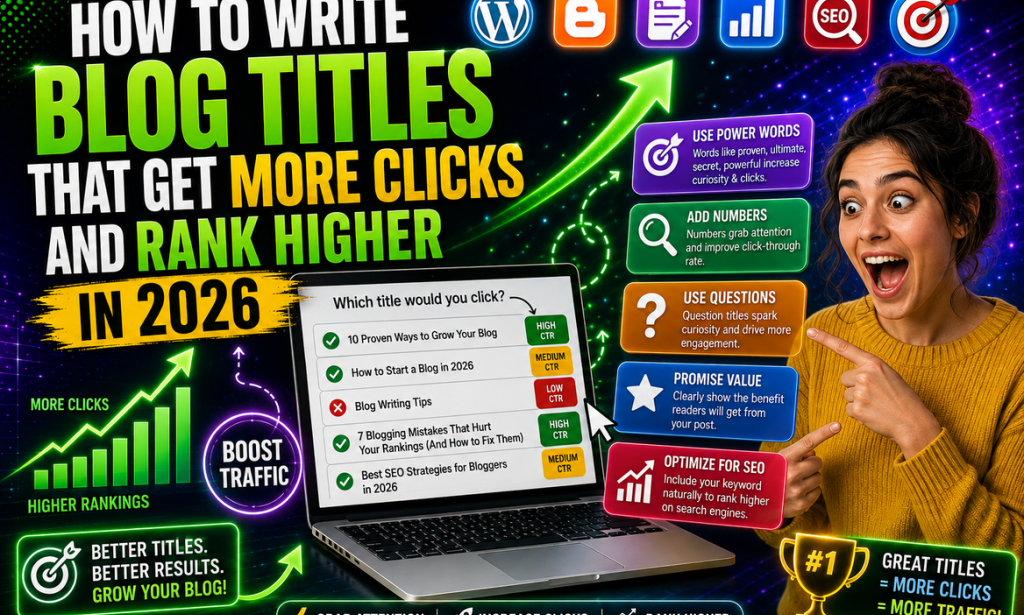
How to Write Blog Titles That Get More Clicks and Rank Higher in 2026
Complete Step-by-Step Guide
Your blog title is one of the most important parts of your article.
Before anyone reads your introduction, looks at your images, or discovers how useful your content is, they usually see your title first.
A great article with a weak title can be ignored.
A clear, compelling title can attract attention, earn more clicks, and bring more visitors to your website.
In 2026, writing effective blog titles is not simply about stuffing keywords into a headline. You need to understand what people are searching for, what they expect to find, and why they should choose your article.
This guide shows you how to write blog titles that are useful, attractive, search-friendly, and more likely to earn clicks.
Why Blog Titles Matter
Your title performs several jobs at the same time.
It tells readers:
-
What the article is about
-
Who the article is for
-
What they can expect to learn
-
Why the article may be useful
-
Whether the article is worth clicking
Your title also gives search engines important context about your page.
For example:
Weak title:
“Blogging Tips”
The topic is too broad.
Better title:
“10 Practical Blogging Tips for Beginners in 2026”
The second title immediately communicates the topic, audience, format, and timeframe.
That extra information can make the title much more useful to a potential reader.
Step 1: Start With Search Intent
Before writing your title, understand what the searcher actually wants.
Search intent is the reason behind a search.
Someone searching:
“how to start a blog”
probably wants instructions.
Someone searching:
“best blogging tools”
may want recommendations.
Someone searching:
“WordPress vs Blogger”
probably wants a comparison.
Someone searching:
“blogging mistakes”
may want to learn what to avoid.
Your title should match that intent.
For example, if people want a tutorial, a title such as:
How to Start a Blog: A Simple Beginner's Guide
is more appropriate than:
The Ultimate Blogging Information Resource
Be specific about what the reader will get.
Step 2: Put the Main Keyword in the Title
If you are targeting a specific keyword, use it naturally in your title.
Suppose your target keyword is:
keyword research for free
Possible titles include:
How to Do Keyword Research for Free in 2026
or:
How to Do Keyword Research for Free and Find Easy Ranking Topics
The important keyword appears naturally without making the title sound robotic.
Avoid forcing the same keyword multiple times.
For example:
Keyword Research for Free: Free Keyword Research Tools for Free Keyword Research
This looks unnatural and provides little value to the reader.
Write for humans first.
Step 3: Make the Benefit Clear
Readers want to know what they will get from clicking.
Compare these two titles:
Blog Email Marketing
and:
How to Build an Email List From Your Blog for Free
The second title communicates a clear outcome.
You can make your titles stronger by answering:
“What will the reader be able to do after reading this?”
Examples:
How to Get More Blog Traffic Without Paying for Ads
How to Build an Email List From Your Blog for Free
How to Find Low-Competition Keywords for Your New Website
How to Create a Blog Content Calendar in 30 Minutes
These titles promise a specific result.
Step 4: Use Numbers When They Make Sense
Numbers can make titles easier to scan.
Examples:
-
7 Ways to Get More Blog Traffic
-
10 Free SEO Tools for Beginners
-
15 Blog Post Ideas for Small Businesses
-
5 Keyword Research Mistakes to Avoid
-
21 Free Ways to Promote Your Blog
Numbers work particularly well for list-style articles.
However, don't add a number simply because you think every title needs one.
If the article is a tutorial, a title such as:
How to Build a Blog From Scratch
may be better than:
7 Steps for How to Build a Blog From Scratch
Use numbers when they genuinely improve the title.
Step 5: Use Power Words Carefully
Some words can make a title more interesting.
Examples include:
-
Practical
-
Simple
-
Proven
-
Easy
-
Complete
-
Beginner-friendly
-
Essential
-
Effective
-
Free
-
Step-by-step
-
Powerful
-
Updated
For example:
SEO Tips
is fairly generic.
A stronger version might be:
10 Practical SEO Tips for Beginners in 2026
However, avoid exaggeration.
If your article isn't actually comprehensive, don't call it the “ultimate guide.”
If something isn't guaranteed, don't promise guaranteed results.
Your title should accurately represent the article.
Step 6: Create Curiosity Without Being Clickbait
Curiosity can increase interest, but there is a difference between curiosity and clickbait.
Clickbait might say:
You Won't Believe What Happens When You Start Blogging!
The reader has no idea what the article actually provides.
A better approach is to create curiosity while remaining specific:
7 Blogging Mistakes That Could Be Holding Your Traffic Back
The reader understands the subject but still wants to know what the mistakes are.
Good titles create interest without misleading the reader.
Step 7: Use Questions When Appropriate
Question-based titles can work particularly well when people are searching for answers.
Examples:
How Much Does It Cost to Start a Blog in 2026?
Can You Start a Blog With No Money?
How Long Does SEO Take to Work?
What Is the Best Blogging Platform for Beginners?
Question titles are especially useful for informational content.
If your article directly answers a question people are asking, consider making that question part of your title.
Step 8: Add Specificity
Specific titles are often stronger than vague ones.
Compare:
How to Make Money Blogging
with:
How to Make Money From a Blog in 2026 With Low Traffic
The second title establishes a much clearer scenario.
Another example:
SEO Tips
versus:
10 Free SEO Tips for New Websites With Low Authority
Specificity helps readers determine whether the article is relevant to them.
Step 9: Use “For Beginners” When Your Article Is Beginner-Friendly
If your article is specifically designed for beginners, tell them.
Examples:
How to Start a Blog in 2026: A Beginner's Guide
10 SEO Tips for Beginners
How to Do Keyword Research for Beginners
How to Build an Email List From Your Blog: Beginner's Guide
This helps the right audience identify your article.
You don't need to use “for beginners” in every article. Only use it when it accurately describes your content.
Step 10: Use the Current Year When It Adds Value
Adding 2026 can make sense when your article contains current information, updated strategies, current examples, or modern tools.
For example:
How to Start a Blog in 2026
can signal that the article is intended to be current.
But don't add a year simply to make old content look new.
If you use a year in the title, make sure you actually update the article.
Step 11: Study the Titles Already Ranking
One of the easiest ways to improve your title-writing skills is to study search results.
Search for your target topic on Google.
Look at the titles appearing on the first page.
Ask:
-
What words are they using?
-
Are they using numbers?
-
Are they answering questions?
-
Are they targeting beginners?
-
Are they promising a specific result?
-
How long are the titles?
-
What information do they include?
Don't copy them.
Instead, identify what makes them useful and then create something more specific or compelling.
Step 12: Find a Better Angle
Sometimes your keyword is competitive because every article approaches it in exactly the same way.
A different angle can make your content more interesting.
For example, instead of:
How to Start a Blog
you might write:
How to Start a Blog With No Money in 2026
Or:
How to Start a Blog as a Complete Beginner in 2026
Or:
How to Start a Small Niche Blog From Scratch
The core topic remains similar, but the audience and angle are more specific.
Step 13: Make the Title Match the Article
Never promise something your article doesn't deliver.
If your title says:
15 Free Ways to Get Blog Traffic
the article should actually provide 15 useful methods.
If your title says:
Complete Guide to Keyword Research
the content should be comprehensive enough to justify that description.
A mismatch between the title and article can disappoint readers.
The goal isn't simply to get a click.
The goal is to get the right click.
Step 14: Avoid Keyword Stuffing
Your title should sound natural.
Instead of:
Best Free SEO Tools: Free SEO Tools for SEO Beginners and Free SEO Tool Guide
write:
10 Free SEO Tools Every Beginner Should Know in 2026
The second title is cleaner and easier to understand.
Use the main keyword naturally and focus on communicating value.
Step 15: Use a Simple Title Formula
You can create dozens of useful titles with a few basic formulas.
Formula 1: How-To
How to [Achieve Result] in [Timeframe]
Example:
How to Get More Blog Traffic in 30 Days
Formula 2: Number + Benefit
10 [Things] That Can Help You [Result]
Example:
10 Free Tools That Can Help You Grow Your Blog
Formula 3: Beginner
How to [Do Something]: A Beginner's Guide
Example:
How to Build an Email List: A Beginner's Guide
Formula 4: Problem + Solution
[Problem]? Here's How to [Solution]
Example:
Not Getting Blog Traffic? Here's How to Find Better Topics
Formula 5: Free Method
How to [Achieve Result] for Free
Example:
How to Find Blog Keywords for Free
Formula 6: Mistakes
7 [Topic] Mistakes to Avoid in 2026
Example:
7 SEO Mistakes New Bloggers Should Avoid in 2026
These formulas give you a starting point, but always customize the title for your specific audience.
Step 16: Write Several Titles Before Choosing One
Don't settle for the first title that comes to mind.
Write at least five alternatives.
For example, if your topic is getting backlinks:
-
How to Get Backlinks for Free in 2026
-
10 Free Ways to Build Backlinks for a New Website
-
How to Build Backlinks Without Paying for SEO
-
How New Websites Can Get Backlinks for Free
-
7 Simple Ways to Get Your First Backlinks
Now compare them.
Which one is:
-
Most specific?
-
Most useful?
-
Most relevant to the search intent?
-
Most attractive?
-
Most accurate?
Choose the strongest version.
Step 17: Optimize for Humans, Not Just Search Engines
Search optimization is important, but your title should still sound like something a real person would want to read.
Imagine seeing your title in a list of ten search results.
Would you understand it immediately?
Would you know what the article is about?
Would you have a reason to click?
If the answer is no, rewrite it.
A keyword appearing in the title is useful, but a compelling and accurate title is more important than forcing awkward SEO language.
Step 18: Think About the Search Results Page
Your title doesn't exist by itself.
It appears beside other titles.
That means you should think about how yours looks when compared with competing results.
If every result says:
10 Best SEO Tools
you could make yours more specific:
10 Free SEO Tools for Beginners in 2026
If everyone is targeting experienced marketers, you could target beginners.
If competitors write broad guides, you could solve one specific problem.
Your goal isn't necessarily to have the most exciting title.
Your goal is to make your result clearly relevant to the person searching.
Step 19: Improve Your Titles After Publishing
Your title doesn't always have to remain unchanged forever.
If an article receives search impressions but relatively few clicks, the title may be worth reviewing.
Look at your search performance data and ask:
-
Is the title clear?
-
Does it match the search query?
-
Is the benefit obvious?
-
Is it too generic?
-
Does it accurately represent the content?
-
Could the wording be more specific?
Make thoughtful changes and monitor what happens.
Don't repeatedly change titles without a reason.
Step 20: Build a Swipe File of Good Titles
Whenever you find an excellent blog title, save it.
Create a simple document or spreadsheet containing examples.
Organize them into categories such as:
-
How-to titles
-
List titles
-
Question titles
-
Comparison titles
-
Beginner titles
-
Mistake titles
-
Case study titles
-
Tutorial titles
Over time, you'll develop your own collection of proven title structures.
You won't copy the titles.
You'll use them as inspiration for creating original headlines.
Examples of Weak vs. Strong Blog Titles
Example 1
Weak:
Blogging Tips
Stronger:
10 Practical Blogging Tips for Beginners in 2026
Example 2
Weak:
SEO
Stronger:
How to Improve SEO for a New Website in 2026
Example 3
Weak:
Keyword Research
Stronger:
How to Do Keyword Research for Free and Find Easy Ranking Topics
Example 4
Weak:
Email Marketing
Stronger:
How to Build an Email List From Your Blog for Free
Example 5
Weak:
Blog Traffic
Stronger:
15 Free Ways to Get More Traffic to Your Blog in 2026
Simple Blog Title Checklist
Before publishing your article, ask:
-
Does the title clearly explain the topic?
-
Does it match the search intent?
-
Is the main keyword included naturally?
-
Does it communicate a clear benefit?
-
Is it specific enough?
-
Is the title accurate?
-
Would a real reader understand it immediately?
-
Does it avoid unnecessary keyword stuffing?
-
Does it stand out from competing titles?
-
Does the article actually deliver what the title promises?
-
Is “2026” useful and supported by updated content?
-
Have I compared several possible titles?
Common Blog Title Mistakes
1. Making Titles Too Vague
A title such as “Online Marketing Tips” doesn't tell the reader enough.
Be specific.
2. Writing for Search Engines Instead of People
Don't turn your title into a collection of keywords.
Make it natural.
3. Using Clickbait
A misleading title might attract clicks but can damage reader trust.
4. Making False Promises
Avoid claims such as guaranteed rankings, guaranteed traffic, or guaranteed income unless you can genuinely support them.
5. Making Every Title the Same
If every article follows the exact same structure, your blog can become repetitive.
Experiment with different formats.
6. Forgetting the Reader
Always ask:
“Why would this particular person want to read this?”
Your answer should influence your title.
Final Thoughts
Writing better blog titles is a skill that improves with practice.
The strongest titles are not necessarily the loudest or most sensational. They are clear, relevant, specific, useful, and designed around what the reader is actually looking for.
Start by understanding search intent.
Then include your main keyword naturally, communicate a clear benefit, use numbers or questions when appropriate, and make your title specific enough to stand out.
Most importantly, make sure your article delivers exactly what the title promises.
A great title can help your content earn more attention, but the content itself must provide the value that keeps readers coming back.
In 2026, focus on writing titles for real people with real questions.
Better titles can lead to more qualified clicks, more traffic opportunities, and a stronger blog over time.
Write for the searcher first, optimize naturally, and always deliver on your promise.


You must be logged in to post a comment.