
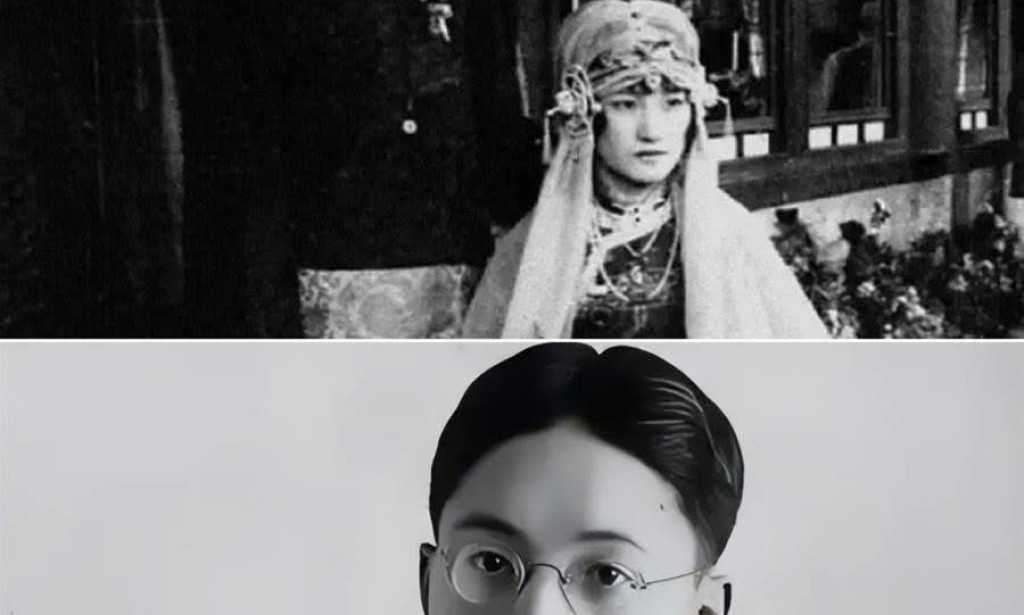
Poet love story
---
【Saying Goodbye to Cambridge Again】Xu Zhimo: A Literary Genius, a Romantic Scoundrel
"Gently I leave, just as gently I came; Gently I wave goodbye to the clouds of the western sky."
Xu Zhimo's "Saying Goodbye to Cambridge Again" is widely known. This talented man of the Republic of China era was a man of many loves, not only writing numerous timeless masterpieces but also leaving behind several romantic escapades for posterity. In the literary world, he was a representative figure of the Crescent Moon School and a giant of the Republic of China's poetry scene; in love, his several marriages and separations left behind a legacy of enigmatic romanticism. As a poet, his works were excellent; but as a lover, his romantic history is less than admirable.
Xu Zhimo (1897-1931) is best known for his relationship with Lu Xiaoman in his later years. But besides Lu Xiaoman, his longing and admiration for Lin Huiyin, and his abrupt departure from his wife Zhang Youyi, are also considered romantic tales of the Republic of China era. Is it true that literary figures have always been prone to romantic escapades? Behind every romantic literary figure lies a heartbreaking love story?
Pursuing Freedom, He Abandoned a Prestigious Family to Marry His First Wife
Zhang Youyi was Xu Zhimo's first wife, arranged by a prominent matchmaker. They married in 1915. Xu Zhimo was 18, and Zhang Youyi was 15. The Zhang family came from a prominent Jiangsu family; both of Zhang Youyi's brothers had studied in Japan, and she herself had attended modern schools, making her a cultured woman of the new generation. However, although Zhang Youyi was virtuous, dignified, and generous, Xu Zhimo simply did not love her. Xu Zhimo was naturally romantic and disliked arranged marriages, but the Xu and Zhang families had political and social ties, and Xu Zhimo, unable to be independent, reluctantly accepted his parents' wishes.
In the early days of their marriage, Xu Zhimo tried hard to cultivate his love for his wife, and initially experienced happiness and joy. However, this marriage could not withstand the test of time. In 1918, Zhang Youyi gave birth to a son for Xu Zhimo, and the Xu family rejoiced. Xu Zhimo, studying abroad, also felt the joy of becoming a father for the first time and felt an increased longing for his wife. The couple entered the sweetest years of their relationship. However, being overseas, Xu Zhimo, a promising young man in his twenties, was exposed to the vast world of Western life, which broadened his horizons and made him, deeply influenced by traditional Chinese culture, increasingly admire the views on free love held by poet Byron and philosopher Russell.
During his studies in England, Xu Zhimo met the first woman he ever admired, Lin Huiyin, later known as a "talented woman of the Republic of China." Just as he was developing feelings for Lin Huiyin, Zhang Youyi arrived in London from China. The couple were reunited after a long separation, but Xu Zhimo felt no joy. A conflict erupted between them on their flight from Paris to London. Zhang Youyi had never flown before, so she vomited a whole bag on the plane. However, Xu Zhimo not only showed no concern for her, but also turned his face away, saying with disgust, "You're such a country bumpkin." After this, their relationship became strained. In Boston, Zhang Youyi revealed that she was pregnant again, but Xu Zhimo, seeing her condition, urged her to have an abortion. Soon after, he filed for divorce, abandoning Zhang Youyi's objections and leaving his wife in America without saying goodbye.
About a year later, Zhang Youyi gave birth to her second son and finally received a letter from Xu Zhimo, in which he formally requested a divorce:
"A loveless marriage is unbearable; freedom must be repaid with freedom. True life must be earned through struggle, true happiness must be earned through struggle, and true love must be earned through struggle! Our futures are limitless… We both have a heart for improving society and for benefiting humanity. We must set an example by being courageous and wise, respecting each other's dignity, and freely divorcing to end suffering. This is the beginning of happiness."
Zhang Youyi knew there was no hope for him to change his mind, so she agreed to the divorce request and signed the divorce agreement in the presence of her friend Jin Yuelin.
A Unrequited Love for a Talented Woman of the Republic of China
The story of Liang Sicheng, Lin Huiyin, Jin Yuelin, and Xu Zhimo—this complex tale of young literary figures in the Republic of China—remains a romantic memory of that era. Lin Huiyin, renowned as a talented woman of the Republic of China era, married Liang Sicheng (son of Liang Qichao), also an architecture graduate. The couple traveled extensively throughout Northwest China and Europe, conducting research and ultimately writing *A History of Chinese Architecture*, the first book in China to use Western architectural methods. When Lin Huiyin was just over thirty, still a high school student, she harbored feelings for Xu Zhimo, who was eight years her senior. However, she ultimately concluded about this relationship: "It wasn't my first love, it was never a love."
Xu Zhimo and Lin Huiyin's father, Lin Changmin, were old friends. Once, when Lin Changmin was in London on a business trip, Xu Zhimo went to his residence to see him. Lin Changmin was out, and the beautiful Lin Huiyin opened the door for Xu Zhimo. Lin Huiyin exuded a refined and elegant air, leaving a deep impression on Xu Zhimo. During their conversation, Xu Zhimo strongly felt that the woman he admired was right before him.
Xu Zhimo abandoned his wife and children back home to pursue Lin Huiyin, but Lin Huiyin and Liang Sicheng were deeply in love and she repeatedly rejected his advances. Some say that Xu Zhimo even asked his wife for a divorce to demonstrate the steadfastness of his love for Lin Huiyin. Lin Huiyin was rational. At this time, Xu Zhimo had already begun to make a name for himself in the literary world and gained some fame. The still-naive Lin Huiyin, even though she admired and liked Xu Zhimo and exchanged letters with him, knew that Xu Zhimo didn't love her as a whole, but rather his imagined "goddess." Lin Huiyin said, "If Xu Zhimo really married me, he would see my flaws." Lin Huiyin was still a minor at the time, yet she already foresaw the problems she would face if she were with Xu Zhimo.
Several years later, Xu Zhimo divorced Zhang Youyi, and Lin Huiyin also publicly began a relationship with Liang Sicheng. However, Xu Zhimo continued his relentless pursuit of Lin Huiyin, constantly writing her letters with sincerity, devotion, and meticulous care. When the Indian poet Rabindranath Tagore visited China, Xu Zhimo deliberately hosted him alongside Lin Huiyin, intensifying his pursuit and even invoking Tagore's name to plead his case. However, Lin Huiyin ultimately remained steadfast in her rejection of Xu Zhimo's ardent advances, choosing Liang Sicheng instead.
Fulfilling His Lover's Desires Leads to His Death in a Plane Crash
In the final years of his life, Xu Zhimo fell in love with Lu Xiaoman, later hailed as one of the four great beauties of the Republic of China era (alongside Lin Huiyin, Ruan Lingyu, and Zhou Xuan). The two became lovers, the envy of many. However, Xu Zhimo's desire to satisfy Lu Xiaoman's extravagant lifestyle ultimately led to his tragic end.
Lu Xiaoman (1903-1965) was born into a scholarly family, received an excellent education, and was fluent in English and French, skilled in music, calligraphy, painting, and chess. She also loved dancing and frequently attended social dances, attracting many admirers. However, spoiled by her parents from a young age, she lived the life of a pampered young lady, spending money like water. Although she married Wang Geng, her husband could not tolerate her willful and extravagant lifestyle, and the two gradually became estranged. Soon after, Xu Zhimo entered Lu Xiaoman's life. He doted on her, and Lu Xiaoman divorced her husband, marrying Xu Zhimo in 1926. Their love was passionate, even bordering on irrational. Xu Zhimo indulged Lu Xiaoman's extravagant lifestyle, supporting her continued lavish spending and tacitly approving her opium addiction.
To support Lu Xiaoman's enormous expenses, Xu Zhimo provided her with the equivalent of tens of thousands of Hong Kong dollars a month for laundry services. Over time, Xu Zhimo himself faced financial hardship, and the once-great writer was forced to borrow money from friends, accumulating a mountain of debt.
Desperate for money, Xu Zhimo traveled extensively throughout China to support Lu Xiaoman's materialistic desires, teaching and earning a living. After settling in Shanghai, he was forced to become a professor in the English Department of Peking University and also taught part-time at a women's university in Beiping. In the spring and summer of 1931 alone, he traveled between the north and south eight times. "So poor I could barely move" (see Xu Zhimo's letter to Lu Xiaoman dated October 23, 1931). Xu Zhimo's air travel wasn't "a willing risk, but simply to save money" (see Xu Zhimo's letter to Lu Xiaoman dated June 25, 1931). The ticket for the "Jinan" plane that later claimed Xu Zhimo's life was a gift from Mr. Bao Junjian, the head of the finance department of China National Aviation Corporation. The company intended to use the poet's name to promote its aviation business free of charge, but things didn't go as planned. In 1931, Xu Zhimo attended a lecture by his old friend Lin Huiyin in Beiping and perished in a plane crash on a flight from Xuzhou to Jinan. Due to Xu Zhimo's fame, the crash shocked the Chinese literary world.
The passionate are always hurt by the heartless.
Since ancient times, passionate love has only brought regret, and the passionate are always hurt by the heartless. The sentimental Xu Zhimo left behind moving poems, and later generations, looking back on his love history, can only sigh with regret and sorrow.
"You need not be surprised, nor need you rejoice, for in an instant, he vanished without a trace."
This short poem, titled "By Chance," was Xu Zhimo's own favorite. Fate, in its cruel twist of fate, transformed him into "a cloud in the sky," leaving his mark on the hearts of readers who loved his work.


You must be logged in to post a comment.