
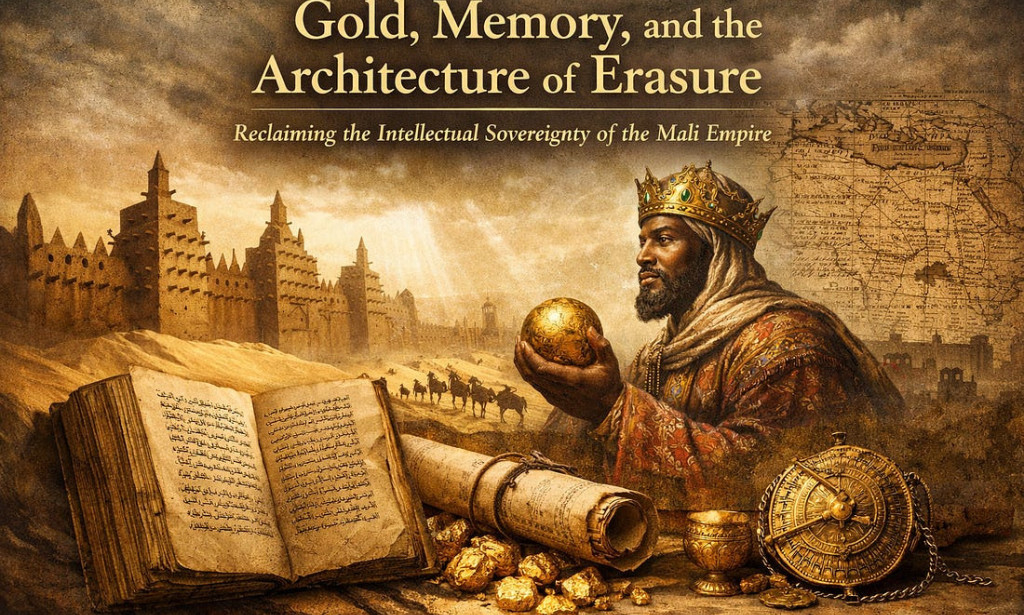
What nobody tells you about Africa...
History is not only about what happened.
It is about what was remembered — and what was allowed to be forgotten.
When we speak of the Mali Empire (c. 1230–1600 CE), particularly under the reign of Mansa Musa, we are not entering the realm of nationalist romance. We are entering documented global history.
Yet for centuries, that history was placed at the margins of the world narrative.
This essay is not an act of exaggeration. It is an act of restoration.
“The tragedy was not merely the loss of gold — it was the attempted looting of memory.”
I. An Empire at the Center of the Medieval World
By the 14th century, Mali was not peripheral — it was pivotal.
Its territorial reach stretched across much of present-day Mali, Senegal, Gambia, Guinea, Niger, and Mauritania. Its power rested on strategic control of trans-Saharan trade routes linking West Africa to North Africa and the Mediterranean basin. Gold from Bambuk and Bure flowed north; salt from Taghaza moved south. These were not minor commodities. Gold underwrote currencies across the Mediterranean world.
Medieval Arab chroniclers such as al-ʿUmarī described Mali as a land of astonishing wealth and order. When Mansa Musa undertook his famous pilgrimage to Mecca in 1324, he traveled with a caravan reportedly numbering in the tens of thousands. Contemporary accounts document that his distribution of gold in Cairo depressed its value for years — a rare case of a single ruler influencing a regional economy (see al-ʿUmarī’s accounts recorded in 14th-century Cairo archives).
Modern estimates that label him “the wealthiest individual in history” are speculative in numeric terms. But qualitatively, the scale of his economic influence is beyond dispute.
The 1375 Catalan Atlas — produced in Majorca — depicts him enthroned, holding a gold nugget. This is not folklore. It is medieval European cartography acknowledging African sovereignty.
Mali was known.
II. Timbuktu and the Civilization of the Manuscript
If gold was the empire’s visible wealth, knowledge was its invisible treasury.
Under Mansa Musa and his successors, Timbuktu emerged as a major intellectual hub. The mosque-university complex known as the University of Sankore became one of several centers of learning in the city, alongside Djinguereber and Sidi Yahya.
Contrary to colonial myth, pre-colonial West Africa was not an oral-only civilization. It was both oral and literate.
An estimated 300,000–700,000 manuscripts — preserved in family libraries — cover jurisprudence (fiqh), astronomy, medicine, grammar, theology, commercial law, and poetry. Scholars such as Shamil Jeppie and Abdel Kader Haidara have documented these collections extensively. UNESCO and the Hill Museum & Manuscript Library have participated in preservation and digitization initiatives.
These manuscripts demonstrate:
- Engagement with global Islamic scholarship
- Local legal debates and commercial contracts
- Astronomical calculations
- Medical treatises adapted to regional realities
This was not imitation. It was participation in a transcontinental intellectual network.
While European universities like Bologna and Paris were developing scholastic traditions, Timbuktu was also cultivating advanced scholarship within its own epistemological framework.
Different architecture. Equal complexity.
“Africa was not waiting to be discovered. It was already thinking.”
III. Decline, Complexity, and the Dangers of Simplification
Serious historical restoration requires intellectual honesty.
The decline of the Mali Empire was not caused by European colonialism. Internal succession disputes, regional fragmentation, and the rise of the Songhai Empire weakened Mali’s political cohesion in the 15th century. The Moroccan invasion of 1591 further destabilized the region.
However, the later European colonial era did something different — it reframed the narrative.
Colonial education systems in the 19th and early 20th centuries constructed Africa primarily as a site of extraction and “civilizing missions.” Pre-colonial empires were minimized or treated as anomalies. The result was not the destruction of Mali itself — that had already occurred through historical processes — but the marginalization of its memory.
This is what scholars call epistemic erasure.
Not the burning of every book — but the relocation of intellectual authority.
When a civilization’s achievements are excluded from global curricula, its descendants inherit a distorted mirror.
IV. The Politics of Historical Memory
The struggle over the Mali Empire is not about nostalgia.
It is about narrative sovereignty.
During the 2012–2013 conflict in Mali, local librarians and families secretly evacuated hundreds of thousands of manuscripts from Timbuktu to Bamako, often hiding them in metal trunks to protect them from destruction. This was not merely preservation of paper. It was preservation of continuity.
The act was political in the deepest sense: a refusal to allow memory to be extinguished.
Today, debates about restitution — including the return of African artifacts from European museums — signal a broader reckoning. When France returned royal artifacts to Benin in 2021, it marked a symbolic shift in global discourse. The question is no longer whether Africa had civilizations. The evidence is overwhelming. The question is how those civilizations are integrated into world history without distortion.
Decolonizing curriculum does not mean romanticizing the past.
It means expanding the archive.
V. Beyond Gold: Intellectual Sovereignty
The popular fascination with Mansa Musa’s wealth risks narrowing the story.
Gold is dramatic. Wealth is clickable.
But the deeper legacy of the Mali Empire is not bullion. It is intellectual infrastructure.
It is the idea that African societies:
- Built administrative systems
- Managed international diplomacy
- Cultivated higher education
- Produced written scholarship
- Preserved archives across centuries
The survival of the Timbuktu manuscripts is a testament not only to scholarship but to resilience.
Families hid them during invasions. Communities protected them during war. Archivists now digitize them for global access.
Memory fought back.
“Restoration is not romanticism. It is proportion.”
VI. A Poetics of Restoration
There is something symbolic about gold losing value in Cairo because one African ruler gave too much of it away.
It suggests abundance beyond expectation.
But perhaps the more radical image is quieter:
- Manuscripts carried in the night.
- Pages wrapped in cloth.
- Knowledge surviving invasion.
Civilizations are not only measured by what they build,
but by what they refuse to forget.
The restoration of Mali’s legacy is not about placing Africa above anyone else. It is about restoring proportion.
Africa was not waiting to be discovered.
It was already thinking.
And in many ways, it still is.
Conclusion: Toward an Expanded World History
The story of Mansa Musa and Timbuktu is not a corrective footnote. It is central to understanding the medieval global economy, Islamic intellectual networks, and the architecture of historical memory.
The task before us is not to create counter-myths. It is to insist on disciplined inclusion.
The archive exists.
The scholarship exists.
The manuscripts exist.
What changes now is not the past —
but our willingness to see it.
If the archive survives, what else have we been taught to overlook?
What does it mean to inherit a history that was never properly introduced to you?
“If this resonated, share it with one person who needs it.”


You must be logged in to post a comment.