
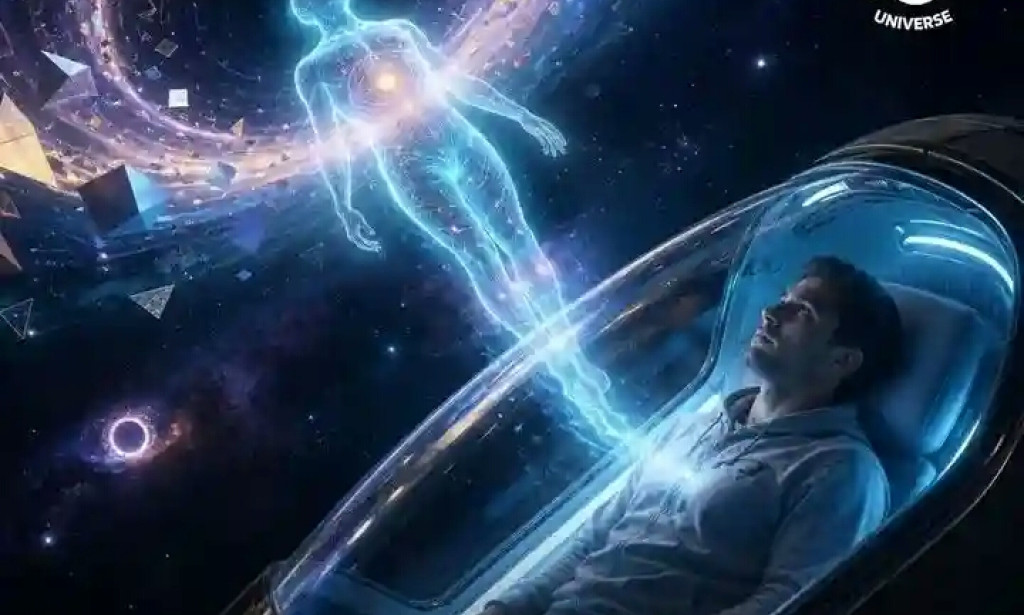
*THE MYSTERY OF DEATH IN SCIENCE*
Death is one of the things that has confused scientists the most since the study of life began. Even though science has advanced to the point where we can transplant hearts, replace organs, and even manipulate parts of the human body, scientists still haven’t discovered what death actually is. They know how the body decays after life leaves it, but they don’t know what “life” itself is.
In biology, death is defined as the point when the body stops carrying out essential functions like breathing, heartbeat, and brain activity. But this explanation doesn’t solve everything. Because the question that baffles scientists is: why can’t a body that still contains all the same organs and chemicals as a living person get up and live again after death?
There is a heart.
There are bones.
There is skin.
There is a brain.
There is blood.
But still, there is no movement.
This is why some leading scientists describe life as a secret that science can observe but not understand.
The strange thing is, everything in a person’s body remains after death, but one thing you cannot see disappears. That “thing” is what has thrown scientists into the dark. Science can measure brain weight, heartbeat, and body chemicals, but there has never been a machine that could detect where awareness, thought, or consciousness is located in the body.
Neuroscience researchers have spent years studying the brain trying to figure out how thought arises. They’ve discovered billions of neurons sending signals like electricity, but they still can’t explain how those signals produce fear, happiness, dreams, or self-awareness. This is called the “hard problem of consciousness” — the most difficult problem to solve in brain science.
Some scientists see the brain as just a computer. But others say that doesn’t explain life. Because a computer can process information, but it doesn’t feel pain, doesn’t feel fear, and isn’t self-aware. This makes people ask if there’s something beyond chemicals and electricity in human life.
Death also breaks some rules of scientific understanding. The human body changes completely within a few days after death. Cells that worked for years start breaking down rapidly. But what confuses scientists most is how life coordinates itself before death. The heart, liver, lungs, brain, and blood all work together in an incredibly complex system that no machine has been able to fully replicate.
Some scientists compare the human body to a vast world full of communication between trillions of cells. Yet despite this amazing system, a tiny change alone can bring death. This shows how fragile life is and how deep its mystery runs.
What further unsettles scientists is how people have a sense that death is not the end of everything. From ancient times to today, almost every society in the world has held some belief that there is continuation after death. Despite differences in religion and culture, this idea repeats itself almost everywhere in human history.
Some psychology experts see this as a mental mechanism to reduce the fear of death. But others believe there’s a reason this thought is so deeply embedded in human nature. Because many things in life only have meaning because people know life is limited. Death makes people question their origin, the purpose of life, and where they are going.
Science can calculate the age of stars. It can enter into cells. It can uncover the secrets of atoms. But it still can’t answer the question closest to humans:
What is life?
And when life leaves the body…
Where does it go?
To this day, there is no definite answer.
That’s why death remains one of the greatest mys teries that science has failed to solve.


You must be logged in to post a comment.