
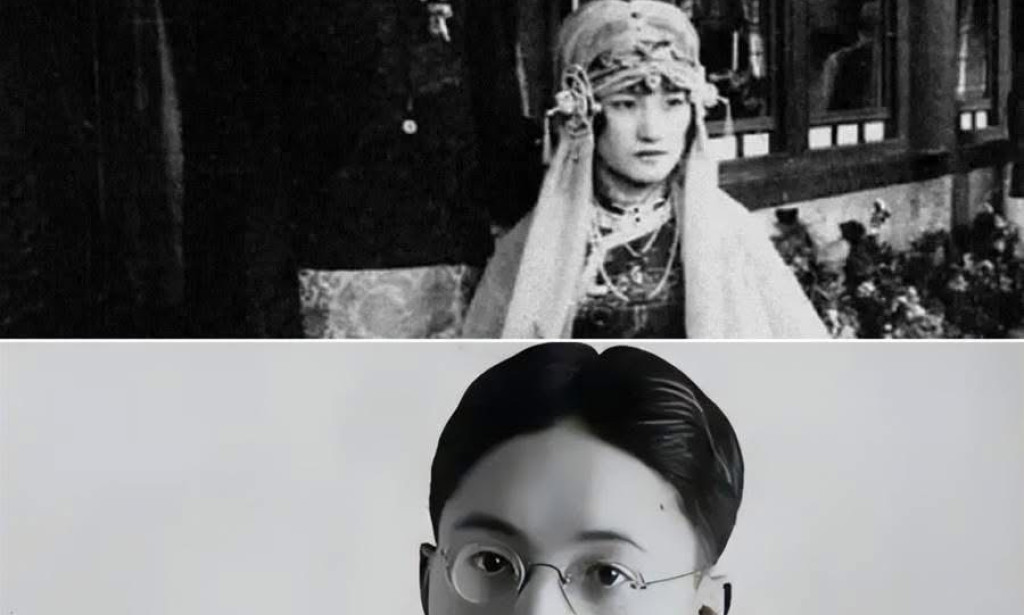
Xu Zhimo, at the age of 34, died a gruesome death. He had a hole in his forehead, all his front teeth were knocked out, and his entire body was fractured. His grave had been robbed, and his remains were nowhere to be found!
"My fate is uncertain." This was the last note Xu Zhimo left on Lin Huiyin's desk.
The next day, he died. He had a hole in his forehead, all his front teeth were knocked out, his legs were broken, and his hands were burned.
That year, he was 34 years old. A man who wrote "Gently I go, just as gently I came," left with far more difficulty.
Who was Xu Zhimo? In today's terms, he was a top figure of the Republic of China era.
He was born in 1897 in Haining, Zhejiang Province. His father, Xu Shenru, was the richest man in the area, owning a money exchange, a soy sauce shop, and other businesses—a true self-made millionaire. Xu Zhimo was the only son in his family, raised in luxury, a typical playboy.
But this playboy was restless.
At 18, his family arranged a marriage for him with Zhang Youyi, a woman from a prominent family. His wife was virtuous and dignified, but he didn't love her. Not long after the marriage, he went abroad to study—first in the United States to study banking, earning his degree in ten months, then going to Cambridge, England, ostensibly to study political economy, but actually to begin writing poetry.
It was in Cambridge that he met Lin Huiyin.
Sixteen-year-old Lin Huiyin, traveling in Europe with her father Lin Changmin, met Xu Zhimo at a party. The talented and beautiful woman instantly captivated Xu Zhimo. He pursued Lin Huiyin madly, even making a decision that was explosive at the time—to divorce his pregnant wife, Zhang Youyi.
This was an explosive scandal in the Republic of China. A man with a wife and children, insisting on divorcing his wife to pursue another woman. His teacher Liang Qichao scolded him, his father Xu Shenru was furious, and public opinion was against him.
But Xu Zhimo didn't care. In 1922, he signed one of the earliest Western-style divorce agreements in modern history.
But he never expected that Lin Huiyin would leave without saying goodbye, being taken back to Beiping by her father and later marrying Liang Sicheng.
Xu Zhimo's unrequited love was all for naught.
In his despair, he met the second woman who captivated him—Lu Xiaoman.
Who was Lu Xiaoman? A leading socialite in Beiping, fluent in both English and French, skilled in painting, acting, and dancing. However, she was already married to Xu Zhimo's friend—the military officer Wang Geng.
Another extramarital affair. Another dramatic divorce.
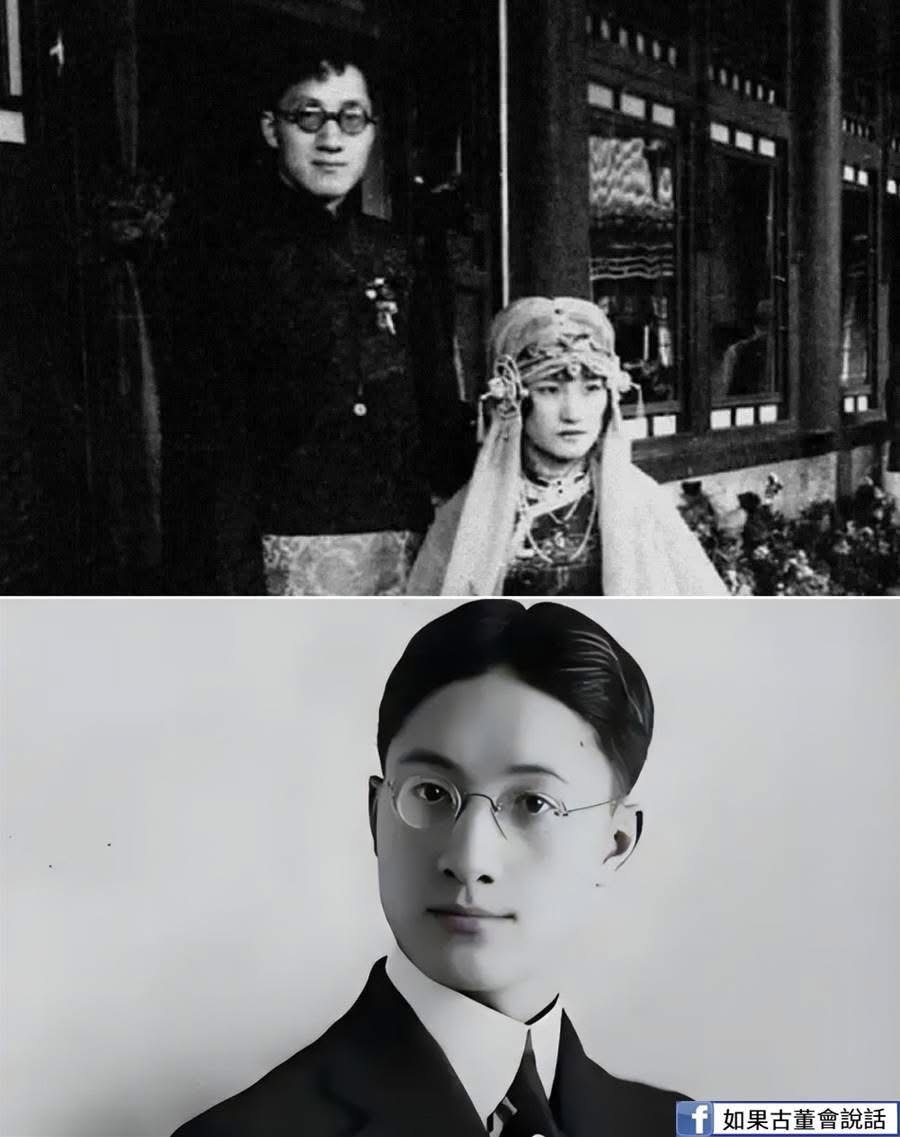
In 1926, Xu Zhimo and Lu Xiaoman finally married. But Liang Qichao, the officiant at the wedding, publicly berated the bride and groom in front of all the guests. Liang Qichao's original words, in essence, were: "You two are unfaithful; you must repent and mend your ways." He also added, "I hope this is your last marriage"—perhaps the most heartbreaking wedding vows of the Republic of China era.
And after the marriage? The honeymoon was sweet, but reality was bitter.
Lu Xiaoman spent money like water. A mansion, a driver, a cook, servants—she couldn't do without any. Even worse, she became addicted to opium. Xu Zhimo's monthly salary of over a thousand yuan—at a time when a library clerk's monthly salary was only five yuan—was still not enough to cover Lu Xiaoman's extravagance.
To earn money, Xu Zhimo had to travel back and forth between Beijing, Shanghai, and Nanjing, teaching part-time jobs everywhere. To save on travel expenses, he often hitched free rides on postal planes.
It was this frugal habit that cost him his life.
On November 17, 1931, Xu Zhimo advised Lu Xiaoman to spend less money and stop smoking opium. Lu Xiaoman exploded at this, and the two had a huge argument. In a fit of anger, Xu Zhimo left Shanghai for Nanjing.
At this time, he learned that Lin Huiyin would be giving a lecture on Chinese architectural art in Beiping on November 19th. He wanted to attend.
On the evening of November 18th, Xu Zhimo was having dinner at a friend's house. His friend, Han Xiangmei, suddenly asked him, "What if something happens tomorrow?" Xu Zhimo laughed and said, "Are you afraid I'll die?"
Han Xiangmei then asked, "Did Xiaoman say anything?"
Xu Zhimo laughed, "Xiaoman said that if I die in a plane crash, she'll be a promiscuous widow."
The whole table burst into laughter.
Before leaving, he also visited Ling Shuhua. Ling Shuhua jokingly wrote "Eternal Remembrance for Mr. Zhimo" in a notebook. Xu Zhimo saw it and laughed, saying, "How can he be eternally forgotten?"
No one could have imagined that these jokes would all become a self-fulfilling prophecy.
At 8:00 AM on November 19, 1931, Xu Zhimo boarded the "Jinan" postal plane of the airline, flying from Nanjing to Beiping (Beijing).
The pilot, Wang Guanyi, and the co-pilot, Liang Bitang, were both veteran pilots who had graduated from the Nanyuan Aviation School, both 36 years old. Besides the 40-odd pounds of mail, Xu Zhimo was the only passenger on board.
The weather was fine at takeoff. Arriving in Xuzhou at 10:10 AM, Xu Zhimo wrote to Lu Xiaoman from the airport, saying he had a headache. However, he still boarded the plane. At 10:20 AM, the plane took off again.
Around 1:00 PM, the plane flew over Dangjiazhuang, about 30 li (approximately 15 kilometers) south of Jinan. A thick fog blanketed the area. The pilots, trying to find a flight path, lowered their altitude and accidentally crashed into the top of Kaishan Mountain.
Oil spilled everywhere, the fuselage instantly caught fire, and the plane crashed to the foot of the mountain.
When local villagers and police arrived at the scene, this was what they saw: the two pilots were burned beyond recognition. Xu Zhimo's seat was towards the back, so he wasn't extensively burned, but—a large hole the size of a plum was ripped open in his forehead, a fatal injury. All his front teeth were knocked out. His leg was broken. His hands were severely burned.
The American pilot, An Lisheng, who investigated the crash, later determined that Xu Zhimo was killed by the impact, not by the burns. The plane crashed into the mountain, caught fire, and then plummeted. He was sitting in the back; the fire hadn't fully reached him before he was gone.
That evening, a light rain fell.
Liang Sicheng, far away in Beiping, went to Nanyuan Airport to pick him up as agreed, but he didn't arrive by 4:30 pm. His heart sank, and he called the police.
The next day, the *Beiping Morning Post* published news of the plane crash on its front page. The entire literary world was shaken.
Yu Gengyu, a friend of Xu Zhimo, rushed to Shoufo Temple in Jinan and saw Xu Zhimo's remains with his own eyes: "His face was slightly swollen, with some red and white marks... His eyes were not completely closed, the pupils were still slightly visible, as if he were staring blankly at someone."
The staff preparing the body for burial told him: "His legs were broken, his hands were badly burned, but the rest were not too serious."
Before the coffin, "a single coffin lay there, utterly alone." Yu Gengyu was deeply saddened.
After the body was transported back to Shanghai, the International Funeral Home was filled with mourners. Two women wept bitterly before the coffin: Lu Xiaoman and Zhang Youyi.
Hu Shi wrote in his diary: "Among my friends, there is truly no one like Zhimo, with such genius and such a profound character!"
Lu Xun—the one who had always been a literary critic of Xu Zhimo—silently cut out the news reports of the plane crash from the newspaper and tucked them into his diary.
Lin Huiyin, however, was devastated. She had Liang Sicheng retrieve a piece of aircraft wreckage from the crash site. She kept this piece by her bedside until her death.
Xu Zhimo was buried in his hometown of Wanshiwo, Dongshan, Haining, next to his father's grave. Hu Shi inscribed the words "Tomb of the Poet Xu Zhimo."
But even in death, the poet could not find peace.
In the autumn of 1966, the catastrophe struck. Xu Zhimo was labeled a "reactionary writer"—Red Guards bombed his grave, smashed his coffin, and destroyed his remains. A fertilizer plant was later built on the site of his grave.
Lu Xiaoman's fate was no better. After her death in 1965, her ashes were also lost in the catastrophe, vanished without a trace. Her only wish was to be buried in Xu Zhimo's grave—a wish that was never fulfilled.
It wasn't until 1983, through the tireless efforts of insightful individuals, that Xu Zhimo's tomb was rebuilt in Xishan, Haining. However, the new tomb contained no remains—only a stone and a copy of "Xu Zhimo's Chronology."
The once dashing and romantic poet was now reduced to a cold, lifeless stone in his place.
After Xu Zhimo's death, three women connected to him took three drastically different paths.
First, Lu Xiaoman.
When Yu Dafu arrived at Lu Xiaoman's home, he found her grief indescribable. Upon regaining her composure, her first instinct was to personally go to Shandong to retrieve the body, but she was firmly stopped by friends and family. Ultimately, it was Xu Zhimo and Zhang Youyi's son, Xu Jikai, who went to Jinan to retrieve his father's coffin.
When the coffin was transported back to Shanghai, Lu Xiaoman saw the only remaining possession—a long landscape scroll she had painted herself. Xu Zhimo had always kept it with him, originally intending to have it inscribed in Beijing. The scroll survived the fire only because it was stored in an iron box. The object survived, but the person was gone.
But the most heartbreaking thing is that Xu Zhimo's father, Xu Shenru, never forgave Lu Xiaoman until his death. The old man believed she was responsible for his son's death—if she hadn't been so extravagant, Zhimo wouldn't have had to work so hard to earn money; if she hadn't been so wasteful, Zhimo wouldn't have had to hitch a ride on a postal plane to save on travel expenses. At the memorial service in Haining and Xiashi, Xu Shenru gave a strict order: Lu Xiaoman was not allowed to attend.
You might think Lu Xiaoman would continue her former extravagant lifestyle. But the opposite was true.
After Xu Zhimo's death, Lu Xiaoman was a changed person. She stopped attending social gatherings, wore mourning clothes for the rest of her life, and devoted all her energy to organizing Xu Zhimo's manuscripts. The works that have survived to this day—*Zhimo's Diary*, *Selected Poems of Xu Zhimo*, and *The Complete Works of Zhimo*—are all thanks to her meticulous editing and proofreading, word by word.
In her later years, Lu Xiaoman lived in a small house in Shanghai, working as a member of the Shanghai Museum of Literature and History and a painter at the Chinese Painting Academy, earning a monthly salary of 80 yuan. The once-renowned socialite of Beiping ultimately became "thin and frail, her cheeks sunken, with only one or two teeth remaining"—these are the words of Zhang Fanghui, a student who later studied painting with her.
Her only wish was to be buried in Xu Zhimo's grave after her death. She passed away in 1965, and this wish remained unfulfilled.
Now, let's talk about Lin Huiyin.
On the day the devastating news arrived, Lin Huiyin fainted on the spot. That evening, she was giving a lecture on the history of Chinese architecture to foreign diplomats in a small auditorium in Beiping—the very lecture that Xu Zhimo had rushed to attend.
On December 6th, a memorial service was held in Beiping's cultural circles.
The venue was personally arranged by Lin Huiyin and Liang Sicheng, and more than 250 people, including Hu Shi and Zhou Zuoren, attended to pay their respects. In her essay "In Memoriam of Xu Zhimo," Lin Huiyin wrote with heartbreaking sighs, each word a lament.
But she did something even quieter, even more profound—she asked Liang Sicheng to bring back a piece of airplane wreckage from the crash site.
This piece of wreckage sat on her bedside table for 24 years, until her death in 1955. No words were spoken, no public weeping. Just a cold piece of metal, quietly placed there, unspoken, yet known to all.
Finally, let's talk about Zhang Youyi.
She was the longest-lived of the three women, passing away at the age of 88. After being abandoned by Xu Zhimo, she did not succumb to despair. She raised her son alone, ran a clothing company and a bank, and lived a successful life. After Xu Zhimo's death, it was her family—her eighth brother, Zhang Jiazhu—who rushed to Jinan to handle the funeral arrangements.
Later, she cared for Xu Zhimo's father until his death and buried him next to Xu Zhimo's grave. This abandoned ex-wife ultimately became the most dignified person to leave the Xu family.
Writing this, I can't help but sigh. Xu Zhimo lived his life with too much intensity.
He loved passionately, left hastily, died tragically, and didn't even have a proper grave. He pursued beauty and freedom throughout his life, only to have everything taken away by fate in the most brutal way.
The note left on Lin Huiyin's desk, "My fate is uncertain," seems like his ultimate epitaph for his short life.
34 years. Three relationships. A plane crash. An empty grave. He came quietly, but couldn't leave quietly.
"Quietly I leave, just as quietly I came. I wave my sleeves, not taking away a single cloud."—He couldn't take the clouds with him, but the clouds couldn't keep him either.
Let's discuss in the comments section: Do you think Xu Zhimo's life was worthwhile?


You must be logged in to post a comment.