
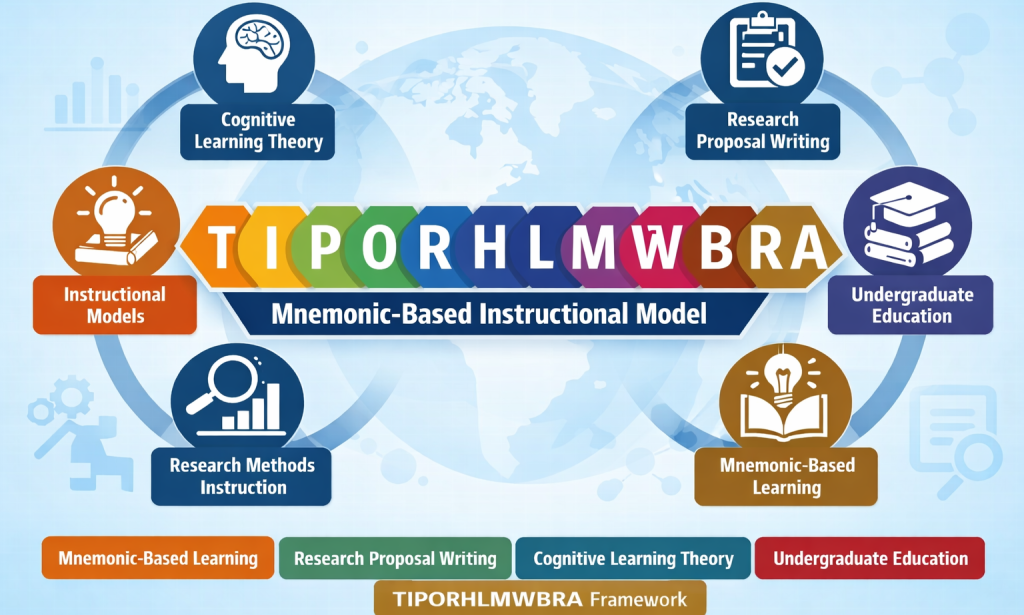
A Mnemonic-Based Instructional Model for Enhancing Undergraduate Understanding and writing of Research Proposal Structure
Nephiny .M.. Nyagaka, Meru university of Science and Technology
School of Agriculture and Food Sciences, Department of Agriculture
Abstract
Research proposal writing is a foundational academic skill that underpins effective scholarly inquiry across disciplines. Despite its importance, undergraduate students frequently encounter difficulties in understanding, organizing, and presenting the essential components of a research proposal. These challenges often stem from the abstract nature of research concepts, limited prior exposure to systematic inquiry, and instructional approaches that emphasize content coverage over cognitive structuring. This paper presents a mnemonic-based instructional model designed to support undergraduate students in memorizing, organizing, and applying key research proposal components. The TIPORHLMWBRA framework is introduced and discussed as a pedagogical tool grounded in cognitive learning theory, particularly principles related to memory, information processing, and cognitive load management. Drawing on existing literature in research methods pedagogy and cognitive psychology, the paper explores the relevance of mnemonic strategies for research methods instruction. The pedagogical application of the framework is examined, with attention given to classroom integration, revision support, and learner-centered benefits. The discussion highlights the strengths, flexibility, and limitations of mnemonic-based learning in higher education contexts. The paper concludes by outlining implications for teaching practice and recommending areas for further research to evaluate the long-term effectiveness and adaptability of mnemonic frameworks in research education.
Keywords: Mnemonic-based learning; Research proposal writing; Research methods instruction; Cognitive learning theory; Undergraduate education; Instructional models; TIPORHLMWBRA framework
1. Introduction
Research proposal writing is a critical academic competency that forms the foundation of scholarly inquiry, academic research, and evidence-based practice. At the undergraduate level, the ability to develop a coherent and well-structured research proposal is often a prerequisite for project work, dissertations, and capstone studies across disciplines. A research proposal not only outlines the intended study but also demonstrates a student’s understanding of research problems, theoretical grounding, methodological rigor, and ethical considerations. As such, proposal writing serves as both a learning tool and an assessment mechanism for evaluating students’ research preparedness.
Despite its centrality, research proposal writing remains a challenging task for many undergraduate students. Common difficulties include identifying and articulating a clear research problem, logically sequencing proposal components, distinguishing between conceptual and empirical elements, and selecting appropriate research methods. These challenges are often compounded by limited research experience, anxiety associated with academic writing, and unfamiliarity with the conventions of scholarly discourse. In many instructional contexts, students are introduced to research proposal writing through lectures or textbooks that present components in isolation, without sufficient emphasis on cognitive organization or memory support.
The increasing diversity of undergraduate learners further underscores the need for instructional innovations in research methods education. Students enter higher education with varied academic backgrounds, learning preferences, and levels of preparedness. Traditional approaches that rely heavily on abstract explanations and dense textual materials may disadvantage learners who struggle with information overload or who benefit from structured, scaffolded learning aids. Consequently, there is a growing recognition of the need for pedagogical strategies that enhance clarity, engagement, and retention in the teaching of research methods.
Mnemonic-based learning represents one such instructional innovation. Mnemonics are cognitive tools that support memory by organizing information into meaningful, memorable patterns. When applied thoughtfully, mnemonic strategies can reduce cognitive load, facilitate recall, and support the integration of complex concepts. This paper argues that mnemonic-based instructional models can play a valuable role in research proposal writing instruction by helping students internalize the structure and logic of a proposal. The introduction of the TIPORHLMWBRA framework responds to this pedagogical need by offering a structured, cognitively grounded approach to organizing research proposal components.
2. Literature Review
2.1 Teaching Research Methods in Higher Education
The teaching of research methods has long been recognized as a complex and demanding area of higher education pedagogy. Research methods courses are expected to equip students with theoretical knowledge, practical skills, and critical thinking abilities necessary for conducting scholarly inquiry. However, several studies have noted that students often perceive research methods as abstract, intimidating, and disconnected from real-world application. This perception can negatively affect motivation, engagement, and learning outcomes.
Traditional approaches to teaching research methods frequently emphasize procedural knowledge, such as data collection techniques and statistical analysis, while underemphasizing conceptual understanding and cognitive organization. As a result, students may memorize isolated components of a research proposal without fully grasping how these elements interrelate. Scholars have therefore called for learner-centered pedagogies that scaffold research learning, promote active engagement, and support the development of research literacy.
Mnemonic sentence structure “ Tall Intelligent, Problem Oriented Researchers Hypothesize Literature, Method, Workplan, Budgets, References, Appendices”
2.2 Cognitive Learning Theory and Mnemonics
Cognitive learning theory provides a useful framework for understanding how students acquire, process, store, and retrieve information. Central to this theory is the notion that learning involves mental processes such as attention, encoding, memory, and retrieval. Cognitive load theory further suggests that instructional designs should minimize unnecessary mental effort in order to optimize learning.
Mnemonics are well-established cognitive tools that enhance memory by associating new information with familiar patterns, imagery, or structured cues. Research in cognitive psychology has demonstrated that mnemonics can improve recall, especially when learners are required to remember sequences, categories, or complex information. By reducing the burden on working memory, mnemonic strategies enable learners to focus on deeper understanding and application.
2.3 Use of Memory Aids in Higher Education
In higher education, memory aids have been applied across a wide range of disciplines, including medicine, engineering, education, and the social sciences. Studies have shown that mnemonic-based learning can improve retention, support exam preparation, and increase learner confidence. Importantly, effective use of mnemonics goes beyond rote memorization; when combined with explanation and application, mnemonics can serve as cognitive organizers that enhance meaningful learning.
Despite their demonstrated benefits, mnemonic strategies remain underutilized in research methods instruction. This gap presents an opportunity to explore how structured memory aids can support undergraduate students in mastering the organization and logic of research proposals. The present study contributes to this literature by conceptualizing and articulating a mnemonic-based framework tailored specifically to research proposal writing.
3. Development of the Mnemonic Framework
The TIPORHLMWBRA mnemonic framework was developed to address the cognitive and pedagogical challenges associated with research proposal writing. The primary objective of the framework is to provide students with a structured, memorable guide that captures the essential components of a standard research proposal while reflecting their logical sequence.
The selection of components included in the framework was guided by their relevance to widely accepted research proposal structures across disciplines. Each element corresponds to a core section commonly required in undergraduate research proposals, ensuring alignment with institutional and academic expectations. Care was taken to avoid redundancy while maintaining completeness, so that the mnemonic could function as both a planning and revision tool.
Logical sequencing was a central consideration in the framework’s design. Research proposals follow a progressive flow, beginning with the identification of a topic and problem, moving through theoretical and methodological considerations, and concluding with anticipated outcomes and ethical considerations. The TIPORHLMWBRA framework mirrors this progression, enabling students to internalize not only the components but also their relationships and order.
By enclosing these elements into a single, coherent mnemonic, the framework aims to reduce cognitive overload and provide learners with a mental roadmap for proposal development. The mnemonic is intended to support understanding, recall, and application, rather than replacing detailed instruction or critical engagement with research concepts.
4. Pedagogical Application
4.1 Use of the Framework by Lecturers
Lecturers can integrate the TIPORHLMWBRA framework into research methods courses as an instructional scaffold. During introductory sessions, the framework can be used to provide an overview of research proposal components, helping students visualize the structure of a proposal before engaging with detailed content. Lecturers may refer back to the mnemonic throughout the course to reinforce connections between topics and maintain coherence.
The framework can also guide lesson planning and assessment design. By aligning lectures, tutorials, and assignments with the mnemonic components, instructors can ensure consistency and clarity in teaching objectives.
4.2 Classroom and Revision Integration
In classroom settings, the mnemonic can be incorporated into lectures, handouts, presentations, and visual aids. Group discussions and activities can be structured around individual components of the framework, encouraging collaborative learning and peer support. For revision purposes, the mnemonic serves as a quick-reference tool that helps students recall key elements during proposal writing and examination preparation.
4.3 Benefits for Learners
For learners, the TIPORHLMWBRA framework offers multiple benefits. It enhances organization, reduces anxiety associated with complex tasks, and promotes confidence in proposal writing. By providing a clear structure, the framework supports independent learning and enables students to self-assess the completeness of their work. Importantly, it encourages learners to view research proposal writing as a coherent process rather than a collection of disconnected tasks.
5. Discussion
The discussion highlights the strengths of mnemonic-based learning as an effective instructional approach in research methods education. Mnemonic strategies enhance information retention and promote quicker recall by organizing complex material into manageable units. In the context of research proposal writing, this organization is particularly valuable, as students must integrate multiple conceptual and procedural elements.
A notable strength of the mnemonic-based approach is its flexibility across disciplines. The TIPORHLMWBRA framework can be adapted to suit various academic fields without compromising methodological rigor. Lecturers can contextualize examples and applications while retaining the core structure, making the framework broadly applicable.
However, limitations must be acknowledged. Mnemonics risk oversimplification if used in isolation or without adequate explanation. They should complement, rather than replace, critical thinking, methodological training, and practical application. Additionally, individual differences in learning styles and cognitive preferences may influence the effectiveness of mnemonic strategies. Educators should therefore adopt a balanced approach that integrates mnemonics with other pedagogical methods.
6. Conclusion
This paper contributes to research methods pedagogy by presenting a structured, cognitively grounded mnemonic-based instructional model for research proposal writing. The TIPORHLMWBRA framework demonstrates the potential of mnemonic strategies to enhance clarity, organization, and learner engagement in undergraduate research education.
The findings underscore the relevance of context-responsive and learner-centered instructional approaches in improving conceptual understanding and practical competence. It is recommended that educators adopt and adapt mnemonic-based frameworks within research methods instruction to strengthen research capacity and confidence among undergraduate students.
Further research is encouraged to empirically evaluate the effectiveness of the TIPORHLMWBRA framework across disciplines and learning contexts, as well as to explore its long-term impact on research skill development and academic performance.
References
Creswell, J. W., & Creswell, J. D. (2018). Research design: Qualitative, quantitative, and mixed methods approaches (5th ed.). SAGE Publications.
Kothari, C. R. (2004). Research methodology: Methods and techniques (2nd ed.). New Age International.
Mayer, R. E. (2009). Multimedia learning (2nd ed.). Cambridge University Press.
McCabe, J. A. (2015). Demonstrating the mnemonic benefit of the method of loci. Teaching of Psychology, 42(2), 169–173. https://doi.org/10.1177/0098628315569937
Sweller, J., Ayres, P., & Kalyuga, S. (2011). Cognitive load theory. Springer.


You must be logged in to post a comment.