
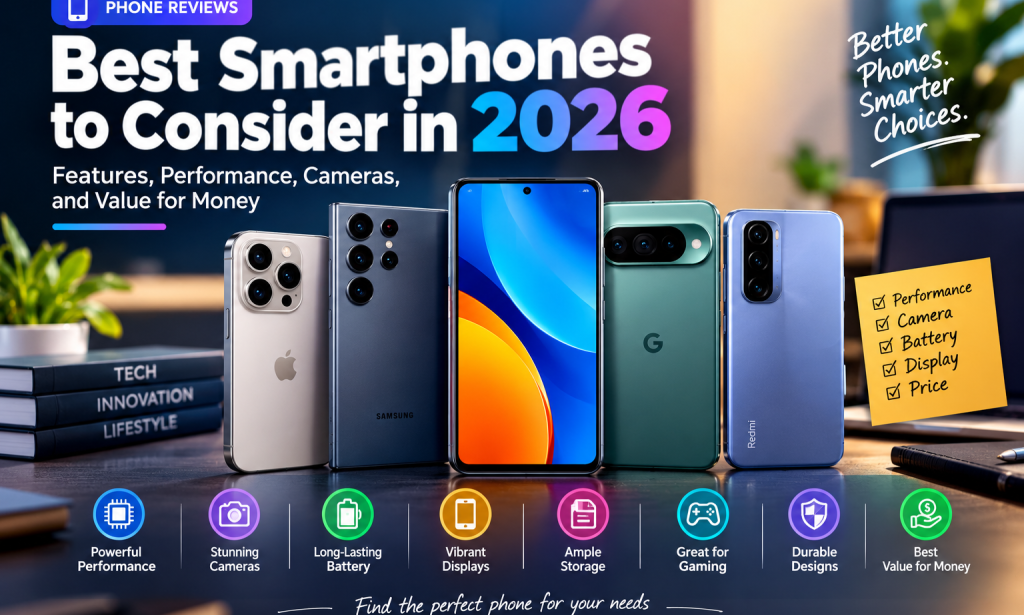
Best Smartphones to Consider in 2026: Features, Performance, Cameras, and Value for Money
Imagine buying a brand-new smartphone, opening the box, and discovering that the battery drains too quickly, your favourite games lag, or the camera struggles to capture clear pictures. Frustrating, right?
Choosing a smartphone has become more complicated because there are so many options available. Some devices focus on powerful performance, others prioritize photography, while some aim to deliver reliable everyday features at an affordable price.
The good news is that you do not need the most expensive phone to enjoy a great smartphone experience.
In this guide, we'll explore the features that matter most when choosing a smartphone in 2026, explain the differences between budget and premium devices, and share practical tips to help you make a smarter purchasing decision.
1. Performance: How Fast Is the Phone?
Performance is one of the first things to consider when reviewing a smartphone.
A phone's processor, memory, storage, and software all contribute to how smoothly it operates. These components affect everyday activities such as opening applications, switching between tasks, editing videos, and playing games.
For people who mainly use messaging applications, social media, and web browsers, an entry-level or midrange smartphone may provide sufficient performance.
However, users who enjoy demanding games or regularly edit high-resolution videos may benefit from a more powerful processor and additional memory.
It is also important to look beyond impressive specifications. Software optimization can make a difference in how a device performs during everyday use.
Our verdict: Choose performance according to your actual needs rather than paying extra for specifications you may never use.
2. Camera Quality: More Than Just Megapixels
Smartphone cameras have become powerful tools for photography, video recording, and content creation.
However, a camera's megapixel count does not tell the whole story.
Image processing, sensor quality, lens design, stabilization, and low-light performance can all influence the final result.
Some smartphones produce excellent photographs in daylight but struggle in darker environments. Others offer useful portrait effects, optical zoom, or advanced video recording features.
If you enjoy creating content for TikTok, Instagram, or YouTube, consider the front camera, video stabilization, microphone quality, and available recording resolutions.
It is also worth checking sample photographs and videos from independent reviewers before purchasing a device.
Our verdict: The best camera is not necessarily the one with the highest megapixel count. Look for consistent image quality in the situations where you take pictures most often.
3. Battery Life: Will It Last All Day?
Battery life can determine whether a smartphone feels convenient or frustrating.
A device with excellent performance and a beautiful display may still disappoint if it constantly needs to be recharged.
Battery capacity is commonly measured in milliamp-hours, or mAh. However, a larger battery does not automatically guarantee longer battery life.
The processor, display brightness, network connection, software, and applications running in the background also affect power consumption.
If you spend hours watching videos, playing games, using mobile data, or recording content, battery performance deserves particular attention.
Fast charging can be useful, but check whether the charger is included and whether the device supports the advertised charging speed.
Our verdict: Look for independent battery tests that show how long the phone lasts under realistic conditions, rather than relying only on its advertised battery capacity.
4. Display Quality: What Will You Be Looking At Every Day?
Your smartphone display affects almost everything you do, from reading messages to watching movies and playing games.
Several display features deserve attention.
Resolution: Higher resolution can produce sharper images and text, although the difference depends on screen size and viewing distance.
Refresh rate: Displays with higher refresh rates, such as 90Hz or 120Hz, can make scrolling and supported animations appear smoother.
Brightness: A bright display is easier to see outdoors, especially under strong sunlight.
Display technology: OLED displays generally offer deep blacks and strong contrast, while LCD displays can still provide good image quality.
A high refresh rate may also consume more power in certain situations, depending on the device and its display settings.
Our verdict: Choose a display that feels comfortable for reading, video playback, and gaming. Do not assume that the highest specification automatically provides the best experience for every user.
5. Storage and Memory: Avoid Running Out of Space
Few things are more annoying than receiving a message that your phone's storage is almost full just when you want to download an application or record a video.
Storage determines how many applications, photographs, videos, documents, and other files you can keep on your device.
Memory, usually called RAM, helps the phone manage active applications and multitasking.
If you frequently download games, record videos, or create social media content, you may need more storage than someone who mainly sends messages and browses the internet.
Remember that the operating system and preinstalled applications use some of the advertised storage.
Some phones also support microSD cards, while others do not. Check this before purchasing if expandable storage matters to you.
Our verdict: Consider your habits and future needs. Buying a phone with insufficient storage can become inconvenient long before the device itself stops working well.
6. Budget Smartphones vs Premium Smartphones
One of the biggest questions buyers face is whether to choose an affordable phone or spend more on a premium model.
Budget smartphones generally focus on essential features at a lower price. They can be suitable for messaging, browsing, online learning, photography, and everyday applications.
Midrange smartphones often offer a balance between price and performance. Depending on the model, they may provide better displays, more capable cameras, faster processors, or improved charging.
Premium smartphones typically compete through advanced cameras, powerful processors, high-quality materials, and additional software features.
However, expensive does not automatically mean suitable.
Someone who mainly uses WhatsApp, watches videos, and browses the internet may not need a flagship device. Meanwhile, a gamer or professional content creator may benefit from features available on more powerful models.
Our verdict: Identify your priorities and budget first. Then compare devices that meet your needs instead of automatically choosing the most expensive option.
7. Software Updates and Security Matter
A smartphone is more than its physical hardware. Its software affects usability, security, and long-term value.
Regular software and security updates can help protect a device and improve its functionality.
Before purchasing a phone, check the manufacturer's update policy. Find out how long the device is expected to receive operating-system upgrades and security patches.
This is particularly important if you plan to keep your phone for several years.
Also consider the software interface, preinstalled applications, available customization, and how easily you can transfer your files from an older device.
A phone with strong hardware but limited long-term support may not provide the best overall value.
Our verdict: Software support should be part of every smartphone buying decision, not an afterthought.
8. Gaming Performance: Can It Handle Your Favourite Games?
Mobile gaming has become an important reason many people choose particular smartphones.
Games can place heavy demands on the processor, graphics hardware, memory, and battery.
If you play titles such as eFootball or other demanding games, look for reliable performance tests using the games you actually play.
A high refresh rate can improve the visual experience in supported games, but it does not guarantee that every game will run at that frame rate.
Cooling is another important consideration. Some phones reduce performance when they become too hot, especially during extended gaming sessions.
Storage also matters because modern games can require substantial downloads and additional updates.
Our verdict: Look for sustained gaming performance, reasonable temperatures, adequate storage, and good battery life rather than judging a gaming phone by one specification alone.
9. Build Quality and Design: Looks Are Only Part of the Story
A smartphone's design affects how it feels and how practical it is to use.
Some buyers prefer slim, lightweight devices that are comfortable to carry. Others prioritize large screens, bigger batteries, or more substantial camera systems.
Materials also influence durability. Glass-backed phones can look premium but may require a protective case, while some plastic-backed devices are lighter and less expensive to repair.
Water- and dust-resistance ratings can offer additional protection, but they do not make a device indestructible. Resistance may also decrease as a phone ages or suffers damage.
Before buying, check the dimensions, weight, button placement, fingerprint sensor, and charging port.
Our verdict: A good design should combine appearance, comfort, practicality, and durability.
10. How to Choose the Right Smartphone in 2026
Before spending your money, ask yourself five important questions.
First: What is my budget?
Set a realistic spending limit and remember to include accessories or other necessary costs.
Second: What will I use the phone for?
Gaming, photography, schoolwork, content creation, and everyday communication place different demands on a device.
Third: How important is battery life?
If you frequently spend long periods away from a charger, prioritize reliable battery performance.
Fourth: How long do I want to keep the phone?
A device with dependable software support and sufficient storage may offer better long-term value.
Fifth: Is the seller trustworthy?
Buy from a reputable seller, check the warranty, inspect the device carefully, and confirm that the phone is compatible with your mobile network.
It is also sensible to compare independent reviews and check prices from multiple sellers before making a final decision.
A few minutes of research can help you avoid an expensive mistake.
Final Verdict: The Best Phone Is the One That Fits Your Needs
Smartphone technology continues to evolve, offering buyers more choices than ever.
Powerful processors, capable cameras, brighter displays, larger storage options, and improved software support can all contribute to a better experience. However, not every buyer needs every premium feature.
The smartest approach is to identify what matters most to you and compare devices based on those priorities.
For gamers, sustained performance and cooling may be essential. For content creators, camera quality and storage may matter more. For everyday users, dependable battery life, smooth operation, and a reasonable price may be enough.
Before making a purchase, read independent reviews, compare specifications, and check the manufacturer's support policy.
Remember: the best smartphone is not necessarily the most expensive one. It is the one that gives you the features you need, performs reliably, and offers good value for your money.
Now tell us: What matters most when you buy a smartphone—camera quality, gaming performance, battery life, design, or price?
Join the conversation and share your thoughts!


You must be logged in to post a comment.