
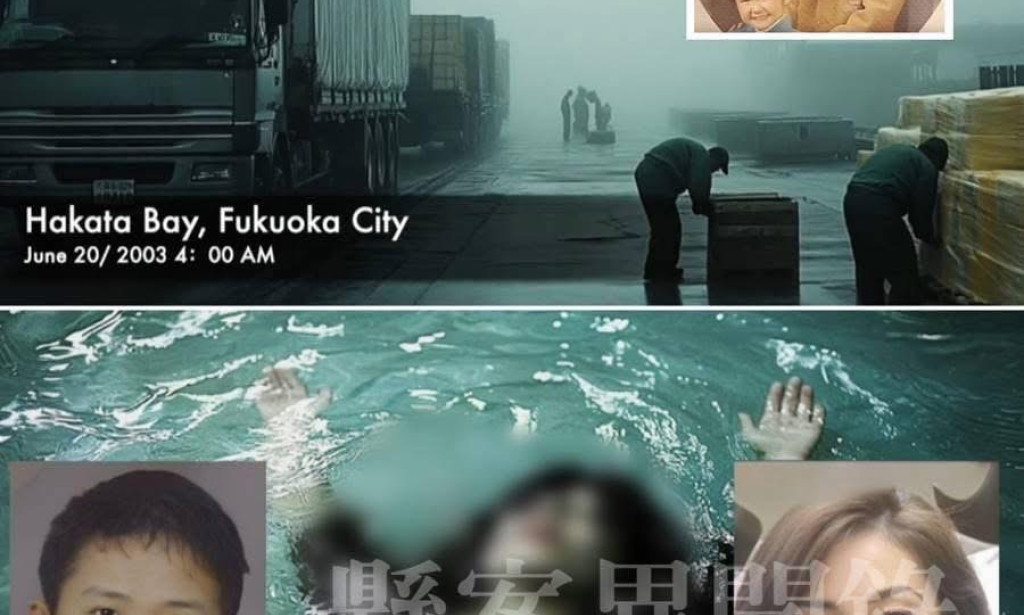
Fukuoka Family Murder Case: A Family of Four Chained and Sinking into Hakata Bay; Three International Students' Bloody Crime Finally Receives the Death Penalty 16 Years Later
On the morning of June 20, 2003, two bodies, handcuffed together, floated to the surface of Hakata Bay in Fukuoka, Japan. Dockworkers initially mistook them for drifting garbage, but when their flashlights shone on them, they froze in shock. It wasn't garbage; it was a man and a woman, their bodies firmly bound together, as if someone had deliberately intended to keep them forever at the bottom of the sea, never to return to the world of the living. Even more horrifying, shortly after, two smaller figures surfaced—a boy and a girl, also handcuffed and strapped with dumbbells. At this point, Fukuoka police finally realized this was not a simple case of dumping corpses, but a horrific murder of a family of four.
The victims were the Matsumoto family: 41-year-old Shinjiro Matsumoto, his 40-year-old wife Chika Matsumoto, and their two young children. They lived in a quiet neighborhood in Fukuoka's Higashi Ward. Although the family had experienced business failures and debt, in the eyes of their relatives and friends, they persevered and never gave up hope. No one could have imagined that overnight, their home would be completely destroyed by three young people. What shocked Japanese society even more was that the three suspects who committed this brutal crime were all international students from China.
The story begins with a failed robbery a few days earlier. Late at night in mid-June 2003, in a narrow alley in Fukuoka's red-light district, a woman who had just finished work was heading home. As she turned into the dark alley, she was suddenly blocked by three men in their twenties. One of them threatened her with a knife, demanding her valuables. However, the three men hadn't anticipated that this area was a melting pot of people, with some shops having lookouts. Before they could even steal anything, they were subdued and severely beaten by the burly men. A normal person in this situation might have been frightened or stopped, but these three men didn't. They didn't dare vent their anger on stronger individuals, but instead directed their resentment at an unsuspecting ordinary family.
A few days later, they targeted the Matsumoto family. In their eyes, the Matsumoto family lived in a nice house and drove a Mercedes-Benz, appearing wealthy. But what they didn't know was that the family was already burdened with heavy debt, and their lives weren't as glamorous as they seemed. But for those consumed by greed, the truth didn't matter; they only wanted to rob them.
On the night of the incident, the three men, armed with handcuffs, dumbbells, and other tools, broke into the Matsumoto family home. The sound of breaking glass could be heard from inside. Matsumoto Chika was home at the time. Hearing the commotion, she went upstairs to investigate, only to witness a scene that would devastate any mother: strangers had entered her home, and her child was being held captive. Chika instinctively resisted. It wasn't that she wasn't afraid; she was just a mother. In that moment of danger for her child, she had no time to think about her own safety; she could only desperately protect her family. But against three well-prepared assailants, she was ultimately powerless to resist.
The forensic doctor later found signs of assault on her body and skin fragments under her fingernails. What did that mean? It meant that in her final moments, she had fought back with all her might. She hadn't quietly awaited death; she had grabbed, struggled, and resisted, trying to buy herself and her child a chance to survive. Unfortunately, she ultimately failed to escape.
Shortly after, Shinjiro Matsumoto returned home and was also subdued by the three men. The robbery ultimately yielded only about 40,000 yen. For a mere 40,000 yen, a family of four paid the ultimate price. Even more infuriatingly, the three men didn't stop after the crime. To cover up their offenses, they handcuffed, chained, and used dumbbells to restrain the Matsumoto family's bodies, then drove their car into Hakata Bay that night. They thought that as long as the sea was deep enough, the truth would be buried forever. But fate did not allow this family to disappear without a trace. On the morning of June 20th, Hakata Bay returned them to the world of the living.
On the same day, Matsumoto Shinjiro's father also sensed something was wrong. The elderly man usually went to his son's house early in the morning to help take his grandson to school, but that day, no one answered the door no matter how much he knocked. After entering the house with a spare key, he found the living room window broken, the house in disarray, suspicious traces in the bathroom, and his son's Mercedes-Benz missing. The elderly man immediately called the police, who quickly linked the four bodies found in Hakata Bay to the missing Matsumoto family.
Fukuoka was shaken. A family of four, a late-night break-in, chains thrown into the sea, a woman assaulted, and a child also victimized—these keywords plunged the entire city into panic. Police began their investigation at the scene. Because dumbbells were strapped to the bodies, they deduced that the perpetrator might have purchased such equipment. They began checking fitness equipment stores in Fukuoka. Soon, surveillance footage from one store caught their attention. The footage showed a young man entering the store, heading straight for the dumbbell section, and looking around nervously while buying the items.
After police released a sketch of the suspect, a language school student provided a clue, saying the person in the sketch closely resembled a Chinese student named Wang Liang at the school. Wang Liang, 21 years old, from Changchun, Jilin Province, originally came to Japan to study but was expelled for poor grades, bad behavior, and even assaulting a classmate. After being expelled, he lost his legal residency status but did not return to China, instead remaining in Japan without his family's knowledge.
When police arrived at his rented apartment, Wang Liang had already fled. However, the hair left inside matched the DNA found on the female homeowner's fingernails. An investigation of immigration records revealed that Wang Liang had already returned to China, turning the case into a transnational manhunt. Chinese police, after receiving a request for assistance, quickly launched an investigation in Jilin and Liaoning provinces. After returning to China, Wang Liang changed his name and worked in a factory in Liaoyang, Liaoning. However, his unusually high spending habits, including frequenting upscale restaurants, quickly aroused suspicion. Following a tip, police arrested him.
After his arrest, Wang Liang implicated two other accomplices: Yang Ling and Wei Wei. Yang Ling, also from Changchun, Jilin, was originally a good student and had even been admitted to a Japanese university through hard work. However, after meeting Wang Liang in Japan, he gradually strayed from the right path, progressing from petty theft to robbery, and then to murder. On August 19, 2003, Chinese police arrested Yang Ling in a hotel in Liaoning, while Wei Wei, who remained in Japan to hide, was quickly apprehended by Japanese police.
Wei Wei, 24, was from Xinmi, Henan. He came from a well-off family; his parents ran a factory and had high hopes for him. Wei Wei wasn't always a bad kid; he was once an excellent student, but later skipped classes, got into fights, and frequented internet cafes, gradually becoming a child his parents couldn't control. His parents sent him to the army, hoping he would reform. After his discharge, he expressed a desire to study in Japan, which his family fully supported.
When Wei Wei first arrived in Japan, he did try hard. He wanted to get into Fukuoka University, but after failing the entrance exam two years in a row, his life began to spiral out of control. His poor Japanese, inability to integrate into local society, and loss of income made him increasingly withdrawn. Later, he met Wang Liang and Yang Ling at an internet cafe frequented by Chinese students. These three disillusioned, penniless, restless, and morally bankrupt individuals came together, ultimately dragging each other into a downward spiral.
Police investigations revealed that prior to the Matsumoto family murder, the three had already committed numerous robberies. They robbed international students, stole money from the shops where they worked, and even robbed women on the street. Their repeated successes emboldened them until the Matsumoto family murder, when their crimes spiraled completely out of control.
After their arrest, the three men began shifting blame. Wang Liang named accomplices, while Wei Wei pushed the responsibility back onto Wang Liang. Both Yang Ling and Wang Liang's confessions indicated that Wei Wei was a key figure in the case. However, regardless of who the mastermind and accomplice were, one thing remained unchanged: the Matsumoto family of four was gone forever.
On January 24, 2005, a Chinese court sentenced Yang Ling to death for intentional homicide, with the sentence carried out on July 12 of the same year. Wang Liang, due to his confession and cooperation, was sentenced to life imprisonment. Wei Wei was tried in Japan. In May 2005, the Fukuoka District Court sentenced Wei Wei to death. He appealed, repeatedly attempting to overturn the verdict, claiming he was not the mastermind, but was only influenced by Wang Liang and participated in the crime out of loyalty. However, the law did not accept this explanation.
Sixteen years later, on December 26, 2019, Wei Wei was executed in Japan. It is said that after being imprisoned, Wei Wei sent a letter to his parents containing only one word: "Regret." But whether this "regret" was regret for murder, regret for burdening his parents, or regret for not escaping legal punishment, outsiders will never know. For the Matsumoto family, all repentance came too late.
A husband, a wife, and two children should have continued living, growing up, and facing tomorrow, but because of the greed, cowardice, and cruelty of these three individuals, they were forever left behind in the dark night of June 2003. What is truly terrifying about this case is not just the brutality of the murders, but that these three murderers were once young people on whom their families had placed their hopes. They were not born monsters; they gradually abandoned their moral compass, repeatedly indulging their greed, ultimately turning themselves into monsters.
Therefore, the warning left to the world by the Fukuoka family murder case is never just about "not committing crimes." Rather, it is that when a person begins to think that minor evils are insignificant, begins to use the suffering of others as a tool to turn their life around, begins to use so-called loyalty to cover up greed, and uses disappointment to disguise violence, they are not far from the abyss. The judgment of the law may be delayed for many years, but the blood of the victims will not be washed away by the sea. No matter how much time passes, the truth will eventually surface



You must be logged in to post a comment.