
Comprehensive Analysis of KrestVillage
An In-Depth Review of the Earning Mechanics, Claims, and Hidden Risks
1. Introduction: The Lure of Digital Wealth
In recent years, the digital landscape in Nigeria and across the continent has seen an explosive proliferation of online earning platforms. Driven by a tough economic climate and the widespread availability of smartphones, millions of individuals are actively seeking alternative streams of income. Platforms that promise easy money from the comfort of one's home are incredibly attractive. KrestVillage is one of the latest entrants into this highly contested and often controversial space. By positioning itself as a "village," the platform attempts to build a sense of community, trust, and shared prosperity.
Based on the provided screenshots and promotional materials, KrestVillage offers multiple avenues for users to supposedly monetize their daily digital habits. The platform’s interface is slick, employing a modern dark-mode aesthetic with neon green and gold accents to convey a sense of premium financial technology. It provides features like Live VTU (Virtual Top-Up) feeds, an integrated marketplace, community chats, and a heavily gamified reward system. At a glance, it looks like a legitimate micro-tasking site. However, the true nature of any earning platform lies in its underlying economic model. This extensive review will dissect every aspect of KrestVillage, from its user interface and earning mechanics to its highly questionable reward structures and the overwhelming likelihood that it is an unsustainable economic model.
2. User Interface and the "Gamification" of Earning
First impressions matter, and KrestVillage has clearly invested in creating an appealing user interface. The platform utilizes a sleek, dark-themed dashboard that mimics modern fintech and cryptocurrency applications. This design choice is not accidental; it is psychologically engineered to make the user feel like they are interacting with a serious, high-value financial tool.
The dashboard is divided into intuitive sections: Home, Tasks, Chat, Market, and Profile. It features a "Live VTU Feed" that acts as a scrolling ticker, showing recent purchases of airtime and data by other users (e.g., "@acting bought airtime 100 KP on Mtn"). This creates a sense of FOMO (Fear Of Missing Out) and provides artificial social proof that the platform is active and legitimate.
Furthermore, KrestVillage employs heavy gamification to keep users engaged. It offers "Chat Streak Rewards," promising daily earnings (like ₦50+ or ₦650 for high streaks) simply for chatting and maintaining consecutive days of activity. This mechanic ensures daily active user (DAU) metrics remain high, which is crucial for maintaining the illusion of a vibrant ecosystem. Upgraded users are given a prominent "VVIP" badge in glowing gold, which appears on their profile, in the community chat, and on the marketplace. This creates a class system within the platform, socially pressuring free or lower-tier users to upgrade to achieve status and unlock higher earning potentials.
3. The Advertised Earning Mechanics: How Are You Supposed to Make Money?
KrestVillage advertises several primary methods for generating an income. According to the platform's claims and the AI-generated summary provided in the Meta search, users can build daily income through simple tasks, referrals, social media, and community engagement. Let us break down these core pillars:
A. Social Media Micro-Tasks
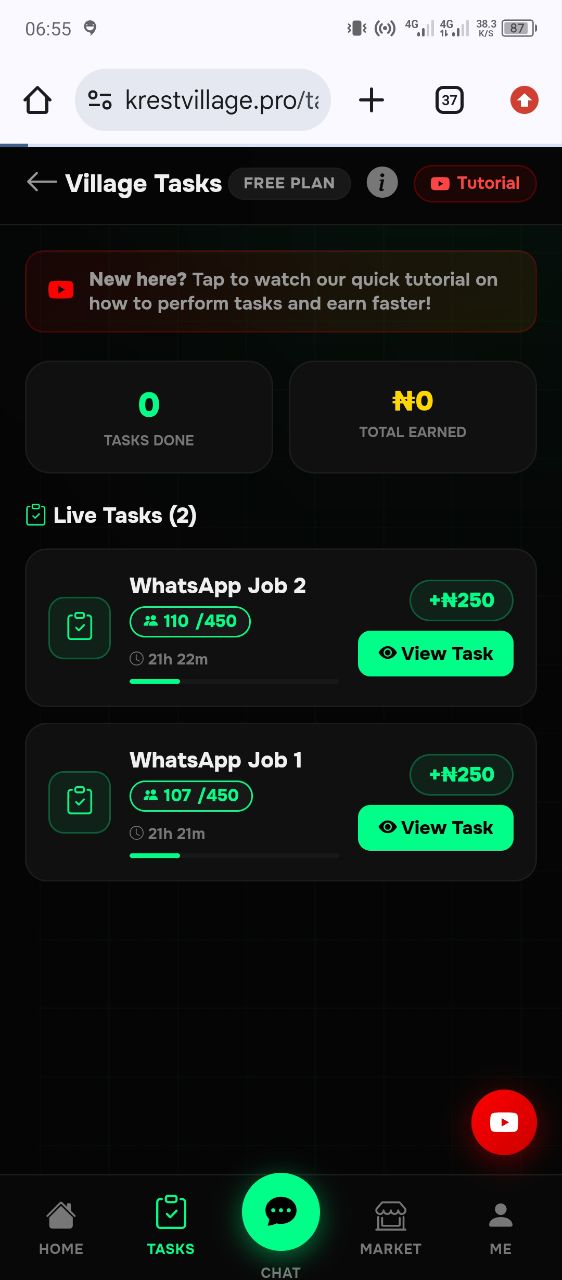
The most visible earning method on the platform is the completion of social media tasks. Users are presented with a "Live Tasks" board where they can claim and complete assignments. Based on the screenshots, these tasks include:
- Telegram Task: Earning up to ₦2,000 for interacting with or joining a Telegram group.
- WhatsApp Channel Task: An astonishing ₦4,000 reward for what is presumably following or engaging with a WhatsApp channel.
- YouTube Task: ₦800 for watching, liking, or subscribing to a YouTube channel.
- TikTok Task: ₦1,000 for engaging with TikTok content.
On the surface, this mimics legitimate micro-task platforms like Amazon Mechanical Turk or Microworkers. However, the payouts advertised here are the first massive red flag, which we will analyze in the economics section.
B. The Krest Points (KP) and VTU Ecosystem
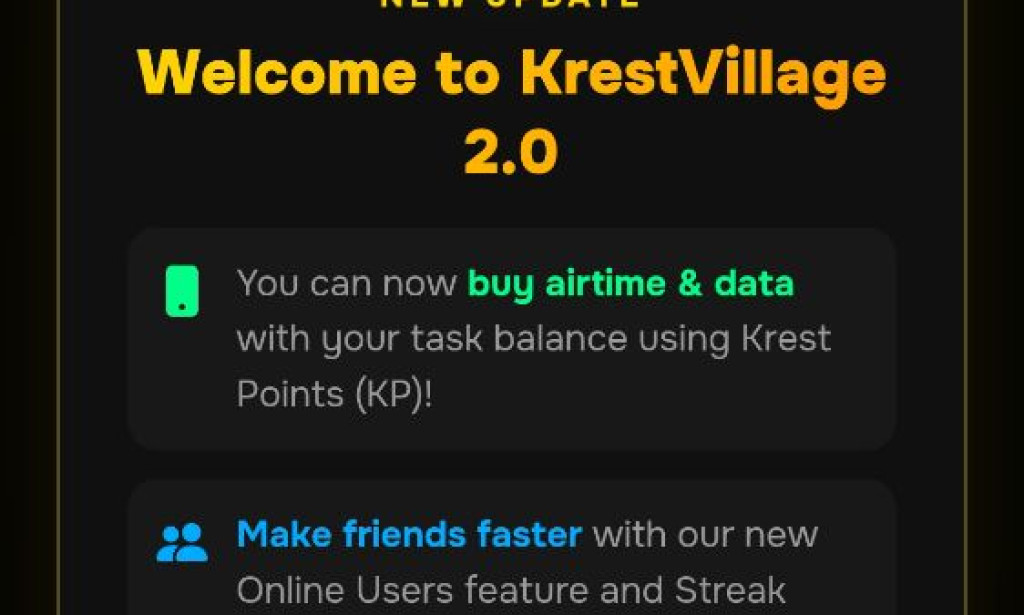
With the release of "KrestVillage 2.0," the platform introduced the ability to convert task balances into "Krest Points (KP)." These points can be used to directly purchase mobile airtime and data within the app. One screenshot displays a successful transaction where a user bought ₦200 worth of MTN airtime using 200 KP. By integrating a utility like airtime top-up, KrestVillage provides an immediate, tangible reward. This is a clever tactic; it proves to new users that the platform "works" on a micro-level, building trust and encouraging them to invest larger sums into premium packages.
C. The Marketplace and Community
The platform also features a marketplace where users can supposedly buy and sell products with thousands of active villagers. Alongside this is the community aspect—Telegram and WhatsApp groups where users can stay updated with news, tips, and "village gist." These social features are designed to create an echo chamber where doubt is suppressed, and success stories are amplified to keep the community buying into the system.
4. The Pay-to-Play Structure: The "Village Head" VVIP Package
While KrestVillage allows users to join as a "Free Plan Villager," it is abundantly clear that the platform is fundamentally a pay-to-play system. The free plan serves merely as a funnel to hook users, show them the potential earnings, and restrict their ability to cash out or access high-paying tasks until they upgrade. The platform explicitly pushes a "Free Plan Upgrade to Earn More!" notification.
The screenshot detailing the "Village Packages" highlights the premier tier: the Village Head VVIP. This package requires a one-time payment of ₦20,000. The platform aggressively markets the benefits of this tier to entice users to part with their money. Let us examine the promised benefits of this ₦20,000 investment:
By offering an instant ₦6,500 welcome bonus credited to the user's balance upon activation, KrestVillage attempts to reduce the psychological friction of paying the ₦20,000 fee. The user feels as though they have already recouped a third of their investment instantly. Furthermore, the 4.00x task multiplier and the promise of access to "all tasks posted by admin" create a powerful illusion of massive future profitability.
5. Critical Economic Analysis: Unmasking the Pyramid Structure
This is where the facade of KrestVillage begins to crumble. A rigorous analysis of the platform's advertised financial structure reveals that it is mathematically unsustainable and heavily exhibits the hallmarks of a pyramid scheme or a Ponzi scheme.
The Unrealistic Cost of Advertising
In the digital advertising ecosystem, legitimate advertisers pay platforms to drive traffic to their content. The platform takes a cut and pays the user a micro-reward. A typical legitimate reward for following a YouTube channel or a WhatsApp group is a few cents (less than ₦50). KrestVillage is claiming to pay users up to ₦4,000 for a single WhatsApp task and ₦2,000 for a Telegram task.
Ask yourself: What legitimate advertiser is paying KrestVillage upwards of ₦5,000 to get a single, unverified, un-targeted user to follow a WhatsApp channel? The answer is absolutely none. The economics of digital marketing do not support these payouts. If the revenue is not coming from external advertisers, where is the money coming from?
The answer to the platform's cash flow lies in its referral structure. Let us examine the flow of money when a new user purchases the ₦20,000 Village Head package.
- New User deposits: +₦20,000
- Platform immediately credits Referrer: -₦9,500
- Platform credits New User (Welcome Bonus): -₦6,500
- Remaining Capital in the System: ₦4,000
Out of a ₦20,000 deposit, ₦16,000 is immediately promised back out to users as virtual balances. This leaves only ₦4,000 of real liquidity for the platform developers to maintain servers, take their profit, and allegedly pay for all the high-priced daily tasks. It is mathematically impossible for the platform to pay out ₦4,000 WhatsApp tasks when they only retain ₦4,000 in real cash from a premium signup.
Therefore, the primary source of revenue for KrestVillage is the continuous recruitment of new, paying members. The massive ₦9,500 referral bonus (nearly 50% of the entry fee) is the engine that drives the platform. Users are not making money from completing tasks; they are making money by convincing other people to pay the ₦20,000 fee. The platform relies on the capital of new investors to pay the withdrawal requests of older investors. This is the exact definition of a Ponzi/Pyramid scheme structure.
6. Analyzing the "Social Proof" and Marketing Tactics
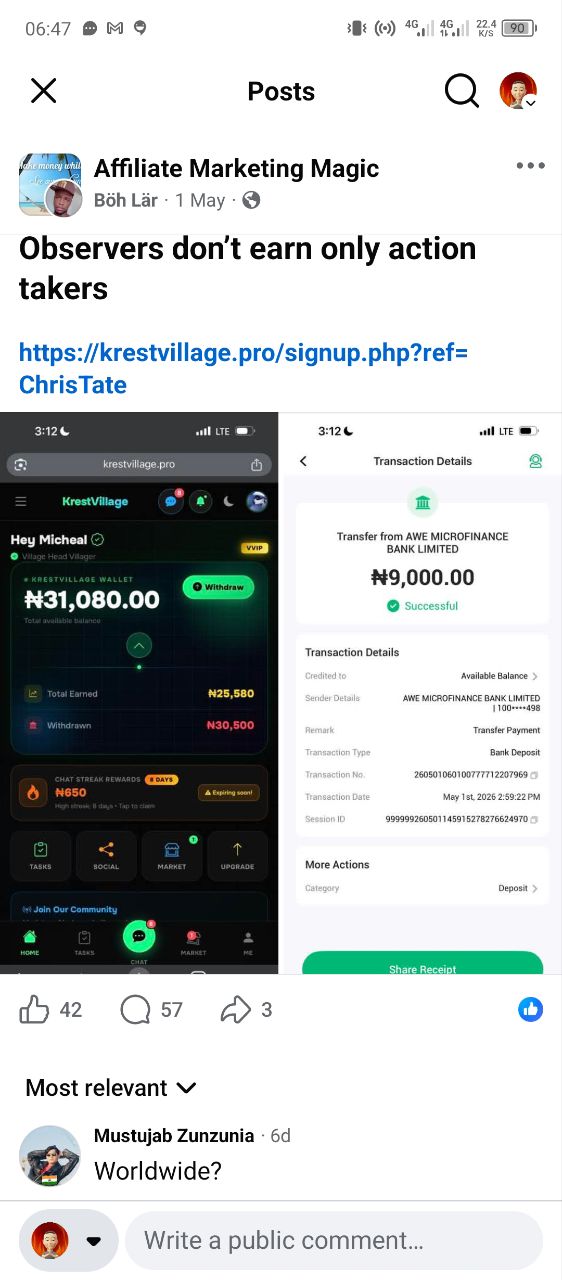
To sustain a system reliant on constant recruitment, platforms like KrestVillage must manufacture intense hype. The provided screenshots from Facebook users like "Böh Lär" (under groups like "Affiliate Marketing Magic" and "Making Money Online") are prime examples of this engineered social proof.
These posts are designed to aggressively target vulnerable individuals looking for income. The captions use psychological pressure tactics. Phrases like "Observers don't earn only action takers" and "Don't dull this update" are intended to shame people who are cautious and pressure them into acting quickly. They present the platform not as an investment risk, but as an exclusive "update" or secret loophole to making money.
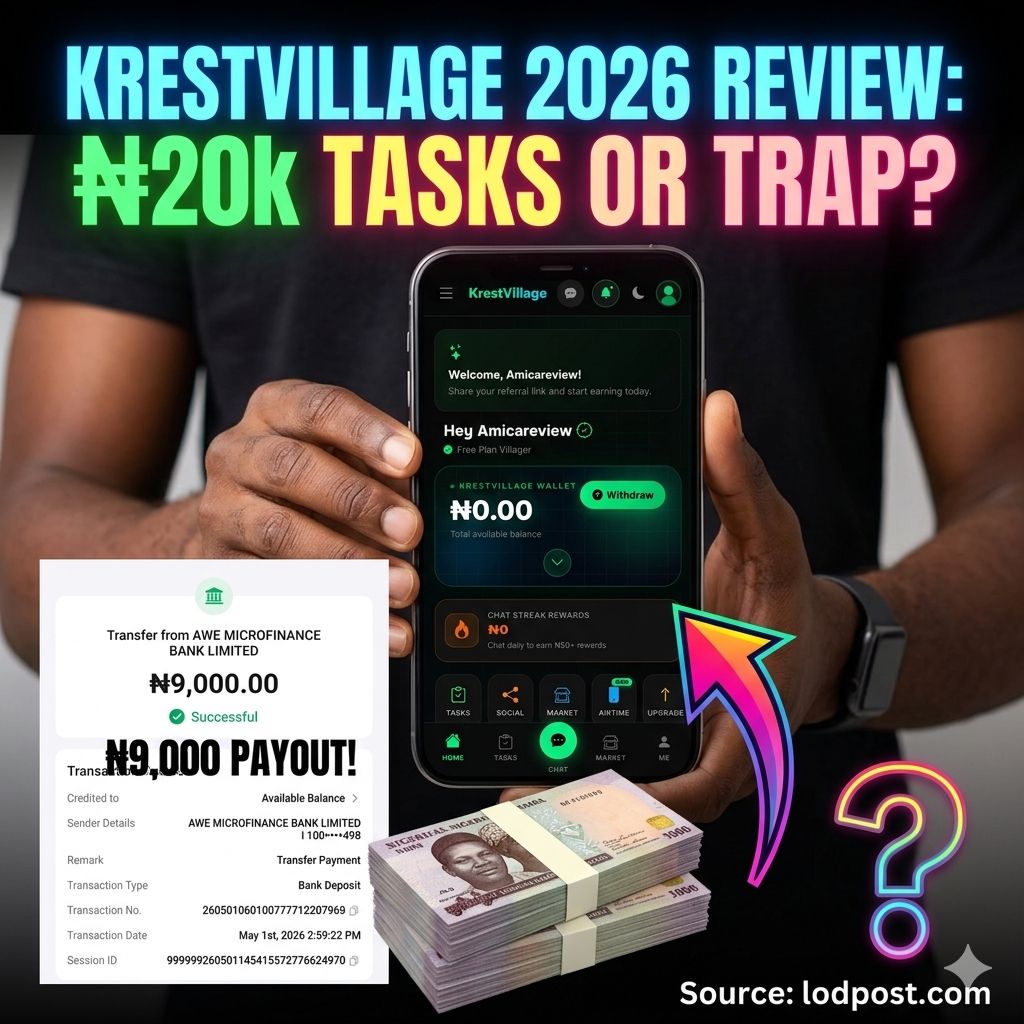
The screenshots prominently feature successful bank transfers, such as a ₦9,000 credit from "AWE MICROFINANCE BANK LIMITED," alongside a KrestVillage wallet showing a massive balance of ₦31,080. While these specific transfers might be real—early adopters in Ponzi schemes are often allowed to withdraw money successfully to create proof—they do not validate the legitimacy of the business model. In fact, early successful withdrawals are a necessary marketing expense for the operators of the scheme. By letting the first wave of recruiters withdraw cash, those recruiters take to social media with "proof," thereby attracting thousands of new victims whose funds will eventually be trapped when the platform collapses.
The mention of "AI support to help their users" is likely just a modern marketing buzzword thrown in to make the platform sound technologically advanced and trustworthy, despite it functioning on rudimentary referral scripts.
7. The Inevitable Lifecycle of the "Village"
Historically, platforms operating with the mathematical structure of KrestVillage follow a highly predictable lifecycle:
- The Launch & Hype Phase: The platform launches. Admins allow seamless withdrawals. Early adopters recruit aggressively, flashing bank alerts and massive digital wallet balances on Facebook, TikTok, and WhatsApp statuses.
- The Plateau Phase: The pool of gullible new users begins to dry up. The amount of money requested for withdrawal starts to exceed the amount of money coming in from new ₦20,000 registrations.
- The Restriction Phase: The platform begins implementing strange new rules. They might claim a "system upgrade," suddenly raise the minimum withdrawal limit, freeze accounts under the guise of "fraud checks," or force users to refer a specific number of people before they are allowed to cash out their task earnings.
- The Collapse Phase: The website goes offline. The Telegram and WhatsApp admins delete their accounts. Millions of Naira from late investors are lost forever.
8. Comprehensive Conclusion and Final Verdict
To conclude this exhaustive review, KrestVillage presents a highly polished exterior designed to appeal to the modern digital earner in Nigeria. Its sleek interface, immediate micro-rewards like airtime top-ups, and massive projected task payouts create a compelling illusion of wealth generation. The platform does an excellent job of using gamification and community pressure to keep users engaged and actively recruiting.
However, the economic reality beneath the surface is glaringly flawed. The promise of paying ₦2,000 to ₦4,000 for basic social media interactions is practically impossible in the legitimate digital economy. When combined with a ₦20,000 mandatory upgrade fee and a staggering ₦9,500 commission paid directly to the recruiter, it becomes undeniably clear that KrestVillage is running a sophisticated pyramid network. The platform's lifeblood is not advertising revenue, but the continuous influx of cash from new users hoping to become "Village Heads."

You must be logged in to post a comment.