
Introduction: A Cryptocurrency That
Actually Works

Most people who have spent any real time in the
crypto space have a story that goes something like
this. They found a coin, read the whitepaper, watched
the price climb, and then waited patiently for the rest
of the world to catch on. Sometimes it does. More
often, it doesn't. But every once in a while, you come
across a project where the technology is so clean and
so genuinely well thought out that you find yourself
returning to it again and again, not because of hype,
but because of the fundamentals.
Nano is one of those projects.
It doesn't have a celebrity endorser. There's no flashy
NFT collection attached to it, and the development
team has never promised that holding XNO will make anyone rich.
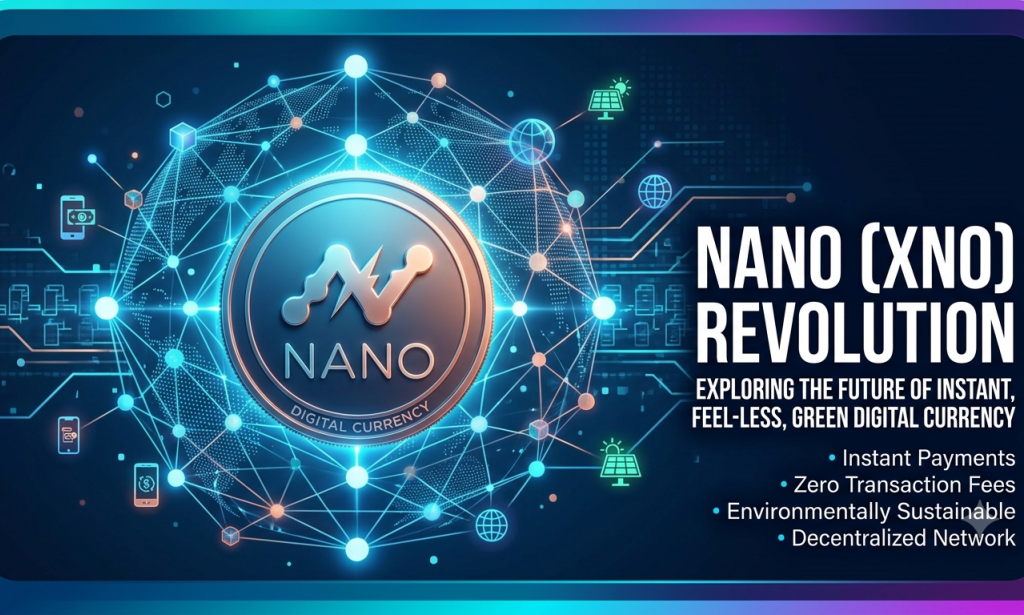
 What Nano does have is arguably the cleanest transaction
 mechanism in the entire
cryptocurrency space: instant, feeless, and energy-
efficient transfers of value. For a space that has spent
years promising to reinvent money, that is not a small
thing.
This article takes a proper look at Nano, from where it
came from to what it is doing today and where it might
realistically be headed. Whether you are new to crypto
or you have been following the space for years, there is
more to this project than its market cap suggests.

Part One: The Origin Story

The story of Nano begins in 2014, with a software
engineer named Colin LeMahieu. At the time, Bitcoin
was already four years old, and the cracks in its design
were becoming harder to ignore. Transaction fees
were climbing. Confirmation times were frustratingly
slow. Every transaction was being recorded on a single
chain shared by every participant in the network, and
as interest in cryptocurrency grew, that chain was
beginning to buckle under the weight.
LeMahieu wasn't trying to build the next Bitcoin. He
was thinking about a narrower, more practical
problem: what would it actually take to build a digital
currency that behaved like physical cash? Fast, free, and
final. Something you could hand someone without
them waiting ten minutes to confirm it arrived.
His answer was a data structure he called a block-
lattice. Instead of a single shared blockchain, every
account in the Nano network maintains its own
individual blockchain, which the team calls an account
chain. When you send Nano to someone, you create a
"send" block on your personal chain, and they create a
corresponding "receive" block on theirs. The two are
asynchronous, meaning neither has to wait on a global
queue of transactions to be processed.
The project launched publicly in 2015 under the name
RaiBlocks, with the ticker XRB. The distribution
method was equally unconventional. The entire
circulating supply of 133,248,297 coins was given
away for free through a CAPTCHA-based faucet
system. There was no initial coin offering, no presale
for insiders, and no allocation set aside for the
founding team. For a space where token distribution
tends to quietly favor the people who built it, this
approach was genuinely unusual.
By late 2017, RaiBlocks caught fire alongside the
broader crypto boom. The price surged from fractions
of a cent to highs above thirty dollars per coin.
Comparisons to Bitcoin were being made in earnest. In
January 2018, the project rebranded to Nano, and the
ticker eventually settled as XNO. Then came the crash,
and with it, something worse
than a falling price.

Part Two: The Dark Chapter

No honest account of Nano's history skips over what
happened with BitGrail.
BitGrail was an Italian cryptocurrency exchange and
one of the primary platforms where early Nano holders
traded their coins. In February 2018, the exchange
announced it had suffered a hack. Roughly 17 million
Nano tokens had been stolen, amounting to
approximately 170 million dollars at the time of the
incident.
The aftermath was messy in ways that went well
beyond the financial damage. Questions were raised
about whether the vulnerability existed in the Nano
protocol itself, in BitGrail's own software, or in the
conduct of the exchange's founder, Francesco Firano.
Independent investigations, including analysis from
the Nano development team, pointed clearly to failures
on BitGrail's side. Legal proceedings followed, and
Firano was eventually convicted of fraud by an Italian
court.
But the association stuck. Nano's price collapsed
alongside the rest of the 2018 crypto market, and the
BitGrail incident added a layer of reputational damage
that would take years to shed. Projects can survive a
bear market. Recovering from the perception of a
major security breach, even one that was not your
fault, is a different and more stubborn challenge.
What deserves to be said clearly is that the Nano
protocol itself was never compromised. No
vulnerability was ever found in the block-lattice
architecture. The network kept running through the
entire ordeal, processing transactions exactly as it was
designed to do. And the development team kept
building.

Part Three: How Nano Actually Works

It is worth stepping back here and explaining the
technology properly, because it is genuinely
interesting, and it explains why Nano attracts the kind
of persistent, technically minded following it has built
over the years.
Traditional blockchains, including Bitcoin and
Ethereum, rely on a global ledger. Every transaction is
broadcast to the entire network, grouped into blocks
by miners or validators, and then added to a single
shared chain. This design has real security
advantages, but it creates a fundamental bottleneck.
As usage grows, fees rise and confirmation times lengthen.
 Scaling solutions like the Lightning Network
or Layer 2 rollups attempt to work around this
problem, but they add layers of complexity and come
with their own tradeoffs.
Nano's block-lattice sidesteps the bottleneck entirely.
Because each account maintains its own chain, there
is no global queue. Transactions do not compete for
space in a shared block. The network does not need
miners in the traditional sense, which means there is
no proof-of-work calculation burning electricity to
confirm a five-dollar payment.
Consensus is handled through a mechanism called
Open Representative Voting, or ORV. Account holders
delegate their voting weight to representatives, and
those representatives vote on the validity of
transactions across the network. The system is
lightweight, fast, and does not require staking or lock-
up periods. You can change your representative at any
time without any cost or penalty.
The practical result of this design is a network where
transactions typically confirm in well under a second,
cost absolutely nothing to send, and consume a
negligible amount of energy compared to other
networks. Independent research has found the energy
cost per Nano transaction to be a fraction of what
Bitcoin or even Ethereum requires. In a world increasingly
conscious of the environmental footprint
of digital assets, that distinction matters.

Part Four: Where Nano Stands Today

As of mid-2026, Nano occupies a genuinely interesting
position in the cryptocurrency ecosystem. It is not a
top-ten coin by market cap, and it does not generate
the kind of breathless media coverage that Ethereum
or Solana attract. But the development team is still
active, the community remains deeply engaged, and
the track record of network performance is hard to
argue with.
The Nano Foundation continues to work on improving
the protocol. Some of the most meaningful recent
work has focused on spam resilience. In 2021, the
network experienced stress from coordinated spam
attacks, which temporarily slowed transaction
processing. The team responded with protocol-level
improvements that addressed the vulnerability, and
those upgrades have made the network meaningfully
more robust under adversarial conditions.
Adoption has been Nano's persistent challenge, and
anyone who follows the project closely will tell you the
same thing. The technology works beautifully, but
getting merchants, exchanges, and everyday users to
adopt a new payment system is a social and logistical problem
 rather than a technical one. A handful of
compelling real-world use cases have emerged,
particularly in regions where remittance costs are high
and access to traditional banking is limited. When you
strip away the fees that services like PayPal or wire
transfers charge, Nano's feeless model becomes
genuinely compelling for small, cross-border transfers.
Several applications have been built around Nano's
capabilities, including tools designed for tipping, peer-
to-peer payments, and merchant integration. Wallets
like Natrium and Nault remain popular within the
community, and third-party developers continue to
experiment with what you can build on top of a
network that never charges for a transaction.

Part 5: How NaNo works

Here is the thing about Nano that makes it genuinely
difficult to dismiss. The problems it was designed to
solve have not gone away. In fact, as cryptocurrency
usage has grown and transaction fees on other
networks have remained a consistent source of
friction for everyday users, Nano's core value
proposition has arguably grown stronger with time
rather than weaker.
The case for Nano's future rests on a few honest
foundations. First, the technology works. The network has
processed millions of transactions across its
lifetime, and the block-lattice design has proven itself
in real-world conditions, not just on paper. Second, the
distribution was unusually fair by the standards of the
industry. There is no massive team allocation creating
structural selling pressure, and no mining community
with a financial stake in keeping transaction fees high.
Third, the community, while smaller than those
surrounding some better-known projects, tends to be
technically informed and motivated by genuine belief
in the mission.
The counterarguments deserve equal
acknowledgment. Nano does not support smart
contracts, which limits its appeal relative to the
sprawling ecosystem that has grown up around
Ethereum. Its market presence remains modest, and
without sustained developer activity or a significant
institutional integration, there is a real risk of being
overshadowed by better-funded competitors. In
cryptocurrency, perception and momentum carry
enormous weight, and Nano has never quite managed
to break through to the mainstream conversation in a
lasting way.
But there is a version of the future worth considering,
one where the noise of speculative excess settles
down, where people grow weary of paying excessive
fees to move modest sums of money, and where a
quiet, reliable, feeless network starts to look like exactly
 what the industry needed to build from the
start. Nano was designed for precisely that world.
Whether the world arrives at that conclusion in time to
matter for XNO's valuation is a question nobody can
answer with confidence. What can be said is that the
technology is ready. It has been ready for a while.

Conclusion: Substance Over Spectacle

What Nano represents, more than anything else, is a
deliberate bet on substance over spectacle. It was
built to do one thing exceptionally well: move value
between people, instantly, for free, without wasting
energy in the process. It does not try to be a platform
for decentralized finance or a base layer for smart
contracts or a vehicle for speculative games. It is, at
its core, a tool for sending money. And it is very good
at that.
There is something genuinely refreshing about that
kind of focus in a space that has often rewarded the
loudest voice in the room. Whether Nano eventually
receives the broader recognition its technology
deserves remains an open question, and anyone who
tells you they know the answer with certainty is
guessing. What is not in question is that the project has
 survived a catastrophic market crash, one of the
most damaging exchange hacks in the industry's
history, years of relative obscurity, and the constant
pressure of faster-growing competitors.
And it is still running. Still fast. Still free.
In a space built on promises, that kind of quiet
persistence counts for something real.


This article is written for informational purposes only
and does not constitute financial advice. Investing in
cryptocurrency carries significant risk. Always conduct
your own research before making any financial
decisions.
Nano (XNO): The Quiet Contender That Refuses to Go Away
Listen to Article
Listen to this article read aloud
Audio uses the voice available in your browser or device.
Support the Writer
Enjoyed this article? You can support the writer with a voluntary donation.
Your donation supports
For internet
About Author


You must be logged in to post a comment.