

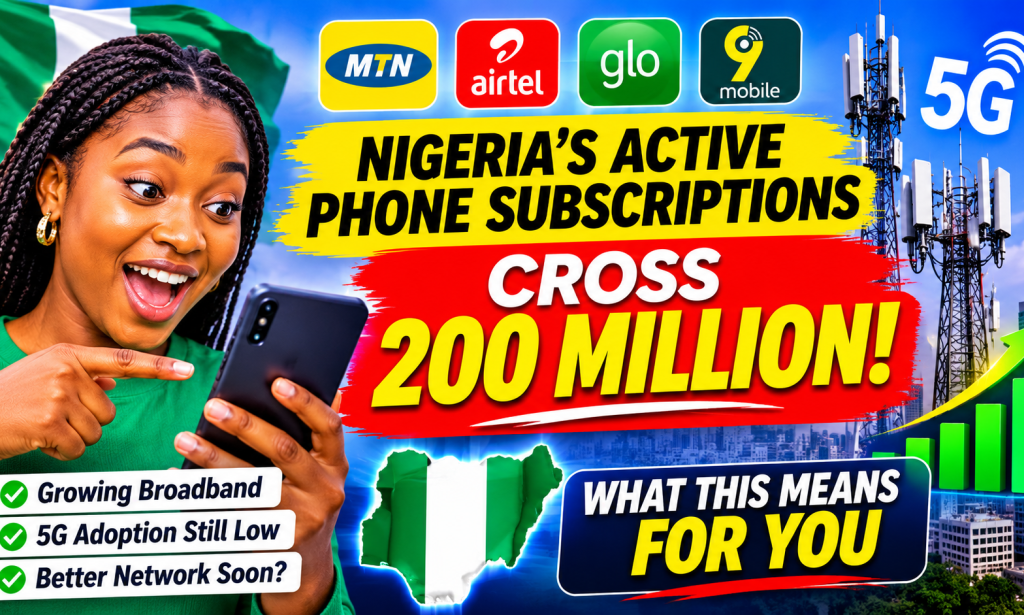
Nigeria's telecommunications industry has reached another important milestone, with active phone subscriptions rising above 200 million in September 2026.
According to industry figures reported from the Nigerian Communications Commission (NCC), the country recorded approximately 200.3 million active telephone connections in September. This represents an increase of more than 18 million connections compared with January 2026.
The development shows how important mobile communication has become to Nigerians, from making everyday phone calls to using mobile banking, social media, online businesses and other internet services.
But there is more to this development than just the number of active phone lines. Broadband subscriptions are also growing, while the adoption of 5G technology remains relatively low.
Let's look at what the latest figures reveal and why they matter.
Nigeria Adds More Than 18 Million Active Phone Connections
Nigeria's active telecommunications subscriptions increased from approximately 182.2 million in January 2026 to 200.3 million in September.
The industry also recorded an increase of about 2.9 million active connections between August and September.
This is a significant development for a telecommunications market that experienced major disruptions during the enforcement of the National Identification Number (NIN)-SIM registration requirements.
However, it is important to understand that 200.3 million subscriptions do not mean 200.3 million individual Nigerians own phones. One person can have multiple SIM cards or phone lines registered across different networks.
The figure represents active telephone connections, not a direct count of unique users.
Broadband Subscriptions Are Also Increasing
Another important development is the growth in broadband subscriptions.
Industry statistics for September 2026 put Nigeria's broadband penetration at approximately 59.05%, with broadband subscriptions exceeding 128 million.
Broadband connectivity is important because it supports activities that require internet access, including online education, video streaming, remote work, digital payments and business operations.
For ordinary mobile users, better broadband infrastructure could mean improved access to online services and more opportunities to participate in the digital economy.
However, increasing broadband penetration does not automatically mean everyone enjoys fast and reliable internet. Network coverage, infrastructure, congestion and the quality of service still matter.
5G Is Growing, but Most Nigerians Still Use Older Networks
While Nigeria's telecommunications industry continues to expand, the adoption of 5G remains relatively small.
Figures reported from the NCC show that 5G accounted for approximately 5.05% of mobile connections in September 2026.
By comparison, 4G accounted for about 54.37%, while 2G still represented approximately 36.42% of connections.
This shows that 4G remains the dominant technology, while a substantial number of connections still rely on older network technology.
Why is 5G adoption still relatively low?
There are several possible reasons. Not everyone owns a 5G-compatible smartphone, and having a compatible phone does not guarantee that 5G coverage is available in your area.
Network infrastructure also requires significant investment. Telecommunications companies need additional equipment, fibre connections, spectrum resources and reliable electricity to expand coverage.
The cost of compatible devices can also make it difficult for some users to upgrade.
What Does This Mean for Ordinary Nigerians?
For someone using MTN, Airtel, Glo or 9mobile, these figures may seem like ordinary industry statistics. However, they are connected to services people depend on every day.
As more Nigerians connect to mobile networks, demand for reliable internet access will continue to grow.
Students need internet access for research and online learning. Small businesses depend on mobile connectivity to communicate with customers and receive payments. Remote workers need stable connections to attend meetings and complete their jobs.
This means the quality of telecommunications services is becoming increasingly important to everyday economic activities.
The challenge for network providers is not simply to increase the number of subscriptions. They also need to improve coverage, reduce network congestion and provide reliable services at affordable prices.
What Should Mobile Users Expect Next?
The growth in active phone subscriptions and broadband connectivity is encouraging, but Nigerians should not assume that every network will suddenly become faster.
The experience of a customer in Lagos may be different from that of someone living in a smaller town or rural community.
The expansion of 5G may also take time, especially in locations where the necessary infrastructure is not yet available.
One development worth watching is the NCC's proposed approach to encouraging telecommunications infrastructure investment. The regulator is considering linking certain spectrum-related incentives to measurable improvements in network coverage and service quality.
If effectively implemented, such measures could encourage operators to invest more in areas that need better connectivity.
Final Thoughts
Nigeria crossing 200 million active phone subscriptions is an important milestone for the country's telecommunications industry. Broadband growth also shows the increasing importance of internet access in everyday life.
However, the next major challenge is making sure that this growth translates into better network quality, wider coverage and more affordable internet services.
For ordinary Nigerians, having a working phone line is important, but having a reliable connection when it matters is even more important.
What is your experience with mobile networks in Nigeria? Has your network connection improved in 2026, or are you still struggling with slow internet and poor coverage? Share your experience in the comments.









































You must be logged in to post a comment.