

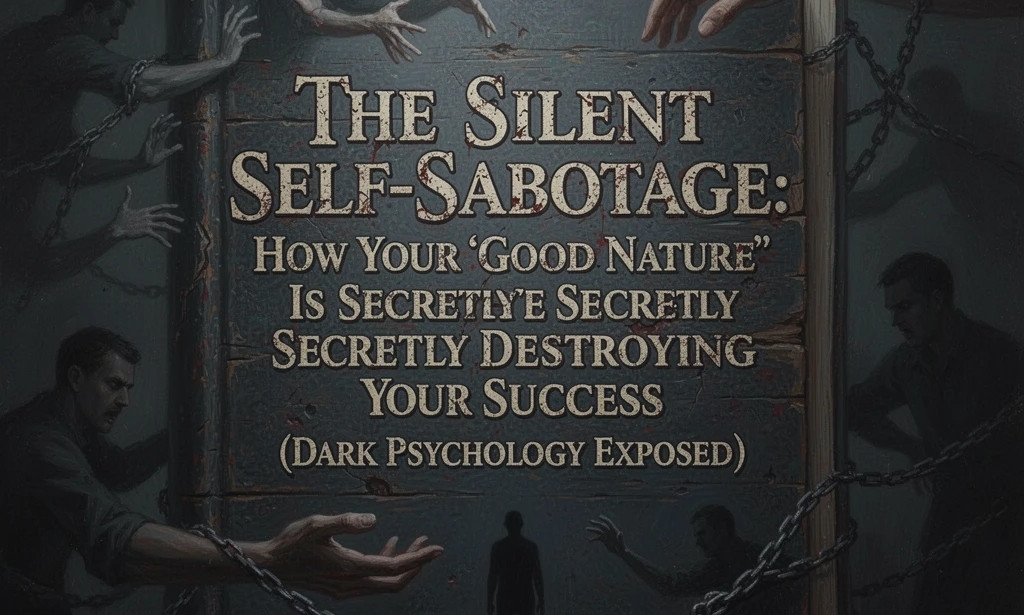
The Silent Self-Sabotage: How Your ‘Good Nature’ Is Secretly Destroying Your Success (Dark Psychology Exposed)

Introduction
Being kind, helpful, and considerate is often seen as a strength. Society praises “good people”—those who put others first, avoid conflict, and go the extra mile without expecting anything in return. But what if this very “good nature” is quietly holding you back?
What if your kindness is being exploited… your generosity is draining your energy… and your inability to say no is sabotaging your success?
This is the hidden side of human behavior—where good intentions turn into self-sabotage. In the world of dark psychology, this pattern is not accidental. It’s predictable, and more importantly, it’s preventable.
In this in-depth article, we’ll uncover:
How being “too nice” can damage your growth
The psychological patterns behind self-sabotage
Why people take advantage of good-natured individuals
And how to reclaim your power without losing your humanity
What Is Silent Self-Sabotage?
Silent self-sabotage is the unconscious behavior that undermines your own success, happiness, and growth—without you even realizing it.
Unlike obvious self-destructive habits, this form is subtle. It hides behind positive traits like:
Kindness
Loyalty
Empathy
Patience
At first glance, these seem admirable. But when they are unbalanced, they become dangerous.
Signs You Might Be Self-Sabotaging
You constantly put others before yourself
You struggle to say “no” even when overwhelmed
You feel guilty for prioritizing your needs
You tolerate disrespect to “keep the peace”
You overcommit and burn out
If this feels familiar, you’re not alone—and you’re not “too kind.” You’ve simply been conditioned in a way that benefits others more than you.
The Dark Psychology Behind “Being Too Good”
Dark psychology doesn’t mean evil—it refers to understanding manipulation, control, and hidden motives in human behavior.
Here’s the uncomfortable truth:
People unconsciously test your boundaries. And if you don’t set them, they will keep taking.
Why Your Good Nature Attracts Exploitation
You appear non-threatening → People feel safe pushing limits
You avoid conflict → Others know you won’t push back
You seek approval → Manipulators sense your need to be liked
You over-give → This sets a precedent that’s hard to break
This creates a cycle:
The more you give → The more people expect → The harder it becomes to stop
The Hidden Cost of Always Being “Nice”
1. You Lose Your Identity
When you constantly adapt to please others, you slowly disconnect from your own needs, desires, and values.
You start asking:
“What do they want?” instead of “What do I want?”
2. Your Time Gets Hijacked
Time is your most valuable resource. Yet, being overly available leads to:
Endless favors
Unnecessary responsibilities
Little time for your own goals
3. You Become Emotionally Drained
Giving without receiving leads to burnout.
Emotional exhaustion signs:
Irritability
Fatigue
Loss of motivation
Feeling unappreciated
4. People Respect You Less
This may sound harsh, but it’s true:
When you don’t value your time and energy, others won’t either.
Respect is built on boundaries—not sacrifice.
The Approval Trap: Why You Can’t Stop
One of the strongest drivers of self-sabotage is the need for approval.
Where Does It Come From?
Childhood conditioning (“Be a good girl/boy”)
Fear of rejection
Desire to avoid conflict
Low self-worth
You begin to associate your value with how much you give to others.
The Dangerous Belief
“If I say no, people won’t like me.”
This belief keeps you trapped in a cycle of over-giving and under-receiving.
The Manipulation Patterns You Don’t Notice
Not everyone is intentionally manipulative—but many people operate in ways that benefit them.
Common Tactics Used Against Good-Natured People
1. Guilt-Tripping
“I thought you cared about me…”
“You’re the only one who can help…”
2. Emotional Dependency
They make you feel responsible for their happiness.
3. Gradual Boundary Testing
They start small, then slowly increase demands.
4. Silent Expectations
They assume you’ll always say yes—and act surprised when you don’t.
Why Saying “Yes” Is Destroying Your Success
Every “yes” to something unnecessary is a “no” to something important.
What You’re Sacrificing
Personal growth
Career opportunities
Mental peace
Physical health
The Productivity Illusion
You may feel busy—but you’re not moving forward.
Being productive isn’t about doing more—it’s about doing what matters.
The Psychology of Boundaries

Boundaries are not selfish—they are essential.
They define:
What you accept
What you reject
How others treat you
Types of Boundaries You Need
Emotional boundaries → Protect your mental space
Time boundaries → Guard your schedule
Energy boundaries → Limit draining interactions
Physical boundaries → Respect personal space
How to Stop Self-Sabotaging Without Losing Your Kindness
You don’t need to become cold or rude. You need to become aware and intentional.
1. Redefine What “Being Good” Means
Being good doesn’t mean:
Saying yes to everything
Ignoring your needs
Tolerating disrespect
True goodness includes self-respect.
2. Learn the Power of Saying “No”
Start small:
“I can’t help with that right now.”
“I need to focus on my priorities.”
You don’t need to explain everything.
No is a complete sentence.
3. Stop Over-Explaining Yourself
Over-explaining signals insecurity.
Instead of:
“I’m so sorry, I wish I could but I have so much work and…”
Say:
“I won’t be able to do that.”
Short. Clear. Respectful.
4. Accept That Not Everyone Will Like You
This is a turning point.
Growth begins where approval ends.
Some people will resist your boundaries—not because you’re wrong, but because they benefited from your lack of them.
5. Build Internal Validation
Stop seeking approval externally.
Ask yourself:
“Am I proud of this decision?”
“Does this align with my goals?”
Your self-worth should not depend on others’ reactions.
The Confidence Shift: From Pleaser to Powerful
When you stop self-sabotaging, everything changes.
You Start to Notice:
More time for your goals
Better mental clarity
Stronger self-respect
Healthier relationships
People Treat You Differently
When you respect yourself:
Others take you seriously
Manipulators back off
Genuine people stay
The Balance: Kindness vs. Weakness
Kindness is strength—but only when it’s controlled.
Healthy Kindness Looks Like:
Helping without harming yourself
Giving with boundaries
Caring without losing identity
Unhealthy Kindness Looks Like:
Over-giving
Self-neglect
Fear-based compliance
Practical Daily Habits to Break the Cycle
Build Awareness
Notice when you say yes out of guilt
Pause Before Responding
Give yourself time to decide
Set Daily Priorities
Focus on your top 3 goals
Limit Draining Interactions
Reduce time with energy takers
Practice Assertive Communication
Be clear, calm, and direct
The Hard Truth You Need to Hear
No one is coming to protect your time, energy, or future.
If you don’t set boundaries:
People will use your kindness
Opportunities will pass you by
You will remain stuck
This isn’t harsh—it’s reality.
Final Thoughts
Your “good nature” is not the problem.
The problem is how it’s being used—by others and by yourself.
You were never meant to:
Shrink for others
Exhaust yourself for approval
Sacrifice your success to be liked
You can be kind and powerful.
You can be generous and respected.
You can be good without destroying yourself.
The moment you stop silently sabotaging yourself…
is the moment your real life begins.


You must be logged in to post a comment.